




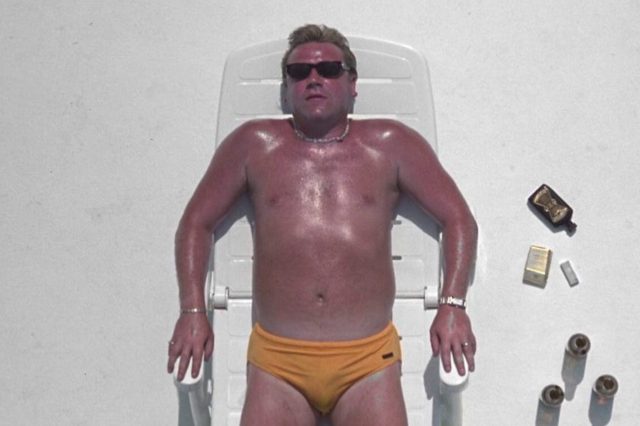
Are you leaning into the piña coladas? (Credit: Sexy Beast / FilmFour)





In England, we used to moan about rainy grey summers. Now it feels like we are in the meteorological version of a monkey paw story. I’m writing from a horrifically well-insulated sweatbox, which I used to refer to as my cosy little home. The fan beside me registers 29 degrees, and it’s 33 outside. Be careful what you wish for.
Every day is the same: clear blue, suffocatingly hot, uncannily still. No one can remember what rain feels like. The parks are brown, and gardens turning to dust. Stressed trees are suddenly dropping huge boughs. At night, you see foxes all over the place, thirstily hunting water.
It used to be fun to indulge in pathetic fallacy, and project hyperbolic human sentiments onto harmless old British weather systems: brooding skies, raging storms, and so forth. But right now, in some places, the implacable heat is in charge, in a very-much-not-metaphorical sense. The feelings it produces in bodies are pretty basic: sweatiness, exhaustion, a mind as vacant as the eerily cloudless sky overhead. But assuming we can find the mental energy, it is worth asking: how do we feel about the new kind of summer, rather than simply because of it? Enthused and leaning into the piña coladas? Scared? Sad?
I feel discombobulated — though that could be because of the screaming sirens that have accompanied the writing of this piece, as dozens of fire engines and ambulances rushed to a derailed train nearby. Four carriages went over; two passengers were seriously injured. Though not confirmed, observers say it looks like the rails buckled in the heat. In other news, the brambles around here are out far too early. The pond at the end of my road is silting up, and I worry about the fish and the ducks.
Inevitably, the usuals are using the fifth heatwave of the English summer to hammer home their preferred theories about the origins of about climate change. But I can’t be bothered to attend, and it isn’t just because of the brain fog. I find it impossible to navigate such large-scale intellectual terrain, where the very nature of the problem is radically contested, let alone the solutions.
Whether apocalyptic or deflationary, every point in this area seems to be delivered with identical confidence, in equally technical language. So who do you trust? A popular way to negotiate the thicket seems to be to pick the political side you hate most, then lampoon everything its representatives say on the matter, and conclude the opposite must be right. Unfortunately, though, I dislike Right and Left equally for different reasons, so that doesn’t much help.
Apparently unconcerned about the extra energy pull on data centres, this week the ever prolix Will Self took on Jordan Peterson about climate catastrophism. Peterson, himself no stranger to verbosity, had published a piece in the Telegraph, also full of contemptuous mockery for the other side. Peterson thinks that, when measuring trends, we should include the Medieval Warm Period. Self thinks this is daft, since nobody could measure warmth reliably in the medieval period and it wasn’t a global effect anyway. Peterson says that rising carbon dioxide produces increased greening and agricultural yields, not desertification; Self says this is true, but ignores the fact that biodiversity is still being reduced. You might assume that tapping the biodiversity sign would nail the argument; then again, others argue it is measured too heterogeneously to be a useful concept at all. Back and forth, the argument rages through each heatwave, a mix of uncertain predictions, categories at cross-purposes, and differently ranked values. It is not surprising that even some Green party members seem to be zoning out.
Something went wrong with the high-level discourse a while ago. Attempting to use words as behavioural prompts rather than accurate descriptions, ecologically-minded types made their desire to frighten or guilt-trip the masses a little too obvious, and neutral listeners started to switch off. Meanwhile some on the Right offered lots of stubborn scepticism, but not much else: little acknowledgement of local social and environmental losses, whatever their cause; no nuanced plan of action, except to keep buggering on as before. These days, the discussion about renewables in this country is absurdly polarised, with one side talking mainly of benefits, and the other talking mainly of harms.
I suggest, then, that we detach consideration of the local situation from the bigger picture, at least for a bit. First, whatever the causes and consequences of global warming, a small country like ours can’t do anything about it alone. Second, clashing over the wider context seems to be hampering useful consensus-building across party lines about how to manage regional problems — the atrocious working conditions, sweltering hospital wards, failing water supplies, buckling railway lines, and so on — and that’s all pretty urgent. Banning disposable barbecues is not going to be enough.
Relatedly, ignoring the global discourse might allow us to better notice what we, in particular, are losing. Our landscapes, industries, and living conditions are changing before our eyes. The least we can do is pay it attention, mourn what is vanishing, and help mitigate the impacts; not change the subject to dramatic losses elsewhere (Left) or deny reality altogether (Right). Jordan Peterson lives in Arizona. Maybe he’s right that the planet is getting greener overall, but yesterday it was 38 degrees in Kew Gardens. The Corsican Pine probably liked it; the ancient yews and oaks definitely did not.
And it is okay to be sad and unsettled by this new normal, in ways it is impossible to rationally explain or defend. Just as grief for people or pets doesn’t require a defence, nor should this. It is indeed strange and distressing that parts of the New Forest are now blackened and ruined, and others still on fire; that the cider apple harvest is failing, and the harebell disappearing; that there are hardly any wasps. I think with anxiety about the elderly people round about me wilting in their oven-like flats; about the two fires reported in surrounding fields only today; about local farmers agonising about stunted wheat and barley yields. It is obviously possible to worry about such problems, and for politicians to form plans to address them, without espousing any grand theory about the role of carbon dioxide.
I anticipate defensive reactions. How can I claim to feel alarm over such small-scale problems when I’m unwilling to look the man-made source squarely in the face, to translate such feelings into action at a global level? But as I say, I don’t see how any action of mine — or even that of the British government — could really help. What we have is a near-impossible coordination problem for major world leaders, who would first have to agree on the nature of the issue and its solutions, then get huge numbers of companies and citizens to toe the line, or else impose authoritarian constraints. Self himself says that to deal effectively with climate change, among other things we would have to “control markets, impose rationing and civic obligation, [and] enact… particular forms of restraint for which the established political vocabulary has no adequate name”. He thinks humanity can and should do this. I think he sounds mad.
Admittedly, if you take my line, you have to lose the comforting illusion that there is some global fix available, if only we could find it. That may be a reality too far for some. Yet there are people firmly within the environmental movement who argue for some form of localism on similar grounds; and it seems to me that even the most contrarian conservative sceptics should do the same. Indeed, I don’t see how they can properly call themselves conservatives if they do not. It’s not good enough to sit around poking holes in the Left’s preferred climate theories and saying nothing else, as if you were an obstreperous audience member at a conference. Whatever the explanation, our bit of the world is still heating up, and flooding more often; there are valuable things here to be treasured and saved, suffering to be alleviated.
It is now 30 degrees in my room. I scroll idly for a minute or two, and learn that part of Stratford-upon-Avon is on fire. Now is the summer of our discontent, and it seems unlikely to be the last. Once the heat breaks, there’s a lot of work to be done.
