




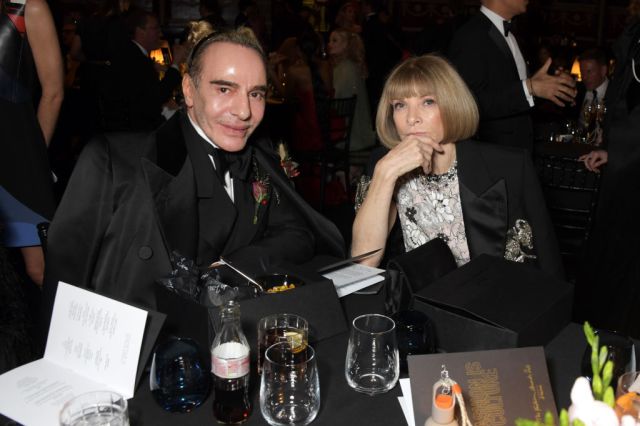
Ana Wintour has given the Met Gala over to the controversial John Galliano. Credit: Getty





Oscar Wilde commanded that “one should either be a work of art or wear a work of art.” What happens, though, when the shirt is sublime but the soul is twisted? That Dorian Gray-like question comes to mind in the wake of the decision by Condé Nast’s global chief content officer Anna Wintour and Metropolitan Museum costume curator Andrew Bolton to devote the 2027 Met Gala to John Galliano, a designer hailed as a visionary who has also spewed baroque bigotry.
Call it “The Devil Wears Galliano”. Wintour reckons that the British designer’s work “combines erudition and creativity, darkness and light, the past, the present, the future all smashing together in a brilliant way”. Less brilliant was Galliano’s tirade in a Paris cafe in 2011, when cameras captured him screaming at a woman, “I love Hitler. People like you would be dead. Your mother, your forefathers, would all be fucking gassed.” Witnesses reported that he also called the woman a “fucking ugly Jewish bitch.” He claims to have no memory of the incident due to substance abuse.
Wintour insists that Galliano “isn’t defined by a moment” and says that “John Galliano: Horizons” won’t “shy away from any of the darkness in John’s past. It’s part of what has shaped him. The show will take in the full arc of his career and grapple with all of it.”
Wintour is garlanding Galliano with a rare honour. Only two other living designers have been feted by the Met with solo shows: Yves Saint Laurent in 1983 and Rei Kawakubo in 2017.
Wintour has met with Jewish machers such as Anti-Defamation League CEO Jonathan Greenblatt and Rabbi Rick Jacobs about the choice of Galliano, who gave it their blessing, citing Galliano’s apologies and contrition. In the wake of the dark incident in the City of Light, he was fired as director of Dior and criminally convicted in a French court. However, he was quickly tapped by esoteric French label Maison Martin Margiela, where he completed a highly successful decade-long run in 2024. He has now taken the reins at mass-market retailer Zara, where he will “re-author” designs from the brand’s archives.
Galliano’s genius glowed early. A school collection inspired by post-revolutionary France, “Les Incroyables,” was snapped up by London’s legendary Browns boutique. A 1994 collection inspired by the murdered Romanovs, “Princess Lucretia,” was hailed by Diane von Furstenberg as a “watershed moment in modern fashion history”. Galliano’s bias-cut gowns ruled red carpets in the 1990s and his runways reached for historical phantasmagoria. No Brit had ever led a French couture house until he took over Givenchy in 1995. A year later, he was at Dior, giving the haute a surrealist flair.
Take the Dior Saddle Bag, introduced in 1999 by Dior under Galliano’s direction. The asymmetrical item was popularised by Sarah Jessica Parker’s Carrie Bradshaw on Sex and the City. It simultaneously conjures posh stables; a low-slung, hip-hop aesthetic; and the melting drip of one of Salvador Dalí’s clocks. Knockoffs became a Canal Street staple, and Wintour’s Vogue christened it a “pop culture phenomenon”.
Galliano’s sins, however, are hardly limited to that one outburst in Paris. His biographer, Dana Thomas, contends that honouring him is a “terrible idea” and that “his infamous antisemitic rants were not an aberration”. And beyond the judgment of Galliano’s character — by all accounts, it’s troubled — lies a more difficult reckoning with fashion’s fascination with cruelty and fanaticism, which all too often has lain behind the glittering surfaces.
80 years before Galliano’s outburst, also in Paris, fashion and fascism were sewn together in Coco Chanel’s atelier. Chanel was just one of many auteurs and geniuses to collaborate with the Nazis and freeze out Jews — Martin Heidegger was a member of the Nazi Party until the end, and failed to protect his mentor Edmund Husserl from being fired under anti-Jewish laws. During the war, the French designer — inventor of the little black dress and Chanel No. 5, the best-selling perfume of all time — had a Nazi lover and was in the formal employ of German military intelligence. Chanel also appealed to Aryanization laws to attempt to wrest control of her perfume company from two Jewish partners, proving that allegiance to beauty provides no inoculation against brutality. She received her own Met show in 2005.
Even worse was Hugo Boss, a German citizen and clothing manufacturer who joined the Nazi Party in 1931 and whose company mass-produced the black uniforms of the SS, the brown uniforms of the SA, and the mixed brown and black ones for the Hitler Youth — made in part by forced labour. The company apologized in 2011 for using the labor of 140 French and 40 Polish prisoners. Boss’s imprisoned workers would have sewn the Totenkopf or “Death’s Head” symbol onto the garments intended for concentration camp guards, though Boss was not responsible for the design. After the war he was found to have been an “activist, supporter and beneficiary” of the Third Reich. On appeal, though, he was ruled to have been merely a “fellow traveller” of the regime.
In a 1975 essay, “Fascinating Fascism,” Susan Sontag coined the phrase “beauty freak” to describe Hitler’s favorite director, Leni Riefenstahl. Sontag means it as something of a compliment — that in movies like Triumph of the Will and Olympia, Riefenstahl was acting not as a “horrid propagandist” but instead as an almost autistic auteur in search of the perfect shot. Fascist art, Sontag writes, “glorifies surrender; it exalts mindlessness: it glamorizes death.”
Sontag reasoned that “most people who are turned on by SS uniforms are not signifying approval of what the Nazis did”, as if the fashion could be detached from the fascism. In truth, Riefenstahl was hardly ambiguous. In 1937, she gushed that “Hitler is the greatest man who ever lived. He truly is without fault, so simple and at the same time possessed of masculine strength.” One of her films used extras sourced from a concentration camp. They were sent to Auschwitz when the movie wrapped.
A half-century ago, Sontag predicted that a “revival of Nazi art, following the revivals of Art Nouveau, Pre-Raphaelite painting, and Art Deco, is most unlikely. The painting and sculpture are not just sententious; they are astonishingly meager as art. But precisely these qualities invite people to look at Nazi art with knowing and sniggering detachment, as a form of pop art.” A harder question is presented when the art is rich but the artist is rancid.
Galliano, then, appears to belong to the tribe of beauty freaks and antisemitic art monsters that includes Riefenstahl, Chanel, and Kanye West, not to mention composer Richard Wagner, poet Ezra Pound, and Voltaire — and, some might say, Sontag herself, who in an infamous piece appeared to justify the 9/11 attacks as “an attack on the world’s self-proclaimed superpower, undertaken as a consequence of specific American alliances and actions”.
The raising up of Galliano comes three years after Karl Lagerfeld, who once declared that “no one wants to see curvy women,” was honoured at the 2023 Gala. Fashion, it seems, has few untainted heroes to choose from. That honour, though, was posthumous. It also came before the Costume Institute took over prime real estate at the Met. In May, it ascended from the basement to the Condé M. Nast Galleries, adjacent to the Great Hall — the former location of the museum gift shop.
In honouring Galliano, Wintour is taking something of a gamble with an event that has become a gilded goose. The Costume Institute has become crucial to the Met’s bottom line. Last year’s Gala brought in $31 million. The museum’s most popular show in history was the Costume Institute’s “Heavenly Bodies,” in 2018, which was seen by 1.7 million people. That edged out 1978’s “Treasures of Tutankhamun,” which was viewed by 1.4 million visitors.
The Met contends that “rather than presenting a conventional narrative of disgrace and redemption, the gallery will examine how memory, experience, cultural values, and historical circumstances continually reshape the reception of a designer’s work.” It could be, though, that the old parabola of grace and redemption, as hoary as it is, remains the best shape to map the choice to honour Galliano, who was raised in a devout Catholic family and whose work often bears the imprint of the Church’s couture.
The Met originally intended to honour Galliano in 2024, but postponed the plan in the wake of the Hamas massacre on Oct. 7, 2023. Those sensitivities appear to have dulled in the years since, even as antisemitism against Jews in New York continues to rise. The New York Police Department reports that antisemitic incidents increased by more than 8% this year, and that more than half of all hate crimes are perpetrated against Jews, who constitute just 10% of the population. Antisemitism is a fashion that is very much back in style.
In a 2023 documentary, John Galliano: High & Low, Wintour explains that “it isn’t often that you meet a great designer. But when you saw what John was doing, you realised that he was one of them.” Perhaps it is as simple as that — the rules are different for the great and glittering, even if their sins and prejudices are no less ugly than ours. Or perhaps a line ought to be drawn when it comes to the world’s oldest hatred.
Sontag concluded that “Riefenstahl’s current de-Nazification and vindication as indomitable priestess of the beautiful — as a filmmaker and, now, as a photographer — do not augur well for the keenness of current abilities to detect the fascist longings in our midst.” Wintour, a lioness in winter, is set to test again if the beautiful ought to bleach the baleful.
