




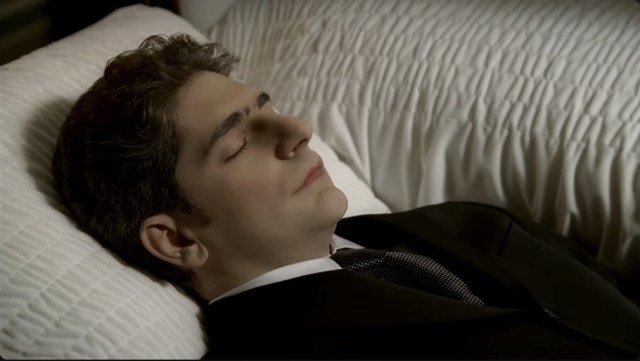
The funeral of Christopher Moltisanti, played by Michael Imperioli, in ‘The Sopranos’ (HBO)





Earlier this summer, a funeral director was sent to prison for 20 years for his grossly negligent way with corpses. Not only did Robert Bush fail to cremate and bury people, but he gave grieving relatives the ashes of strangers. Some of us might find his sentence a touch draconian. What sent this man to jail was really superstition — the belief that dead bodies are somehow sacred, and must thus be treated with special respect. Ironically, it’s a respect they might not have been granted when they were alive. Some people are revered only when they’re six feet under.
It may be that our reverence for the dead masks a certain fear of them. Tombstones are usually inscribed with a few pious reflections on the deceased, but they’re as weighty as they are in order to keep them down. Otherwise the dead might go gallivanting off around the place, rattling their bones and dragging their shrouds behind them. Something like this is the point of a wake, which is still a common custom in Ireland. The corpse is treated with extravagant courtesy, with the coffin lid left open and perhaps a bottle of Paddy’s or Bushmills conveniently to hand. In the good old days, he might even have been taken for the odd whirl around the dance floor. All this is to persuade the deceased that he isn’t dead at all, since otherwise he might grow envious of the Guinness-guzzling living and return to plague them. The dead body is treated as though it’s really alive; but if it’s able to haunt the living, then maybe it is. Wakes exist to console the dead for not being alive, thus disavowing the fact of death; but they also celebrate death as part of the great natural cycle of growth and renewal.
Corpses and ashes are really fetishes. For Sigmund Freud, a fetish was a piece of matter invested with a mysterious power, and which thereby enters the sphere of the sacred. It’s a liminal affair, dead and alive at the same time, transgressing borders and disrupting our tidy conceptions of what’s inanimate and what is not. Ghosts have this unsettling capacity, and Freud’s word for the realm in which things which are suspended between life and death is the uncanny. Scarecrows and snowmen are uncanny because it’s hard to tell whether they’re dead or alive. Children may also appear uncanny, which is one reason why they play such a role in horror movies. They resemble adults in many ways, but at the same time they’re an alien species. In fact, it’s hard to say what they are for. They don’t work or rustle up delicious soufflés or have fascinating views on Islamic architecture. They are like visitors from some other dimension, and as with the creepy children in The Midwich Cuckoos, they may well be secretly communicating with each other at this very moment. If they are, then they’ve got a head start on AI.
The fetish plugs a gap — the gap left by the deceased, but also, more fundamentally, that perpetually unfulfilled void at the heart of the human subject known as desire. What bereaved relatives desire is for the dead to be present again; and if this can’t be accomplished by bringing them back to life, you can at least treat their remains as a surrogate for their living selves. It’s a way of disavowing the fact that they’re gone forever, since “forever” is not something we can conceptualise. No doubt this is why those who have lost a loved one but can’t locate their body are often desperate in their efforts to reclaim it. Recovering a single cadaver can involve extraordinary amounts of time, people and resources, but what’s being searched for is the nearest thing there is to a live human being. From another standpoint, however, the corpse is also what’s most different from it. When we hear the phrase “the body in the library”, we can be fairly sure that the body in question is unlikely to be reading a book.
Thomas Aquinas, perhaps the finest theologian who ever lived, refused to use the word “body” of a corpse. He spoke instead of the remains of a body. Human beings were in his view naturally embodied. If heaven doesn’t involve my body, Aquinas considered, it doesn’t involve me. The true self in his view wasn’t some elusive spirit lurking within the flesh, but the living flesh itself. This is why he wouldn’t have believed that the soul of Cleopatra was Cleopatra. To say that Cleopatra was human isn’t to say that she was a body with something superadded to it, but that she was a body of a certain kind, one different from material bodies such as ashtrays and umbrellas. Ashtrays aren’t able to join political parties and umbrellas aren’t capable of irony, whereas Cleopatra was presumably capable of both. Whether an AI machine can be ironic or join a political party is a question yet to be resolved.
Ashes, in this view, are the remnants of a dead body, not a living one. Our future ashes will have little more to do with us than someone else’s ashes will. The same goes for corpses, which aren’t the bit of a person that’s left to us after death, but are no person at all.
There’s no reason, then, to think that it’s outrageous to mix up people’s ashes or sling their corpses casually around. I would have no great objection to having my ashes lapped up by a leopard, granted that I was around to have such objections in the first place. Corpses and ashes can’t be treated abusively, any more than a can of sardines can be. Dead bodies are as senseless as slabs of concrete. It’s our fear which makes us afraid of enraging them. Revering the dead is a way of keeping them at arm’s length. They’re also stark reminders of our own impending dissolution, which may then breed a certain unconscious hostility to them. Jesus’s dismissive remark that the dead should bury their dead would have struck the pious Jews of his day as obscenely offensive. For them, burying the dead was a sacred duty, whereas Jesus himself turns out to be rather less in awe of the grave.
One might claim, then, that the 20-year sentence handed down to the rogue undertaker has no rational justification. It’s equivalent to the amount of jail time you would get for strangling someone, not just messing around with their remains. This isn’t, to be sure, a popular view. A great many people find what the man did abhorrent, and no doubt some families have suffered severe trauma as a consequence. Their disgust must be acknowledged and respected. Some years ago, however, millions of people in the Muslim world felt a similar sense of scandal and outrage at the publication of Salman Rushdie’s novel The Satanic Verses. Not many people in the West, and certainly not many intellectuals, considered those sentiments worthy of esteem. Yet the disciples of Islam in Baghdad and Birmingham were no doubt as mortally affronted by Rushdie’s representation of Mohammed as those families who feel that their deceased relatives have been grossly mistreated.
Perhaps Rushdie might have been rather more alert to how his satire might appear to a people who already felt abused and humiliated by much of Western civilisation. Yet if corpses aren’t sacred, neither are books. There are devout Christians who enjoy jokes about Jesus, and plenty of Jews who laugh at anti-Jewish jokes or even pass the time inventing them. Not many Jews would be offended by the story of one Isaac Goldberg, who was walking with his adult son beside a river when the son missed his footing and fell into the water. “Help, help!” Goldberg shouts. “My son, the lawyer, is drowning!”
The point is that you can be serious and light-hearted about something at the same time. If we live our beliefs from the inside, we can also get a fix on them from the outside; and this double-take is part of the dualistic animals we are. This, admittedly, isn’t the case with those evangelical Christians who believe that every word of the Bible is literally true. To refute this view, you simply have to look at the nature of language. To read is not to move from one fixed, absolute meaning to another, but to interpret; and interpretation always involves open-endedness and ambiguity. No sign can be fixed and absolute, since it’s a sign only by virtue of being caught up with other signs. No piece of language is ever finished. This is true of notices in theatres which read “Please Do Not Sing Along with the Performers”, to which you could always add “You Drunken Yobbos”.
None of this is to claim that nothing is sacred. There are words which should never cross one’s lips (certain statements about the Holocaust, for example). It’s just that words of this kind shouldn’t include, say, jokes about mixing up corpses or the dog running off with the ashes. Some things are sacred and some are not; it’s just that we’re sometimes confused about which is which.