




‘Each of us was doing their best, and we al had an imaginary friend in the form of Tyler Durden.’ (20th Century Fox)





Philadelphia, 2019. An Uber is hauling me to the nearest Alcoholics Anonymous meeting, and I ask the driver to name the best parts of Philly. A twenty-something black guy, he says, “I don’t think there are any good parts.” He clocks me in the rearview mirror and asks, “Are you the writer?” The young man pulls out his phone and hits a number, saying, “You have to talk to my mom. Her favourite movie is Fight Club.” He hands the phone to me in the backseat.
In 2019, the film was already two decades old. This year, the book turns 30.
In 1999 the head of publicity at Twentieth Century Fox had told the director, David Fincher, “You’ve made a movie with so much male nudity that no man will want to see it, and so much blood that no woman will. You’ve made a movie that’s impossible to market.” Yet here I am laughing away with a middle-aged mother and her son who both came to love the story.
Maybe it’s because the story gave them permission to disregard all of the consumption and status static. “You are not your job.” “You are not your khakis.” These were memes before memes, and they flew in the face of a million Gap commercials. Lines like “May I never be perfect and complete” broke the stranglehold of demands the culture put on young people.
Maybe “self-improvement” as dictated by well-meaning cookie-cutter guidance councillors and college advisers never was the answer. Maybe “You are not a beautiful and unique snowflake” snapped readers out of the self-esteem messages they’d been force fed all their lives. Maybe they saw how such constant reassurances kept them from moving forward, and how emotional handholding came to stink of a lifelong panacea. Maybe “Deliver me from clever art” saved people from drowning in the era’s flood of David Letterman snark and irony and hinted that “clever” wasn’t enough.
National Public Radio once hosted me on a panel discussion where black academics and female academics dismissed Fight Club because it didn’t directly address the lives of racial minorities and women. Yet here I was in a car listening to a mother and her son who loved the story.
Another possibility? Fight Club was one of the few stories that told young people they’re mortal. You’re going to die. And the story didn’t just state that truth the way The Dead Poets Society took a bunch of prep school students and showed them old photos and declared, “These boys are all now food for worms.” No, Fight Club dropped us into the support group world of the Aids era, an age of mass dying, and made that sadness the “meet cute” of an old-school rom-com. The hero and heroine meet at the edge of an open grave, staring death in the face. Not since Harold and Maude had we seen Eros and Thanatos so romantically entwined.
To put all of this in a larger context: way back in 1949, the mythologist Joseph Campbell had given us the concept of “the hero’s journey”, the blueprint for so many movies, including Star Wars. Among Campbell’s concepts was the “secondary father”, the coach or teacher or boss or drill sergeant. After the first father, who must love and nurture the child, the secondary father can more sternly mentor the child toward greatness. For an example of the secondary mother, just watch The Devil Wears Prada and see how women fulfil the same role.
So Campbell gave us Star Wars and The Karate Kid, and, in 1990, Robert Bly gave us Iron John, the dry, sober seed for so much of the humourless men’s movement. Yet by the mid Nineties, Bly had thrown up his hands in surrender. Men were unruly, as were people in general nowadays, so in 1996 Bly wrote The Sibling Society to explain how all hierarchies of authority had broken down. No one stood above anyone else in the culture, and all teaching was now done peer-to-peer. Mind you, this is still a few years before social media, but Bly was already predicting “influencers” and “looksmaxxing” and the manosphere in general, where the flattened landscape of faceless “likes” does the teaching.
The year 1996 was also when W.W. Norton published Fight Club. It was the world of Maxim and Loaded magazines, football hooligans, Trainspotting and Snatch. So-called “lad culture”. In her 1991 book Backlash, Susan Faludi had described a male pushback against feminism, including a scene where she depicts Robert Bly as a cold tyrant, reinforcing traditional gender roles and abusing an elderly female acolyte of his. In 1996’s Sibling Society, Bly attacked Faludi’s version of events, and a public pissing match was on.
That was Nineties lad culture: the rowdy, moshing Backlash world became the kind of playpen that doesn’t want a stern secondary father. What the uncouth Sibling Society needed was… a trickster. We needed a Loki or Coyote or Hermes or Puck or Pan. And not the androgynous Pan of Disney’s Peter Pan, or a Pan played by tiny Mary Martin, what we needed was a reckless, wild, Dionysian Pan who could scare the pants off of you if you ventured into the forest at nighttime.
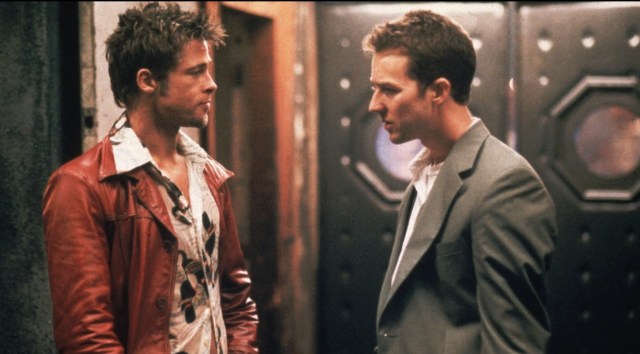
Enter Tyler Durden. What my Uber driver and his mom loved was Tyler and his messaging and the knight’s errands of “homework” he assigned. Tyler was a buddy, not a father, and he acted on impulse. He spoke in memes, not the endless lectures of a Campbell or a Bly. Still, he nurtured without “mothering”, and he lived without the world’s approval and endless self-censoring. Tyler’s minions were the nameless “space monkeys” who were tired of aimless lives as atomised self-loving snowflakes. They no longer wanted to each be “beautiful and unique”. What they wanted was to be part of something.
In the Uber, on my way to Alcoholics Anonymous, laughing with the driver and his mom, didn’t I also want to be part of something? Clearly, drinking in my hotel room no longer worked. I wanted to surrender my will to a greater power.
Often, people most love the aspects of a story they can’t articulate. Years ago, for example, I asked the writer Ira Levin if his masterpiece Rosemary’s Baby wasn’t actually a metaphor for the generation of infants born deformed by Thalidomide? Wasn’t the horror people expressed in fact the horror they could not express over how the medical establishment had misled and mis-medicated so many trusting pregnant women? In the book, the baby is even described as having the classic features of a “flid”, as people shaped by Thalidomide often call themselves.
Levin was cagey. How could he answer truthfully? And perhaps he didn’t know what he’d written until after it was in print; often the best writers don’t. As Samuel Taylor Coleridge said, only a genius can combine the conscious and the subconscious. “In every work of art there is a reconcilement of the external with the internal… that is the genius in the man of genius.”
Which brings us to the oldest trick in the book, so to speak. A trick American readers adore, but only if it can be reinvented. Let’s call it the “martyr-murder-witness” trick. Of three main characters, the most obedient must commit suicide, the most rebellious must be killed, and the witnessing character must reject both those options and leave the scene to begin a new life. Think of Myrtle Wilson in The Great Gatsby, throwing herself in front of Gatsby’s speeding car. Myrtle is Jennifer North in Valley of the Dolls who overdoses, who is Billy Bibbit in One Flew Over the Cuckoo’s Nest who cuts his wrists, who is Melanie Wilkes in Gone with the Wind who knows that birthing another child will kill her but gets pregnant anyway. The Good Boy or Girl always commits suicide. And that includes the doctor’s obedient son in The Dead Poets Society who shoots himself. Or the misled waif Terry Gionoffrio in Rosemary’s Baby, who leaps from a seventh-floor window.
Americans recognise this pattern and love it.
Immediately after the suicide, the most robust character is murdered. Sometimes, particularly when that character is female, she is banished, as Scarlett O’Hara and Neely O’Hara are banished in their stories, and the teacher played by Robin Williams is banished in Dead Poets. However, in most cases, the rebel, be he Jay Gatsby or Randle Patrick McMurphy or Edward Hutchins — or Tyler Durden — is murdered.
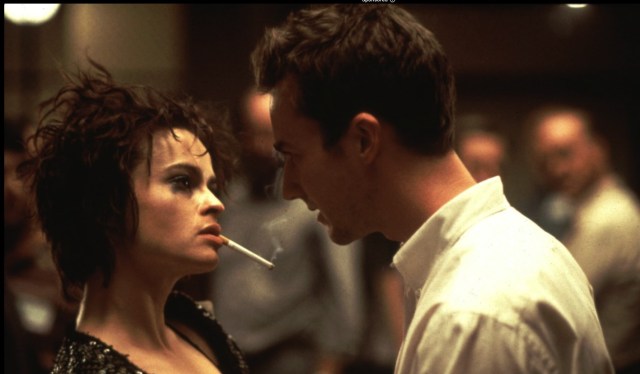
This leaves the witness to tell the tale. Nick Carraway hightails it back to the Midwest. Big Chief journeys back to his tribe. Rosemary Woodhouse embraces her strange-looking infant. For a heartbeat she weighs the idea of leaping from the window with the newborn, but finally surrenders herself to the cards she’s been dealt.
Whatever the case, Americans love the martyr-murder-witness formula, just so long as you tweak it to keep it fresh. And who can blame Americans? In a two-party political system, you’re either slave or master, so you’d better get accustomed to playing either. Those who can’t adapt to swift changes in power, they either kill themselves or they are killed. The magic in Fight Club was to distill this three-character formula down to a single character. The Good Boy narrator kills himself, thus murdering the Bad Boy, and leaving the fully integrated Witness.
A reconcilement of the external with the internal. The genius in the man of genius.
Maybe it’s that age-old formula — albeit tweaked — that’s made the book and film a classic. Whatever the case, it was a slow climb to the pantheon. Of the original five thousand hardcovers printed in 1996, most hadn’t sold by the time the film premiered in 1999. The film itself had a dismal theatrical run. Then 9/11 happened, and the image of skyscrapers crumbling cut too close to the bone. All puckish pranking and horseplay withered under the watchful eye of the newly formed Department of Homeland Security. The transgressive story, be it Fight Club or Trainspotting or The Monkey Wrench Gang, simply fell out of fashion.
Not that Fight Club resonated with everyone. On my first book tour in 1996, live on the radio, a male NPR host asked me, “Having written this book, Fight Club, what can you tell us about the state of the American woman in the world today?”
Colour me flabbergasted. I was silent for an eternity in live radio time. What did I know about being female or being black? My goal had been to write about the common experience of all my friends who were navigating into adulthood without either secondary mothers or fathers. The goal of Fight Club was never to depict an organisation that perpetuated its own power. Instead, I wanted to show how this little machine could create stronger individuals before the machine itself imploded. If just one person remained, stronger, more free, more self-determined, that would be worth all the Sturm und Drang.
The book was always about helping the individual. The little machine of Project Mayhem would be the secondary father.
In this world of constant poverty and addiction and injustice, to borrow a phrase, “I don’t think there are any good parts.”
But be that as it may, we can’t surrender to hopelessness or lash out in rage. That night in 2019 there were the three of us, this mother, her son and I, connected by a story. Each of us was doing their best, and we all had an imaginary friend in the form of Tyler Durden.
Maybe trickster Tyler is still around 30 years later to show us we always have options. If you’re reading this, you are still not dead.