




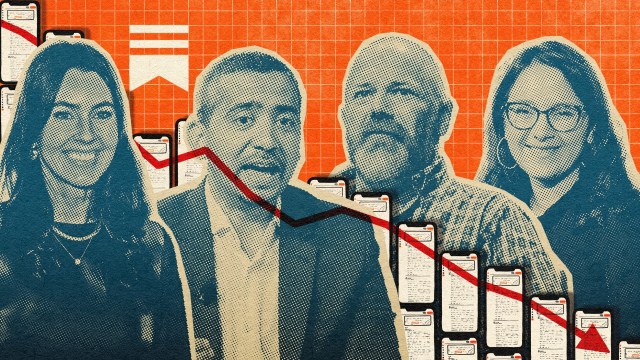
Four Substack successes, from left to right: Taylor Lorenz, Mehdi Hasan, Andrew Sullivan and Bari Weiss. But how long can the good times last? (JG Fox/UnHerd/Getty)





When Substack launched, nine years ago, working journalists thought this new platform might manage the unthinkable: make their profession economically sustainable. That hasn’t happened. Last week, one of Substack’s most successful journalists, Taylor Lorenz, disclosed on Substack Notes (the platform’s micro-blogging stream) that her paid subscriptions had “fallen off a cliff” — even while her follower count was “skyrocketing”. Lorenz has some 200,000 followers, an order of magnitude more than probably 99% of the other writers on Substack, and more internet fame than probably 99.9% percent of us. And yet, on the most basic metric of Substack success, she’s failing.
If it’s happening to Lorenz, it will be happening to everyone downhill from her, too. Certainly, there are plenty of people who will attest to that. Most of them have noticed an obvious problem with the business model: there are only so many paid subscriptions a reader will spring for. Eventually, Substack was going to hit a demand ceiling.
Back in 2017, Substack solved a particular problem for a particular type of journalist at a particular time. We were a few years into Black Lives Matter, and, of course, the first year of Trump’s first term. The Great Awokening was well underway, and over the next few years, culminating in the summer of 2020, the media industry would come to resemble a grumpy religious sect, with its theological dogma and mechanisms for punishing dissent. It became a suffocating place for anyone who wanted to think the least bit freely.
In Substack, journalists who refused to bend to the new rules had a refuge to escape to. That is the story of how Bari Weiss founded the biggest media outlet on the platform, The Free Press. Substack served that early generation of writers well: they became its poster children and its evangelists.
But while it solved a problem for journalists, it did not solve the problem of journalism: which is that its business model was shattered two decades ago and is yet to be fixed. In the 20th century, journalism was propped up by mass advertising, which, as Andrey Miroshnichenko has pointed out, was effectively a tax on corporations to sustain the jobs of journalists. Companies couldn’t find their customers without getting their brand names in front of them, and the only way to do that was by running advertisements in the newspapers that showed up on everyone’s doorstep each morning and on the TV shows that were piped daily and nightly into their living rooms.
This was the marketing equivalent of trawling: it caught a lot of fish by casting a net wide enough to scoop up everything in its path. It was inefficient and expensive, and it produced enough revenue to sustain an entire profession of reporters, editors, producers, and news anchors. The peak of profitability for The New York Times was at the cusp of the emergence of the internet — 1999, when it reported net income of $447 million. Last year, conversely, that figure was $334 million.
But along came Facebook, and suddenly, instead of trawling, advertisers could fly fish, but on an industrial scale. Targeted advertising allowed them to individually pick their customers from the teeming mass of humanity on the internet, and for a sliver of what it cost to run a TV commercial or run a newspaper ad. Today, digital advertising costs from $3 to $10 for every 1,000 customer “impressions”, versus $22 to $1,300 per person reached via traditional media. Moreover, it’s far harder to find your most receptive consumers with a billboard or TV commercial than a social-media ad, and far, far harder to measure its impact in real time.
Mass advertising quickly became a relic of the 20th century, and the economic floor it was holding up for the journalism industry collapsed. By 2017, The New York Times‘s net income was just $4 million, and that wasn’t even its worst year (in 2011, it actually lost money). In the 12 years following 2008, newsroom employment dropped by more than a quarter. Laid-off reporters were as mundane a part of this new landscape as the 20-something software engineers making doctors’ salaries.
Substack created an alternative to this business model by shifting the journalism tax from advertisers directly onto consumers. Now, instead of indirectly subsidising reporters’ careers by buying products from the companies that market them through print ads and TV spots, readers could pay them directly via the online marketplace of journalism that is Substack.
The problem with this model is obvious: it will never come close to producing revenue on the scale that mass advertising generated for media corporations. From the perspective of advertisers, of course, that’s a good thing: their profits aren’t being siphoned off by an industry they have nothing to do with. From the perspective of news consumers, though, it sucks. It means less journalism, and journalism of a much lower quality.
The upside, some might argue, is that journalists are now truly independent. When you’re not controlled by editors and producers who answer to corporate bosses who answer to shareholders, you can report candidly without fear of professional repercussions. There isn’t an upper floor of suits to stop you from running a story on the corruption of defence contractors because the toothpaste company that’s the network’s biggest primetime advertiser owns an overseas subsidiary that manufactures land mines. Or, to take a real example, a parent company that censors your reporting on the tobacco industry out of fear of a potential lawsuit that could disrupt a pending corporate merger.
Your only bosses are your readers, and what they expect of you is honesty and integrity. The incentive to do good journalism aligns with the incentive of making money. That’s the theory, at least.
But that theory both overstates the level of corporate control over the old model and understates the malign influences insinuated into the new one. Noam Chomsky might have you believe that New York Times editors and NBC News producers once quaked in fear of the punishment they would face from their industrially polluting advertisers if they reported too honestly about industrial pollution. As Chomsky wrote in his 1988 book, Manufacturing Consent: “Television networks learn over time that such programs will not sell and would have to be carried at a financial sacrifice, and that, in addition, they may offend powerful advertisers”.
But the nice thing about mass advertising was that there was so much of it that individual advertisers rarely had that kind of clout.
There may have been some vague sensibility among media professionals about not wanting to fall too far afield of the establishment, but that wasn’t rooted in anxiety over advertiser boycotts; it was rooted in publishers sharing the same alma maters as Congressmen and corporate executives and their kids going to the same private schools. In an exception that proves the rule, the 2017 Steven Spielberg movie The Post portrayed former Washington Post publisher Katherine Graham as a national hero for putting the public interest ahead of her personal relationship with Defence Secretary Robert McNamara when she approved publication of the Pentagon Papers.
If anything, the pressures that the new model exerts on journalists are more direct and specific. Journalists who work for major media outlets are salaried employees; journalists who sell Substack subscriptions are small-time entrepreneurs. At least in establishment media outlets, there are institutional divisions between the editorial side and the business side. When you’re selling your reporting directly to readers, by contrast, there is no firewall in your brain that separates the part that’s thinking about what you’re reporting and how you’re reporting it from the part that is thinking about how this story will affect your subscriber base and thus your bank account.
Altogether, this makes Substack ripe for audience capture. You have very good reasons not to report on stories that might upset your readers or to arrive at conclusions that might anger them. You have equally good reasons to serve them slop that confirms their priors. After years of watching your subscriber graph go up and down, and the Stripe payments to your bank account get bigger and smaller, eventually you shape your newsletter into a product. And since your newsletter is, effectively, you, you have made yourself into that product. You might not have to worry about some corporate suit telling you what you can or can’t say, but that’s only because you are that suit and you’re telling it to yourself. The call is coming from inside the house.
If Taylor Lorenz’s experience is indicative of a larger pattern, these perverse incentives are only going to get worse as people’s paid subscriber bases dry up. Substack’s executives would have you believe that the consumer market for email newsletters is only getting bigger. But it’s easy to imagine another possibility. As Scott Carney has written, Substack is growing its user base principally by attracting more people to Notes, its Twitter knock-off. The theory appears to be that people will come for the social media and stay for the paid newsletters.
But that doesn’t seem to be working out, particularly for Substacks that aren’t already on the leaderboards (why do they even have leaderboards?). People who like to scroll aren’t necessarily people who pay to read long-form essays. My own paid subscriber count has proceeded along the same downward path that both Lorenz’s and Carney’s have, even as my tallies of free subscriber and “followers” (whatever that is) have stacked up. If that’s happening for many others, we can expect that as paid subscribers become scarcer, the incentives to gain and retain them will become harder to resist. More and more Substack writers will conform to the demands of the market by flattering their readers, avoiding risky topics, arriving at prefabricated conclusions, and repeating formulas that have worked in the past. I’ve seen it happen over and over again.
In other words, Substack hasn’t fixed the broken media model: it hasn’t even attempted to. All it has done is giggify it. That has given some established reporters the freedom to do their own thing and made a handful of already famous and wealthy journalists even more famous and wealthy — good things, I guess. But it has also likely further degraded the already broken-down institutional structure of the journalism profession. That might bring joy to a few nihilists who simply despise the establishment media, but that doesn’t make it progress. It just makes it another step towards the death of the craft.
***
This essay was adapted from Leighton Woodhouse’s Social Studies Substack.
Leighton Woodhouse is a journalist and documentary filmmaker based in Oakland, California.
 lwoodhouse