




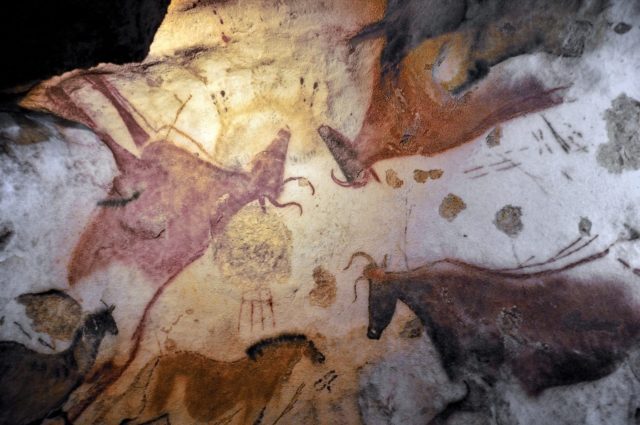
Thrill-seeking kids discovered the paintings in Lascaux Cave. (Philippe Wojazer/Getty)





For many years I had been obsessed by cave art. In the late summer of 2025, I travelled to Carcassonne to host a literary salon at Convenanza, the late DJ Andrew Weatherall’s annual pilgrimage for followers of what he termed “gnostic sonics” a kind of slow-moving visionary disco that would generate trance states via chugging shamanic remixes. The yearly ceremony took place at the castle of the Cathar heresy, a 12th or 13th-century Christian dualist belief that posited an evil demiurge who ruled over the physical world. In the wake of the ritual, I realised that many of the original palaeolithic caves were only a short drive away. Feeling suitably magicked-up, we headed for the Niaux caves, tucked into the Pyrenees, host to some of the most astounding examples of early art forms. As we approached the visitor centre, we could see the majestic Corten Steel sculpture commissioned from the architect Massimiliano Fuksas looming from the mouth of the cave, towering above the trees.
A buffoon was appointed to show us around. A daft kid cracking corny jokes about cave men. Why was school so easy for cave people? Because there was no history to study. As we ventured into the impossibly dark cave system, with nothing but low-powered torches to light our way, he told us not to touch the walls; there are still handprints on there from 13,000 years ago. Stick to the main path, he said. In the undisturbed sand either side of the path we saw perfectly articulated groups of small footprints: they were those of a child of around 12 leading two others, of six and seven, to the far ends of the cave.
Of course they were kids.
I’ve long nurtured a theory, first set off by R. Dale Guthrie’s monumental study, The Nature of Palaeolithic Art, that most of the art in the palaeolithic caves was in fact made by adolescent males. There are so many beautiful images in the palaeolithic corpus, but many of them, especially the ones that don’t tend to feature in coffee table books, are just like the adolescent graffiti you see in toilet cubicle walls. Or on the walls of ransacked, burgled buildings. Sex and violence are the motor, and sometimes both at once, as with pictures of hunters with huge penises killing animals while impregnating women at the same time. Who else but a spirited young boy would engage in the kind of high-risk activity that climbing into a dark cave and walking for underground kilometres involves? No surprise to discover, then, that many caves, like the most famous of all the palaeolithic sites, Lascaux, were re-discovered by thrill-seeking kids. And if your house is broken into and there is graffiti on the walls, you can be sure you have been burgled by young men.
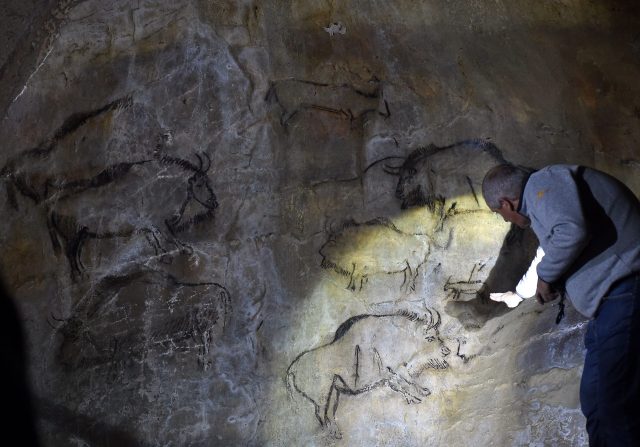
I’m thinking of all this as we make our way through the caves, following the puns thrown into the air by our guide, up between slopes of rock that look like the cathedral fountains of Mars. And, yet, it’s never oppressive, never claustrophobic, like something benign is drawing us in, ever deeper. Finally, we arrive in the belly of the “black salon”, where all the daubings are in black. Our boy guide asks us to switch our torches off and in a blink we are left in a disorienting state of absolute sensory deprivation. Then he flicks on his to light up the wall, and there they are. Ibex, horses, deer, all over the walls, some merely legs and lower torso, looking as though they are disappearing into, or emerging from, the stone walls, which now function as the gateway to the noumenal world: the place of death and of birth and of animal identity. There is only one human figure drawn in this cave, he tells us, and it is inaccessible. You have to crawl into a hole to see it, he says. And it consists, simply, of the lower legs and body of a person, disappearing, or emerging from, the rock. “O mother,” I think, recalling those lines of the poet Allen Ginsberg, “no harm on your body!”
A wall of bison is conjured in the beam of his torch. Can anyone see what is weird about these beasts, he asks. No one can. They have eyebrows! he tells us, delightedly. Look! It’s true: the bison have human eyebrows. And then, as he moves his spotlight up and down the wall, the animals start to dance. They are painted into the crevices in the rock itself, and the cave is suddenly alive with the suggestion of moving animals. They would have had a fire here, our guide tells us. Our ancestors. This was where the ritual took place, he says. Psychedelic mushroom rituals, he says. These people were shamans, he says. And they were young boys. No one lived to be old, he says. The young men were the elders. Then he asks: What is missing from the ritual? No one has a clue. Music, he says. Music. Then we turn off our torches again and stand silently in the enveloping darkness for what feels like forever.
But then our young lad starts to sing. A wordless Navajo hymn. His voice resonates through the thick blackness as this cathedral-like honeycomb tower casts his voice perfectly. And it is the most spiritual moment of my life. I’m home — this is what it feels like — I am returning home after a very long absence. I have never felt a more powerful connection to my ancestors, to all of humanity that came before. This is no longer a guided tour. This is what the caves were being used for 13,000 years ago. We are interacting with those same boys. And it still works, this… well, I want to call it technology. The caves have preserved this paleolithic son et lumiere, perfectly. It still works. When our guide stops singing, the spell breaks. The boy shaman asks if anyone else would like to sing — for once, not a joke. Thankfully no one does. But then we must leave. My partner and I hold back, we loiter at the back of the party, we stare longingly back into the darkness, at the place we once came from. Home, at the beginning of mankind. Everything is speaking in the present. We emerge from the cave into the light, reborn. Again. Astonished.
When I was a kid, our house was broken into. The thieves helped themselves to some biscuits in the kitchen, stole all of my Doctor Who novelisations, and drew a huge cock and balls next to my bookshelves. I knew who it was immediately. Two teenage boys, James Cassiday and Stephen Wotherspoon. Two absolute headcase schoolfriends who also happened to be obsessed with Doctor Who. Twin vandals and artists. They were arrested but we didn’t press charges, even though I never got part of my Doctor Who book collection back, because they had buried some of them in a park next to Clarkston Primary and couldn’t remember, or relocate, the exact spot. I still imagine someone digging in the grass one day and finding a tattered copy of The Deadly Assassin: what kind of ritual was that?
And there was the time when my gran’s favourite bingo hall was broken into and trashed. Some young adolescent males — obviously — had kicked the windows in and smashed the place to bits, and behind the pulpit — that quasi-religious raised platform, where the crier would call out the numbers — one of them had written “God will reek vengeance on all poofy sinners”. There it was: the sacred and the profane in the mindless vandalism of young boys. The hall never reopened, to my gran’s lasting disappointment. It was abandoned and left to ruin. The art deco B.I.N.G.O. sign collapsed onto the roof. The bricks crumbled. The woodwork rotted. The building seemed to be sinking into the ground; like the great Sphinx of Egypt, swallowed by entropic sands. The sign barely visible through the accumulated detritus of the decades, and then centuries. What might future archaeologists make of it? How to explain its function? The machine that ejected balls with numbers on them; the cards that were matrices of code, some numbers circled. The strange entreaty on the wall against perceived sin. And now, every time I pass a bingo hall, I think of shamans and of teenage boys, and of caves, and of future ruins.
David Keenan presents his latest novel, Boyhood, as part of the Edinburgh International Book Festival on Friday 21 August at Venue NW at the Edinburgh Futures Institute, 18:45 – 19:45.