




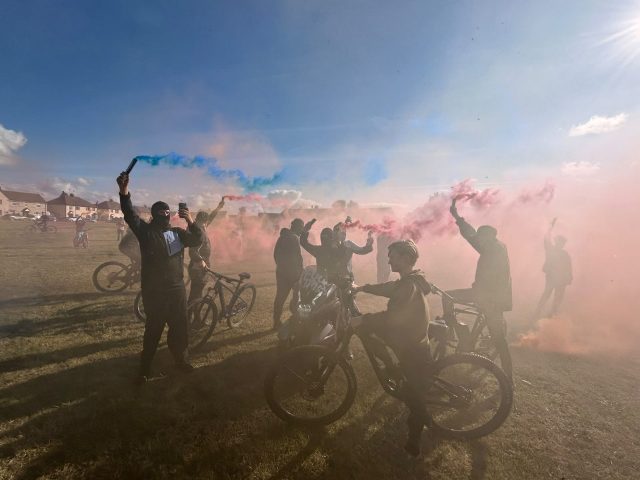
A balloon release in memory of Jakub Matusiak, 23, who died in the A66 crash.





“D22 robbery crew no better,” read a comment on a now-deleted TikTok showing reckless driving in County Kildare, complete with a smiling devil face and a heart. “You know it,” read the reply with its own answering devil. This is the high-octane conversational patter of social media’s new-gen boy racers, who goad police officers into chases — often driving on the wrong side of the motorway — before uploading the footage online to impress other scallywags. It may sound pointless, even absurd, but like other inexplicable trends it is catching, and it is fatal.
In the small hours of Sunday 16 August, five teenage boys crashed head-on into a family on their way to Dublin Airport to catch a flight to a wedding; none of the boys survived. They had been driving a BMW stolen during a night of carjacking and house break-ins. The family — three adult sisters and a little boy — were all injured; two remain in critical condition. A police spokesman described the crash as part of a trend of “gangs” of young men “trying to outdo each other” with Grand Theft Auto-style car thefts, chases and police exploits. Their audience: TikTok. Mary Aiken, a professor of forensic cyberpsychology at the University of East London, told The Guardian: “They have one foot in the real world and one foot in cyberspace.”
Grief quickly made way for anger. It emerged that three of the boys were known to Ireland’s childhood social services agency; one had been living under their care. It also transpired that local police had been instructed not to chase them. The public responded with fury, raising more than €660,000 for the injured family in the other car. A predictable outcry was volleyed at TikTok itself, whose representatives said they were “proactively engaging” with Ireland’s media regulator. The Chinese tech giant then refused to appear in front of a government committee on removing dangerous content, saying ongoing investigations by the media watchdog and the police prevented it from doing so.
At the funerals of two of the boys on Friday, photoshopped images of them squaring up on the stairway to heaven accompanied their white horse-drawn carriages. A vigil was held for the injured sisters that evening. An awful, indecorous story seemed to have drawn to a close.
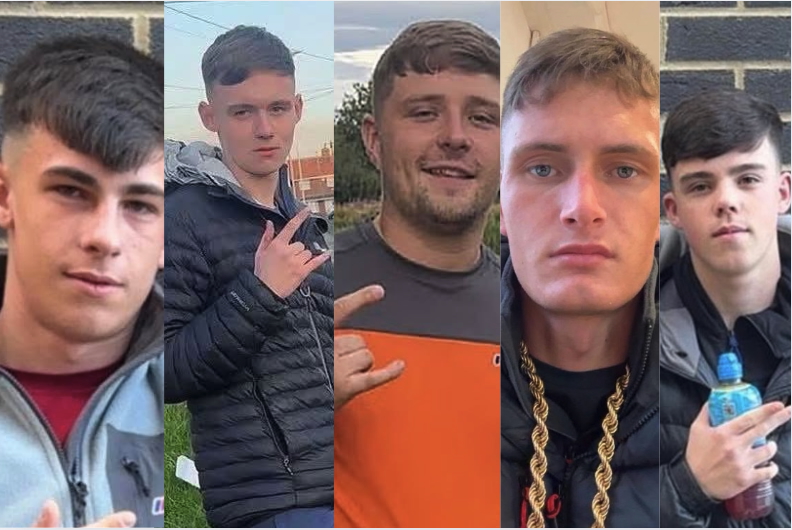
Then, less than a week after the crash, the same thing happened again: five young men died in a preventable collision, this time taking two police officers with them, 37-year-old Matthew Blades and 38-year-old Tom Clough. As before, five boys and men aged 17 to 23 were packed in a Volkswagen Passat bombing the wrong way down the A66 near Middlesbrough in the early hours of Saturday morning. A night of violence by rival gangs — including a stolen car being driven into the house of one of the dead boys’ fathers — sparked a police chase. The boys evaded one squad by joining the motorway; 10 seconds after that chase was called off, they hit another parked police car. Everyone involved was killed.
Cleveland police said there was no evidence that the fatal crash was filmed for TikTok. But one of the boy racers, 18-year-old Makai Saddington, had previously posted police pursuits on his TikTok account, according to The Sun. In May, one of these videos showed teenagers zooming through a housing estate followed by blue lights. In another, they joyride then torch a Nissan.
A Facebook tribute to Saddington shows the boy in a Nike tracksuit throwing a gang sign; “all of you” are invited to the “baloon release” in his memory. At the event, masked youths “roared around the field” next to a church vigil for the dead, according to The Times. The Prime Minister sent his condolences, then on Monday said glorifying dangerous driving online was “truly reprehensible”. Tributes to the officers described them as “heroes”; Blades was just about to begin coaching an under-7s football team. One of his two young sons was on the squad. His colleague, Clough, was a former soldier; his family said he was “always on public duty throughout his short life”. Nine men and three women have since been arrested in connection with the crash, some on suspicion of firearm offences and threats to kill.
On Monday evening another police pursuit, this time in Warwickshire, saw a 19-year-old boy die after crashing into a woman in her seventies; she sustained critical injuries. The item was among the main headlines on Radio 4’s World at One. Fatal crashes happen every day; the events this summer, it seems, represent something bigger.
The mindlessness of speeding the wrong way down the motorway is self-evident. But there have always been bored teenagers, vandals with graffiti cans, incorrigible yutes with the urge to smash up garden gnomes. There has also always been adolescent road stupidity; boy racers have been doing donuts in Morrisons car parks since the dawn of time. But this month’s deaths are not being spoken about online as banal accidents: these twin fatalities, just days apart at the fag-end of the school holidays, have provoked an especially intense feeling of disgust. Thousands of under-the-line comments ask the same horrified question: what is social media doing to our young people?
TikTok itself is clearly not the root cause of teenage recklessness. Teenagers are, by definition, doomed to battle against their own meaninglessness. They are destructive by design, seeking dopamine and adrenaline, wired to go on borderline suicidal jaunts for the meagre reward of peer admiration. What social media has done, however, is provide ASBO-ism with a new imagined audience, the wondrous potential for your midnight misdeeds not just to shock your parents but thousands of online strangers, many of whom will comment approvingly on just how mint giving police the runaround really is.
This sort of tomfoolery is also tonally rural: teenage boys in the middle of nowhere get their kicks by terrorising country lanes, far more than the ruffians of the metropole — many of whom won’t even learn to drive. There is something maddening about the boredom of countryside adolescence. In a village near where I grew up, two troubled foster teens were rumoured to have been driven to distraction by their tutting fogeyish neighbours and took their revenge by “tatering” a goose. That is, they stoned it to death with Maris Pipers. Nowt so queer as folk, especially when those folk are teen outcasts who lack parental discipline. The Tater Taliban kept the good locals talking for years — but that was before the age of algorithm-engineered social media megavirality.
Many a chav has smashed up a bus stop to the giggles of his four friends; today we must factor in the spectral presence of four million strangers. Teenage delinquency is a local ritual, a spell to conjure attention. The more imagined spectators, the more glorious the act. TikTok, Snapchat and Instagram turn the spotty GCSE candidate into an intrepid digital gladiator; they give his boredom meaning.
Because all teenagers experience crises of purpose and identity, each act of rebellion has its own meaning. The meaning of graffiti is “I was here”. Theft, “everything is mine”. Joyriding, “I’m not scared”. Gang-larping, “I belong”. It’s all quite touching when you look at these irritations through the clouded lenses of a frustrated adolescent. In a strange way, too, ASBO-ism is a bonding ritual for difficult young men: this is not the bedroom-bound psychopathy of a lone school shooter, but the forging of fraternities around vague notions of omertà. All of this was understood in the age of moral panic around “hoodies”, those irreverent hoodlums David Cameron once wanted us to cuddle (or so his critics said). The difference today is that the stakes go far beyond local notoriety: the world is now the teen tearaway’s stage.
Few of us would oppose the careful regulation of daft viral trends which, for example, encourage young men to drive the wrong way down the motorway. It’s common sense: platforms should be quicker to ban accounts and videos that glorify criminality and dangerous driving. The extent to which governments can compel TikTok to act is of course hampered by the usual legislative snags — Politico reported tech insiders’ concerns that the Online Safety Act gives ministers little recourse to act on any offences other than “priorities” like terrorism. Dangerous driving doesn’t get a look-in.
Yet the motivating principle is something we cannot possibly keep in check: the imagined audience. This is the real jet-fuel for global adolescent narcissism. Teenagers have an often desperate desire to be seen. And the hypothetical hippodrome of admirers cheering and booing the lonely boy with a provisional license makes him a “legend”. In place of talent, temerity will do. Even when under-16s are banned from social media, they will continue to exist on this new and perverse stage. Rather than dismissing this month’s motorway tragedies as incidental, we should see them as part of the new pantheon of online adolescence.
General audiences take boy-racer videos for what they are: pleas for attention from the fast, the furious and the fuckwitted. TikTok should ban them, of course — but there’s not that much else we can do in the face of tyrannical teenagers who go around nicking cars. We can train our police in high-speed chases, issue tickings-off, and even roll out public-safety campaigns in schools, but these prove to be blunt instruments against an adolescent brain set on stupidity.
Perhaps the real lesson, at a time when social-media firms are facing major legal reckonings over child safety, is to think more broadly about how this technology is changing the psychological picture of Western youth — making them more reckless, more hungry for attention. These stories contain ancient warnings about schoolboy rashness, but they also prophesy a frightening future where risk is rewarded by faceless people on your phone. It’s difficult to imagine this summer’s motorway tragedies taking place without TikTok, and the invisible millions who give bored teenagers something to live — and die — for.
