




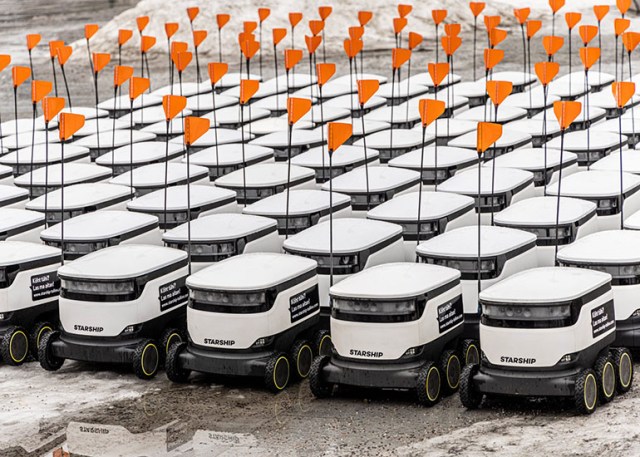
Starship robots have been already been introduced to British pavements. (Starship Robotics)





A walkway is, by definition, a space where machines do not go. It is a hard-won sliver of human-exclusive sanctuary within the treacherous kinetic landscape of urbanised civilisation. Bound in legislation but enforced with stone, a pavement’s purpose has been unchanged since the Bronze Age: to mediate the inherent conflict between travellers on foot and larger, more powerful traffic. It worked in Rome, it worked in Corinth, and it works, more or less, in Los Angeles, Tokyo and London. New attempts to undermine this ancient institution in order to facilitate the mechanised distribution of junk food should therefore concern any intelligent pedestrian.
The plan, hinted at by policymakers but confirmed by a Government report last month, is to legalise the use of unmanned delivery vehicles on pavements in Britain. Citing a need to provide “clarity” on this matter to commercial operators — a majority of which are in the takeaway business — the Government says its intention is to create a “clear, lawful route to the UK market for pavement delivery robots”, which have been operating in grey areas and tiny numbers for a couple of years.
To most ordinary road users, that “clarity” already exists. The 1835 Highways Act, among other established legislation, stops just short of actually stating “it is forbidden to drive your pizza delivery machine down the pavement”. That the Government plans to dilute these rules, as early as 2027, risks subverting a millennia-long consensus that pedestrian spaces are for the exclusive use of walking people.
Yet pilot schemes are underway around the world, notably in North America, where disability advocates, active travel campaigners and community organisations are incensed by the arrival of camera-controlled vehicles in historically pedestrian spaces. Videos abound of these robots hassling walkers, blocking wheelchair users, damaging street furniture and generally being pestilent. Meanwhile, the companies in charge of the robots insist that such incidents are rare, or don’t matter, or are otherwise acceptable collateral damage in the righteous pursuit of progress.
In Chicago, where residents are so aggrieved by this new sidewalk traffic that local legislators have actually moved to stymie the trial’s expansion, delivery drones are prone to smashing the glass walls of bus shelters. A level crossing in Miami is one of several railways where robots have been obliterated by locomotives in pointless collisions, with one video showing a spectacularly fiery result. Across North America, “Sidewalk Autonomous Delivery Robots” star in a fast-growing filmography of wince-inducing videos captured by bystanders.
There is, of course, no central tally of people harmed by these machines, but several have been injured or sent to hospital. The victims include a cyclist in New Jersey who broke his collarbone after being taken out by an Avride robot, and a pedestrian in Arizona who was knocked over and then injured again by the robot, she alleges, when she was on the ground.
In purely physical terms, the robots are formidable. A laden weight of over 50kg and a top speed of 10mph make larger examples quite frightening. Smaller, slower units have also been trialled, many limited to 4mph when they detect pedestrians, but even the more diminutive models have been filmed bothering people’s ankles, diving beneath the wheels of passing cars, and genereally getting in the way. Humans are expected to dodge these machines when they plot uncompromising routes through crowds, sidestep them when they halt, or yank pets out of the way if the vehicles’ on-board AI hasn’t learned to detect a Yorkshire terrier. And when a robot pulls up at a pedestrian-controlled crossing, or otherwise gets stuck, its operator hopes that you will step in to assist.
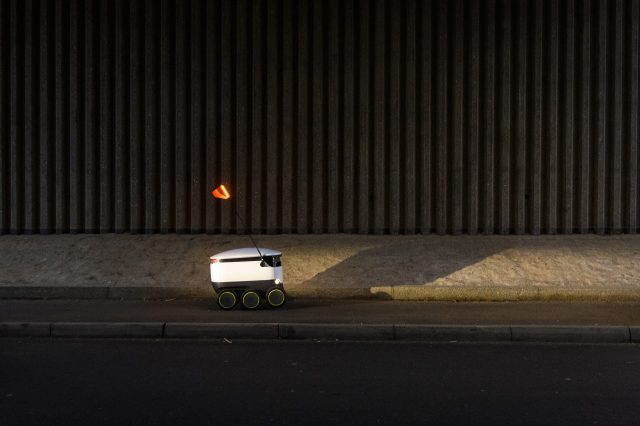
To date, the pavement delivery drone experiment is going as badly as you’d expect, with predictable resistance from its unwilling, unconsenting human participants. But the scheme operators have turned to one of the oldest tricks in the consumer robotics playbook to mitigate public anger: cuteness. Almost all pavement delivery vehicles have smiley faces, exaggeratedly large anime-style eyes for headlamps, and affectedly unthreatening styling that resembles a child’s toy. Many have electronic voices capable of synthetic obsequiousness, humanoid nicknames emblazoned on their flanks, or large dot matrix screens on their fronts that can “emote” with basic expressions. Once the robot, called something like Cuthbert, has crashed into you, it can change its digital face to a sad one before whirring off with its cargo of bubble tea.
This reflects the unlovably cutesy approach to accountability shared by most of the big operators of delivery drones. Following one of the Chicago bus shelter crashes, the startup Serve Robotics ran a local advertisement campaign that featured an anthropomorphic delivery robot displaying the self-deprecating message “Nasir is sorry” and “I took ‘breaking into the market’ too literally”. Corporate statements immediately following crashes are stiffly unrepentant and almost always downplay the severity of whatever went wrong. When the aforementioned woman in Arizona spoke with the robot operator Starship, having been injured by one of its machines, the representative offered her takeaway discount codes along with the firm’s insurance details. The twee design language of the robots themselves might be effective in manipulating hearts and minds, but this type of oopsie-daisy non-apology lands badly when the damage is physical, painful or frightening.
The purpose of this experiment has yet to be adequately explained. Human beings have successfully carried pizza and curry to one another for generations, at a cost that evidently can be absorbed by consumers, without the need to legislate away pedestrian protection. The government has said that the proposed legalisation of food delivery vehicles in traffic-free space will “facilitate low carbon, last mile delivery services in ‘delivery deserts’”, a newly-invented non-issue, and somehow “drive productivity gains in our NHS, by connecting medical goods around hospitals, maximising the benefits of aviation drones and boosting productivity so staff can focus their time where delivery robots are not suitable”. None of this really follows. Deliveries within hospitals do not require sweeping changes to the constitution of our public realm, and there is no obvious connection between curry-bots and the more serious field of medical drones. While the official rationale includes magic words like “NHS” and “low-carbon”, it reads like a startup’s solution looking for a nice-sounding problem. Beyond vague hand-waving at “innovation” and “growth”, none of the evidence submitted to Parliament by regulators or industry (which is, of course, lobbying for deregulation) have adequately justified the assumption that pavement robots should happen here.
The key beneficiaries and proponents are foreign companies, which stand to win financially and are consequently leading the demands for “clarity”. Regulators are outnumbered and outgunned; the DfT has no staff dedicated to pavement robots within its tiny Micromobility team, which specialises in scooters and e-bikes. The companies encircling the regulators are large, slick affairs with established lobbying practices and great heaps of VC cash. If all goes to plan for them, they and others will receive explicit permission to run their vehicles along walkways, with licensing and supervision responsibility falling to local authorities — ill-funded and often haphazard organisations that are even less likely to push back on Big Tech’s excesses than Whitehall is.
We can study soaring injury rates from dockless e-bike and e-scooter initiatives to understand how effective borough councils are at supervising “innovation”. The accountability vacuum carved out by those micromobility operators shows us that, even with an identifiable human rider, who is tracked via GPS and who has paid for their session using their bank card, personal liability for injuries cannot reliably be established. Delivery robot operators enjoy a similar shroud of invincibility; nobody will ever be personally prosecuted for damage done with their autonomous machines. Instead, disincentives against harming passers-by fall within the murky corporate apparatus of civil liability and “provisions”.
What happens when the penalty for maiming or killing is merely financial? It’s a well-worn talking point in the decades-long conversation about driverless cars, but the government proposes far feebler regulation of these pavement vehicles. It’s likely that we’ll sooner contend with machine autonomy on our walkways than our highways. Delivery companies have expressed their preference for their robots to be treated like a person rather than a machine; the then-boss of Amazon’s Scout drone programme said in 2019 “we want to be viewed as a pedestrian and treated as a pedestrian”. In Korea the technologists are getting their wish, with pedestrian status, including priority at crossings, granted to pavement bots of up to half a tonne.
The bleakness of being legally obligated to kowtow to someone’s kebab is eclipsed only by the more broadly depressing reflection this shows us of our societal proclivities and what we describe as “growth”. With walking too difficult to monetise, the pedestrian has been deprioritised in the pecking order of public space to make room for something profitable — a galling demotion in the era of sustainability and low-traffic neighbourhoods. And in the absence of strong advocates or principled regulation, the institution of the pavement can be stripped of its assets by foreign companies. Those foreign companies will spoil these capitulated tracts of realm in the most annoying possible way — with a column of infantile machines, carrying infantile food, loosing their payloads of “picky bits” into Britain’s inert, dribbling maw.
This is not a good idea. Unlike more promising entries on Britain’s innovation to-do list, this proposal irritates everybody while benefiting very few. And unlike similarly arrogant and exploitative transport proposals of decades past, this one seems likely to happen, with legislation to reformulate the tenet of the pavement due to reach Parliament this or next year. Distributing tepid takeaways does not justify the granting of pedestrian-like status to vehicles, no matter how much “clarity” it would offer tech firms, and the prospect of allowing such a transparently extractive coup against the public will be an historic test of Britain’s regulatory gag reflex. Regrettably for the pedestrian, still bruised by a century of vehicle-centric urban planning, a new and more exploitative machine age may have dawned.