




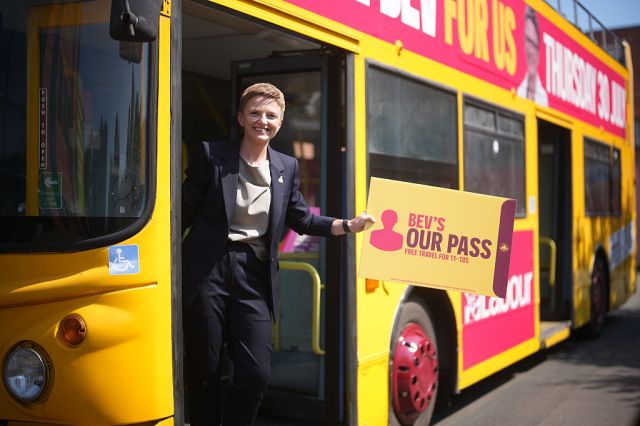
Bev on a bus. (Christopher Furlong/Getty)





If a week is a long time in politics, then seven months must be an age. It was only in January this year that members of Labour’s ruling National Executive Committee briefed that Andy Burnham couldn’t possibly be allowed to stand as a candidate in Gorton and Denton. Their fear was that, if Burnham resigned, the role of Manchester mayor could fall to Reform in a subsequent by-election. Inadvertently, the briefing served as an embarrassing admission. In 2024, Burnham had won 214 of 215 Greater Manchester electoral wards. If each of those wards had represented a seat in a secessionist People’s Republic of Manchester Parliament, then Burnham would have held a greater share of the legislature than the Chinese Communist Party does in Beijing’s de facto one-party state.
Manchester had always been Labour for as long as anyone cared to remember. It was pro-labour before Labour even existed. This was a centre of Chartism, Radical Liberalism and mass, industrial trade unions well before the Labour Party proper had even been conceived. But the King in the North had transformed it into an impenetrable Red Fortress, nested on the edge of the Pennines, with even the salubrious middle-class suburbs voting for the Left-wing Mayor. The narrow, New Labour apparatchik had transformed, butterfly-like, into a broad, avuncular tribune of all the Mancunians, fighting their corner against the Great Wen. He had transcended his bland ministerial origins, and mastered the art of the floating signifier, the vibes politician, letting people transplant their own desires onto his person. And yet such was the unique unpopularity of Prime Minister Keir Starmer, then barely 18 months into his premiership, that it was genuinely proposed that the mayoralty in Greater Manchester might be lost to the national-populist teal tide, should the Labour candidate not be named “Andy Burnham”. Rarely in politics does one hear such a willing confession of weakness.
Labour’s hapless bigwigs were right to be afraid. In May, the local election results seemed to bear out their worst fears. Across the 10 Greater Manchester councils, Reform’s aggregate vote was 30% compared with Labour’s 24% and the Green’s 20%. Labour didn’t win the largest share in any of the local authority areas, with its voters pulled between the siren populisms of Left and Right. The old bloc had been blown apart by a tragically inept, dithering lawyer, who had sullied the party brand with his refusal to project any sense of purpose to a beleaguered nation desperate for an active response to falling living standards.
But barely three months later, Andy Burnham is Prime Minister, and Labour has retained Greater Manchester at a canter. Its candidate in yesterday’s mayoral election, Bev Craig, won 47.2% of the vote in the first round, and 66.3% in the second. In Labour’s first electoral test since the new Prime Minister entered No. 10, we see a glimpse of the Burnhamite electoral bloc coalescing: the Greens squeezed into a humiliating third place after boasting that they were in contention to win; the Liberal Democrats barely registering and subsumed into Labour’s orbit; and perhaps even some soft Reformers peeled off from the Faragist insurgency now that the national face of Labour is no longer so lacking in verve. We can see the Labour coalition being tentatively restored.
The winner of the Greater Manchester contest matters now more than ever, as new fiscal levers are devolved to regional representatives. Two of our last five prime ministers have used their respective mayoralties as a springboard for national leadership. As a relatively new constitutional addition in Britain, combined authority leaders have, up until now, often acted as beefed-up ambassadors for their locales, corralling councillors and the private sector into some semblance of partnership, trying to drum up FDI, and bidding for investment from Whitehall in what the West Midlands Mayor Andy Street called a “begging bowl culture”.
But mayors will be beggars no more. Now that a proportion of income tax revenues are set to be devolved, regional executives will suddenly find themselves with the ability to implement their visions without sign-off from Westminster’s mandarins. Where previously Britain was an international outlier in terms of its political and fiscal centralisation, the new policy puts the country more in line with most advanced democracies in which city and regional leaders are able to use local initiative to a far greater extent.
We are perhaps living in a new age of mayors. Zohran Mamdani has become an international figure, studied by anxious Leftists for translatable lessons and a winning formula. (It helps to stand a charismatic frontman in a liberal megalopolis, eschewing typical Leftist campaign obsessions in favour of strong, cost-of-living-first message discipline.) Burnham is consciously emulating Mamdani’s media strategy, communicating via vertical video rather than obsessing over the lobby, unread press releases, or meandering speeches that rarely cut through anywhere outside of Fleet Street and wonk-land. Mayoralism, based on a blurring of the personal and civic identification — “who do I call when I want to call Manchester?” — lends itself to TikTok-enabled soft personality cults. Meanwhile, Britain toys with the notion that mayoralism and English devolution could also solve a growth conundrum that has bedevilled politicians of all stripes since 2008.
In this regard, the work of two of Burnham’s reportedly close economic advisers is instructive. The former Goldman Sachs economist, Jim O’Neill, and the former Bank of England economist, Andy Haldane, have advocated for increased mayoral and city-regional powers as a productivity and growth-booster for many years — and the idea is finally in vogue. A recent well-received paper, co-authored by Ed Balls, made the case for an intensification of a regional rewiring of the British state, coupled with a lot of infrastructure spending. In line with O’Neill’s and Haldane’s long-term thinking, the formula of increased capital expenditure plus bolstered levers for local leaders is held up as a solution for the anaemic economic performance over the last two decades. A figure of £200 billion over two decades is cited for transport upgrades outside of the capital, while it is calculated that bringing second-tier cities up to the standard of Western European counterparts would add £70 billion per annum to the receipts of the Exchequer.
Burnham’s heavy focus on devolution stands out in these early, honeymoon days of his leadership. The public clamour for increasing the powers of mayors is minimal. Most people are as likely to feel as estranged from their local Town Hall as they are from Whitehall: each represents a failing state monolith, long shorn of any vigour or capacity, rather than the latter being seen as an unfair colonial imposter on the rightful terrain of the former. Burnham’s dogged pursuit of this agenda, then, is a sign of his convert’s zeal.
Those old-fashioned Labourites hoping for a premiership focused on old-school nationalisation and state-backed reindustrialisation will likely be disappointed. Burnhamism will be technocratic, not revolutionary, with any fiscal space or wiggle room on investment prioritising infrastructure spending and mass transit in and between the great cities of the North and Midlands, not on transferring privately held natural monopolies back into the public sector. In office, Burnham will attempt to do the old model better, extending it outside of London, and pursuing the real economic drivers of “Manchesterism”: metropolitan agglomeration, city-based service and knowledge economy growth, and the so-called “triple-helix” model of innovation through partnerships between the local state, universities and business.
But there is a difficulty buried in all this, and the story of Greater Manchester epitomises the problem. The agglomeration model works, in the narrow sense that it has already worked: central Manchester’s impressive skyline is the product of three decades of precisely this formula. What it has conspicuously not done is reach the same impressive heights in Rochdale, or Leigh, or the stretches of Oldham where the promise of spillover from the core has been renewed at every electoral cycle, without ever quite materialising beyond the improved Bee Network: all roads lead to Piccadilly Gardens. And yet Burnham’s political achievement as mayor was to hold both constituencies at once — the defender of the left-behind town and the apparent originator of the glass-and-steel city boom — without ever being made to say that the growth model had a primary beneficiary in the Northern laptop class. That is a considerable trick. The question is whether it can be repeated on a national scale.
The academic Paula Surridge’s extensive quantitative research into the British electorate reveals a majoritarian appetite for the active state, public investment, and the economic populism of the Left. And yet Labour’s potential voters are split according to their divergent values, between the cultural conservatism of (broadly speaking) the patriotic, non-graduate working class, and the liberal-progressivism of the graduate urban salariat. If Burnhamism can bridge those gaps with an inclusive social imaginary of dad-rock, professional Northern cheeky-chappiness, football, pints and pies — moulding the projected cultural offer with the common-sense social-democratic nostalgia that forms the vague political economy of his normie populism — then the Right has cause to be very afraid.
Reform is in disarray nationally and has been roundly beaten in Greater Manchester, where it was ahead just in May. And this coincides with a symbolic turning point: the first polls in over a year in which Reform has lost its lead. The contradictions within Burnhamism are real, but only as real as those on the Right, which is suffering its own version of tribal-electoral fragmentation. Permanently welding together the post-industrial, provincial proletariat with the petit-bourgeois and affluent middle-classes of the Home Counties and Southern England was always a tall order, which Boris Johnson’s Tories only momentarily succeeded in doing for a short-lived “realignment” in 2019. Those discrete blocs have since bifurcated into a more plebeian populist movement and remnants of Sensible Conservative ultra-loyalism. The current state of politics is this: Reform is in defensive mode, the Tories have stabilised, the Greens and the Liberal Democrats are going backwards, and Burnham is outpolling every rival leader by margins Starmer never once managed.
In 2007, a new Labour prime minister with an inherited mandate and a commanding lead decided against going to the electorate while he was ahead. Burnham was sitting in the Treasury when it happened. Now, he finds himself in a similar position. He could extend his own lead over the coming months — but only as long as he is able to maintain his everyman status, as long as the ambiguity of a difficult-decision-free Burnhamism allows him to ride two horses at once. That won’t be easy: at present, we have a perilous fiscal inheritance that means promises will be reneged upon. We have a Downing Street staffed by former Blairites; a soft-Left and Brownite Cabinet; and Socialist Campaign Group, Progressive Britain and Blue Labour MPs alike on the government payroll. Those elite-level contradictions are accompanied by deeper, population-level fissures in the composition of Labour’s electoral demographics. Greater Manchester has taught Burnham that the Labour coalition can be rebuilt, but not how long it holds. In September, when Parliament returns, with a Budget due soon after, we will see how good a floating signifier Burnham can be.
Jonny Ball is a Contributing Editor at UnHerd. He formerly wrote under the name Despotic Inroad.
 DespoticInroad