




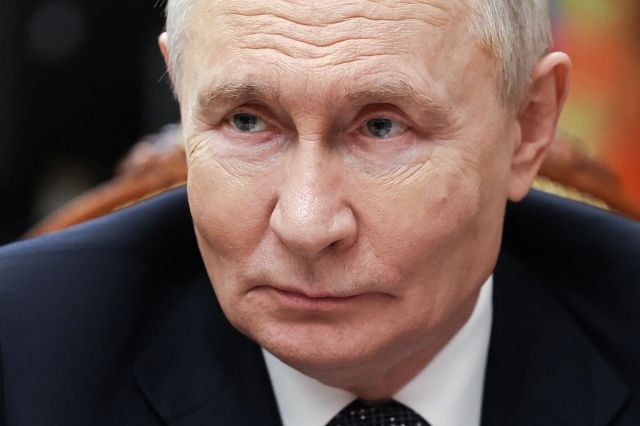
‘The reason why a war with Russia is so dangerous is the presence of nuclear, chemical and biological weapons.’ (Alexander Kazakov/Pool /AFP/Getty)





John Ratcliffe, the CIA director, surely did not secretly fly all the way to Moscow last week merely to warn the Russians not to attack a Nato country. There is clearly more to it than has been reported. It has always been the official policy of Nato to defend itself when attacked, and so this alone wouldn’t justify Ratcliffe’s visit. I can only assume that the circumstances behind this meeting are darker, more serious and more complex than we can possibly know.
Based on the information we have, the most plausible explanation for the visit is that Ratcliffe and his Russian counterparts were discussing de-escalation. If Russia’s war against Ukraine were to turn into a broader European war, it would pose a vast security risk to the entire world.
What the US and Russia have in common is that they are both already fighting wars. Vladimir Putin and Donald Trump clearly do not wish to go to war with each other. There are reports that Putin may be planning a large autumn offensive in Ukraine. Russian troops are currently making slow but steady progress towards the Donbas cities of Kramatorsk and Sloviansk. It is quite plausible that Putin could step up this war — but for this he would need to recruit more troops and intensify his attacks on Ukrainian infrastructure. Some Western security officials are convinced that once Putin is done with Ukraine, he will try to test Nato’s cohesion.
I struggle to see what purpose this could possibly serve. If he really wanted to test Nato’s resolve, by far the best way would be to escalate the hybrid warfare that is already going on. One of the more serious recent incidents was a military drone flying into the wing of a parked Ukrainian cargo aircraft at Leipzig airport in early August. Attached to the drone was 600g of Semtex explosives, which did not detonate because of a malfunction. At the time there were several drone sightings in Germany. However, military leaders tend to underestimate hybrid warfare, even though it can easily morph into a conventional war.
Another escalation scenario is disagreement on what constitutes legitimate European support for Ukraine. International diplomacy has its rules on this that everybody including the Russians pretend to accept: if you support a party in a war financially, or with defensive weapons, you are not deemed to be participating in the war. If you take part in manoeuvres, you are considered a party of the war. The supply of offensive weapons falls into a grey zone. Nato has gone to great lengths to steer clear of that zone. The Western European countries that support Ukraine also made it clear that they did not wish to participate in the war.
But beware of the grey zones. The issue is not who is right and who is wrong. Wars are not settled by fact-checkers in broadcasting companies. The issue is disagreement itself.
Another grey-zone matter is the raids by Western countries of Russian ships or vessels that transport goods from Russia. The same goes for the supply of British drones for Ukrainian attacks inside Russia. Russia has responded with outrage to Prime Minister Andy Burnham’s decision to provide Ukraine with technical blueprints that would enable Ukraine to manufacture the Franco-British Storm Shadow cruise missiles. This prompted Putin’s spokesman to declare Britain to be a participant in the war. This is how escalation starts.
There is an awful lot of stuff going on that could blow up in our faces. The US economist Branko Milanović wrote an essay last week in which he described a very plausible escalation scenario. He writes the thirst for war is palpable in the Nordic and Baltic countries and is also growing in the UK and Germany. “The role of small countries—that through their geopolitical irresponsibility can wreck great damage to the world—tends to pass under the radar,” he writes. “The Nordic-Baltic coalition is essentially calling for a war with Russia, citing its own fears and traumas of Russian/Soviet control and occupation.”
I agree with his assessment. If I listen to assorted Finnish and Baltic politicians, it feels to me like 1914, the year when Germany started the First World War in a mood of euphoria. The person who sets the tone in European foreign policy right now is Kaja Kallas, a former Estonian prime minister who is now the EU’s high representative for foreign and security policy. I see her as the European warmonger-in-chief.
The job of diplomacy is to find solutions to problems. This is a tough job. You keep your diplomatic back channels open and talk to the enemy. But the EU has cut off all diplomatic channels with Russia. EU countries have their ambassadors in Moscow, and they all reiterate the official lines they are given.
The US, meanwhile, has maintained diplomatic relationships with Russia. The Ratcliffe-Russia meeting makes it clear that these exist at several levels, including that of intelligence chiefs. The officials in charge of nuclear policy also talk to each other. Henry Kissinger maintained a strong diplomatic back channel with the Soviet ambassador to the US during the Nixon administration.
The reason why a war with Russia is so dangerous is the presence of nuclear, chemical and biological weapons. Russia has an estimated total inventory of over 5,400 nuclear warheads. France has 290 and Britain has 225. Given the vast size of Russia, the French nuclear arsenal could make 0.1% of the Russian territory uninhabitable. The Russian nuclear arsenal could completely destroy all of Western Europe, and still have a lot of missiles left. This is not a war Europe can win.
If Putin were to launch an unprovoked attack on a Nato country, the picture would be different. This would draw in the Americans. I assume that Ratcliffe would have taken the opportunity to clarify the US position and possibly contradict statements from some administration officials that Europe is now in charge of its own security and that the US would not directly intervene in case of a war.
The big European countries, meanwhile, are following the lead of the war-mongering minions because they have no plan B. If the war in Ukraine were to end, they would have to provide security guarantees. They would have to integrate Ukraine into the EU at an enormous cost. Only last week, Germany and five other EU countries announced that they would cut the EU budget by several hundred billion euros. This is Germany not putting its money where its mouth is.
Rhetorical escalation often precedes physical escalation, often triggered by a particular event — like the assassination of Franz Ferdinand in 1914. One such foreseeable event would be the seizure of Russian assets held in Europe, which amount to around €200 billion. People have gone to war over much less.
The Europeans already tried to seize the money at an EU summit last December. They failed. Most of the money lies at Euroclear, a large bank depository and clearing house in Brussels. If the EU had seized it, Belgium would have been legally liable in the case of litigation in foreign courts. Belgium is a very small country with a very large bank — a bad combination. Back in December, Bart De Wever, Belgium’s prime minister, demanded robust risk-sharing guarantees by the other EU members. They refused because they did not want to put themselves at risk of another financial crisis.
But if the EU is good at one thing, it is coming up with technical solutions to complex problems. They could attempt to develop a hideously complex financial instrument, similar to the subprime loans that gave rise to the global financial crisis 20 years ago. There is only ever one purpose behind such financial instruments — to hide risk, and lure naive investors into making unwise decisions. The same logic applies here. National parliaments would have to sign up to any risk-sharing deal, but they might be fooled into thinking that the risk is well controlled.
I have no idea how likely such a scenario is. All I am saying is that the sequestration of Russian assets is once again under discussion. If it were to happen, I would attach a high probability that it would trigger a dramatic Russian response.
It is, of course, entirely possible that Ratcliffe and his Russian counterparts spoke about something entirely different: Iran. But Russian support for Iran is not the critical factor in the Gulf War right now. Trump has clearly found himself in a predicament in Iran. He cannot afford another conflict. Therefore, an attempt to de-escalate tensions with Moscow seems like the most plausible explanation of the Ratcliffe-Russia meeting. A war is in nobody’s interest, least of all Europe’s. European countries are simply not prepared; de-escalation is the only rational strategy.
The problem is that escalation is not by definition a rational thing. The fact that something is in nobody’s interest does not mean that it is not going to happen. History is littered with examples of irrational wars and, lest we forget, the biggest ones were mostly Europeans.
