




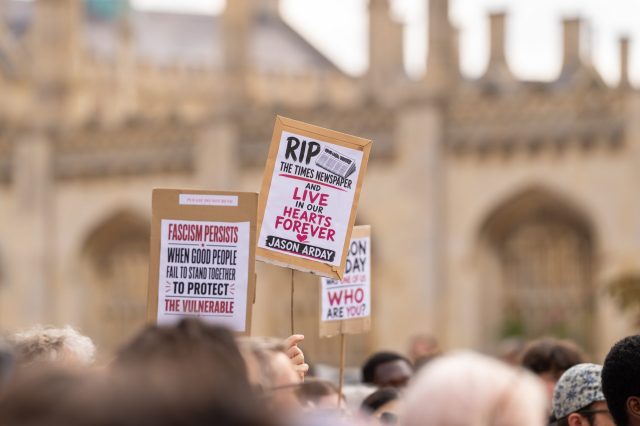
A vigil for Arday at Cambridge (Credit: Nordin Catic/Getty)





Marie Sophie Hingst was a promising young woman. Born in Germany, she received a doctorate in history from Trinity College Dublin. Her blog, “Read On, My Dear, Read On”, detailed the history of her own family. Several of her relatives had been murdered in the Holocaust, but her grandparents survived. She wrenchingly described how every year, on the anniversary of Kristallnacht, they would sit in the darkness, waiting for all those relatives — 22, to be exact — who never came home. She kept in her pocket the yellow star which her grandmother had worn at Auschwitz. Hingst’s family was also blighted by a more recent tragedy: her mother, Rachel, had committed suicide. Hingst herself, however, led an altruistic life. She spent some time working at a hospital in an Indian slum. In Germany she ran sex education classes for Syrian refugees. She was thoughtful, sensitive, and interesting. People wanted to hear her story, and she enjoyed telling it.
There was just one problem. None of it was true. She never worked in an Indian slum or as a sex educator. She was not Jewish. None of her relatives died in the Holocaust. She had conjured up 22 Holocaust victims out of thin air, giving them Jewish-sounding names, and depositing falsified information about them at Yad Vashem. “Rachel” didn’t exist. “My daughter has many realities,” her real, living mother explained to a journalist. “I only have access to one.”
Hingst had spent years weaving a web of lies. Readers of her blog gradually began to notice small inconsistencies. Doubts started to grow. In 2019, an exposé in Der Spiegel took a wrecking ball to the whole edifice that she had carefully built up. A month later she killed herself. She was 31.
Sophie Hingst did not deserve to die. Neither did Jason Arday. We all know the mythology that now attaches to the former Cambridge professor, found dead at his home on Friday: the plagiarism, the marathons, the nonverbal autism, the brain tumour, the illiteracy, the armed intruder, the pig’s head. But beneath it all — if it needs to be said — was a man, a father, whose death marks a horrible end to a sorry tale.
Already the blame game has begun. The Labour MP Dawn Butler has written to IPSO accusing the press of a “harassment campaign”. “Many of us believe that Jason would still be alive today if not for the relentless and pernicious coverage by the Times, Telegraph, Mail, and Spectator”. (It is worth noting that the most damning investigation of Arday, the one that really brought things to a head, was published by The Guardian, a newspaper which Butler wrote for just a few days ago.) The Prime Minister has invited us to spend a moment “reflecting on how things came to this”. Mary Beard similarly urges “taking a break from any discussion of Cambridge’s policies” in order to “remember with compassion the person who paid a dreadful price”. Thus she deftly forecloses any possibility that “reflection” might end up indicting the university for its part in the fiasco.
In attempting such reflection on Arday, however, and on the events of the past month in the light of their tragic conclusion, we quickly run into a problem: we are bad at thinking about suicide.
I first became aware of that when I was at school. One of the older, un-PC teachers announced to the class that, due to some diktat from the higher-ups, he would no longer mark our homework with a red pen. “Apparently if I do,” he said, “you’ll kill yourselves.”
From there it was a short step towards saying that the marks themselves, and not just the colour of ink they were made out in, should be shaped by an overbearing consciousness of suicide. That, sure enough, is the governing mindset in education today. Universities take a slacker approach to deadlines; discussion of in-person, closed-book exams — a pressing issue in the age of ChatGPT — is stifled by the fear that they would pile on to the already weighty burden on anxious student minds.
The word “suicide”, as this serves to show, has an extraordinary coercive power. But it has to be handled with tremendous care, not least because it can be a contagious act. This is difficult terrain, but the Samaritans provide a helpful guide. They wisely caution us, for example, against speculating about the motivations for a given suicide, or ascribing it to a single cause. Suicide tends to resist neat rationalisation.
That didn’t stop Teachers’ Unions blaming Ofsted, and indeed the very notion of applying rigorous standards to schools, for the suicide of headteacher Ruth Perry in 2023. Nor does it stop the constant invocation of suicide in the debate over gender transition in children. Such rhetoric explicitly intends to shut down debate. When Kathleen Stock spoke at the Oxford Union, an activist glued herself to the floor wearing a T-Shirt with the slogan, “No more dead trans kids.”
This logic is not confined to one part of the political spectrum. Pete Newbon was a lecturer in English literature at Northumbria University. He was a director of Labour Against Antisemitism and a passionate critic of Jeremy Corbyn. In 2021 a Twitter spat with the Left-wing children’s author Michael Rosen caused his employer to be inundated with complaints. Issued with a final warning, and while embroiled in a separate legal case concerning his behaviour online, he took his own life. Some fellow anti-Corbynites suggested that Rosen and his allies were to blame, thus turning a complex case into a political cudgel.
Suicide is a tragedy. It is not an argument. It is not a good argument, in any case. It turns political disagreement into a hostage situation. In ordinary personal relations we would call this manipulative, even abusive. Chad Varah, the founder of the Samaritans, understood as much, and knew just how to deal with it. A client once rang him up, threatening that she would kill herself if he didn’t make time for her there and then. “You do that, sweetie,” he replied, “and I’ll find out where you’re buried and come and piss on your grave.” Harsh as it may seem, this was the compassionate thing to say. Varah refused to suspend his usual rules and standards to make a special case. He did not want to give the vulnerable woman the impression that her suicide threats would have their desired impact, and thereby risk encouraging her to act on them.
That the risk of suicide can be used as a means of censorship is, in Arday’s case, no mere hypothetical. Last year, a police officer called a journalist investigating Arday — an act for which the Met has since apologised — advising him to cease and desist for the sake of Arday’s mental health. There is, however, a balance to be struck between taking such a risk seriously and allowing it to place legitimate scrutiny off limits. The suggestion now being made by Butler and others is that this police officer was right all along: that the risk of suicide — a risk which sadly materialised — ought to have put the whole matter to bed for good. Tragically, the attempt to suppress scrutiny carried risks of it own: once the scandal did break, it concerned not only his academic integrity but a serious and heavy-handed cover-up.
It risks being forgotten that there were very good public interest reasons for the Arday story to have garnered so much attention. Somehow, the story damned everyone. The police, for serving as a Cambridge professor’s personal goon-squad. British libel law for elbowing out the Times Higher Education and leaving Arday in the maw of Nathan Cofnas. The fields of sociology and education, which allowed him to ascend to the top of the profession and exalted his work as “the best in the world”. The roster of universities, which patted him through without bothering to apply standards or even to check that his work was his own.
Cambridge comes out particularly badly. They appointed him to a post for which he seemed manifestly unsuited. Having spent years waving him around as a mascot, they dumped him once the details of the case, which they ought to have known all along, made him more embarrassing than he was worth. They had a stronger interest than anyone in personalising what most of the press understood to be a much wider scandal: they were the ones who suggested that Arday was sui generis, an “aberration”. The story invited questions about all those things and more. None of those questions has gone away.
Those are among the reasons the affair has dominated the headlines for an unusually long time. Some of it might also be because it is “silly season”. Some of it, too, can be explained by the sheer scale of the fantasy, each revealed falsehood more outlandish than the last.
It could have been otherwise: if the Times Higher Education had been able to report the story as intended, this exposé might have looked more like the Observer’s impressive investigation last year of Raynor Winn’s Salt Path.
Instead, the story unfolded in agonising slow-motion, with Arday and those around him having to attempt live damage control (sometimes contradicting each other) as his life came crashing down. The press was relentless — one can only imagine the effect of a drip-fed character assassination on a vulnerable psyche. Here, perhaps, the straightforward demolition of his fantasies by the Guardian was, if anything, more distressing than the litany of anti-DEI columns — precisely because the details of the matter were damning enough.
Arday’s eventual resignation of his professorial chair might have thrown some cold water on the scandal, at least as it related to him personally. But then the scandal was kept alive by Simon & Schuster’s decision to publish his memoir, encouraging legions of readers to go through his made-up stories with a fine-tooth comb. At the time of writing, it still hasn’t been pulled.
When Sophie Hingst killed herself in 2019, Der Spiegel came under immense pressure. The media in Ireland, where she lived, tended towards the view that Hingst was vulnerable, her wrongdoing victimless, and Der Spiegel out of order. But Der Spiegel held their nerve. They stuck to a solid principle: investigative journalists cannot be cowed by the fear that their subjects might kill themselves. The mental health of any fabulist will suffer when their webs come unspun. The deaths of Hingst and Arday are tragic. But they cannot retrospectively make reporting illegitimate.
You can call Samaritans for free on 116 123, email them at jo@samaritans.org, or visit www.samaritans.org to find your nearest branch.
