




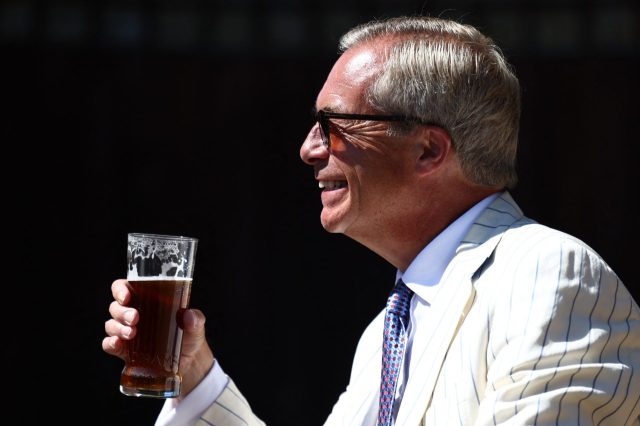
(Henry Nicholls/Getty)





What do people usually say about politicians? “They’re all the same.” “They never do anything for anybody.” “They’re only in it for themselves.” None of this is particularly accurate. Jeremy Corbyn and Jacob Rees-Mogg are alike only in that each of them has four limbs and belongs to the male branch of the species. Nye Bevan did something for countless numbers of citizens when he founded the NHS. As for politicians being in it for themselves, nobody would choose the House of Commons as a route to untold riches. Not even Nigel Farage did this, though he’s certainly piled up riches as a result of politics, and some of them do seem to be untold.
Most people don’t make such remarks simply because they’re stupid. If the government threatened to drive a motorway through their back garden, they would wise up on the planning laws quickly enough. They come up with such clichés because they don’t know much about politics, for the reason that the kind of politics we practice doesn’t seem to know much about them. The country, like much of the rest of the world, is gripped by a profound crisis of legitimacy. Great swathes of the population no longer have the faintest trust in its political institutions. It’s as though the passengers on a train greeted an announcement that they were approaching their destination with hoots of derision and sniggers of scepticism. Politicians are about as popular as pimps. As far as institutions go, a lot of people still admire the Royal Family; but this is partly because the royals don’t really impinge on their daily lives, as politics is supposed to do. The fact that royalty does nothing of importance is one of the major reasons it stays in power. Most citizens see no more point in abolishing it than in ridding humanity of Morris dancing or the Yeomen of the Guard. There’s no harm in adding a few useless decorations to your domicile.
Widespread disaffection can lead to political revolution, were it not that people are sometimes too disaffected to be revolutionary. Astonishingly, however, a third of Britons told a recent survey that capitalism had failed and that a communist revolution was necessary. Or so The Times reports. It’s hard to believe that it’s true. A quarter of those polled declared themselves open to supporting enemies of the state like Russia and Iran, which is to say that the bespectacled bank clerk opposite you on the Tube train might well be a fifth columnist. The prospect of a collapse of legitimacy is why Edmund Burke appealed in the wake of the French Revolution for government by popular consent. This is one reason why he was a Whig and not a Tory. Power must respect the values and customs of the populace. Governing classes in Burke’s view survive only by engaging the affections of their inferiors, and a loveless sovereignty is politically bankrupt. India must be ruled with due respect to its indigenous culture, not with the ham-fisted brutality of the stereotypical imperialist.
Nations in Burke’s view aren’t primarily governed by laws, but by a set of affinities and tacit understandings between rulers and ruled. What holds them together is more cultural than political. If colonies like America can associate being subordinate to the Crown with their own civil rights, the more perfect will be their obedience. The only firm seat of authority, Burke declares, “lies in the minds, affections and interests of the people”. If this fails, and the common people take to the streets, then of course you unleash on them the full force of your repressive powers. There’s always a coercive fist within the consensual glove. But to unleash your powers is to risk an even more drastic loss of legitimacy. It’s better on the whole to woo your citizens than to shoot them down. Governments who do the latter have won and lost at the same time.
Cynicism about the political class isn’t quite such bad news for the Establishment as it might appear. People don’t live by politics alone, even when they trust and admire their politicians. The dull inertia of everyday life may be enough to keep them from tearing up the cobblestones. Most of them spend most of their time simply trying to keep their heads above water. What absorbs their attention isn’t the break-up of the social contract but the price of bacon. This is one way in which economics takes precedence over politics. What Marx calls the economic base is what Americans call the bottom line. A certain amount of economic pain has a distracting effect which may benefit the guardians of the system, whereas too much of it poses a threat to them. Even so, regular visitors to Davos may console themselves with the thought that revolutions only occur when people can glimpse an alternative to what they have now which strikes them as both feasible and desirable. If the problem isn’t simply a specific political regime but politics as such, this isn’t likely to happen. In the view of a disillusioned populace, even Lenin would simply be more of the same.
“They’re all the same” and similar sentiments may not be true, but the impulse behind them is surely authentic. People are right to be cynical about politics; it’s just that a lot of them are cynical for the wrong reasons. If the political sphere can’t bring genuine change, it’s largely because it’s severely constrained by the banks, major corporations, domestic bureaucracies and international capitalist institutions. In this sense, globalisation breeds an erosion of political trust at the national level. The same is true of geopolitics, which forces political states into crippling amounts of expenditure while underfunding the institutions that ordinary people rely on. Besides, capitalism is the fastest-changing system in human history, which can make political promises hard to keep. Politics shrinks to a cramped arena in which room for manoeuvre is drastically curtailed. Nations become agents of forces they can’t control. The Britain that once ruled the world is now ruled by it.
There’s a false solution to the widespread prejudice against politics, which is to make a politics out of it. This is known as populism, which is currently sweeping the globe. You can denounce international set-ups while being bound hand and foot to the global corporations, and cheer for the Common Man while supporting the world-wide financial markets which are pushing him towards the breadline. You can even make a fortune on those markets yourself, while blaming immigrants for the social damage which such financial forces wreak. You can castigate elites in the name of the common people while stashing away millions of pounds or billions of dollars yourself and owning a large number of posh houses. You can also speak out for some ordinary people by demanding an end to immigration, while not speaking out for others who demand better health care and a decent standard of living. A figure who represents the whole of this hypocrisy is currently king of the world, able to change the rules of international football with a flick of his fingers. Pretty soon he’ll be setting the menu at McDonald’s. We’re in danger of a return to absolutism, when politics was a matter of the monarch’s will.
Some MPs claim to have been drawn to politics by sheer altruism. They prop up the Commons bar out of an insatiable desire to serve their country. Most people, however, are driven to political action by material reasons, not fancy ideas. Where the populists have the advantage is that these reasons exist in plenty — failing health service, crumbling schools, unemployment, buckling social provision — and with consummate sleight-of-hand can all be attributed to a single source: immigration. Anti-immigrant politics means changing the population rather than changing the system. Moreover, populism combines its material grievances with deep-seated cultural ones, and this is a formidably powerful fusion. Who would have thought that culture, of all things, should play such a key role in the political realm? It is, however, culture in its most potent sense, which is to say issues of identity, rather than Balzac and Beethoven. Populism feeds on a profound human fear of the Other, along with an anxious attachment to the familiar. In blaming this monstrous Other for most of the nation’s woes, it refuses to recognise that capitalism has always generated private wealth and public squalor as sides of the same coin. It’s a form of life which populism wants to deepen and defend, whatever its apparent concern for the standard of living in Southend.
If “They’re all the same” is the mantra of the disillusioned citizen, what are the most common words spoken by politicians? “To be clear.” “I’ve been very clear from the outset.” “Kemi has always been clear about our policy on…” This is curious, because it suggests that people consider obscurantism to be the major vice of politicians, which surely isn’t true. They may be distrusted, thought to break their promises, spout a lot of garbage or be paid too much for doing too little, but not to obscure their meaning. They may lie from time to time, but they usually do so lucidly. Some of their deceptions are wonderfully transparent. Besides, clarity can be overrated. Part of the fun of everyday life lies in its ambiguity, as with the notice “Refuse To Be Put in This Basket”, the meaning of which varies according to which syllable of “Refuse” you stress. I pointed out many years ago that the instruction “Dogs Must Be Carried”, sometimes found on escalators in Underground stations, might be thought to exclude those who approach the escalator without a canine in tow. There’s an apocryphal story about the rockstar Bono opening a concert with an appeal for starving children. Clapping his hands, he says: “Every time I clap my hands, a child in Africa dies.” “Well stop fucking doing it, then,” someone in the audience shouts in mock-indignation.
One of the finest ambiguities in the English language is built into Henry James’s novel The Wings of the Dove. Kate Croy and Merton Densher are a young couple in love but without the means to marry. They befriend a fabulously rich young American woman, Milly Theale, whom they discover to be terminally ill. Kate persuades Densher to pay court to Milly, who has fallen in love with him, so that Milly and Densher may marry and Densher may inherit Milly’s wealth when she dies. In an extraordinary twist in the narrative, Milly is told on her death bed of the plot against her, but bequeaths her fortune to Densher even so. The result of this act of forgiveness causes him such deep remorse, as well as such love for Milly’s memory, that he refuses to accept the bequest, and he and Kate part forever.
A question, however, lingers. Milly’s generous act breaks up Kate and Densher’s relationship as surely as might a bout of sexual infidelity. But did Milly foresee this consequence? Is that why she left Densher her money? Is her forgiveness a devious act of aggression? And is Densher’s penalty for deceiving her to be besotted with a corpse for the rest of his life? As often in James, the issue is undecidable. We shall never know whether Milly was saint or schemer. Life, as Ludwig Wittgenstein remarks, is like a rough ground, not a sheet of pure ice. Clarity is only occasionally to be attained. It’s there for the most part in the discourse of politicians. But sometimes they’re lying even so.