




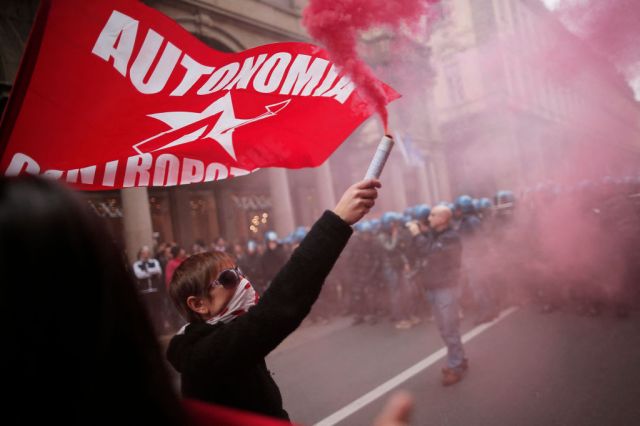
A May Day marcher in Turin. (Marco Bertorello/AFP/Getty)





In recent months, the Turin suburb of Vanchiglia has begun to look like Belfast at the height of the Troubles. Pairs of Carabinieri riot vans are top-and-tailed on a dozen corners. There’s not a bar without a few cops either inside or out. And, to an extent, this is nothing new. Over the centuries, Turin has always appealed to radicals — and, in turn, witnessed repression. With the snowy Alps so close, the city attracted outlaws, and Jewish and Protestant refugees, who had a fighting chance to flee to France or Switzerland if the Dukes of Savoy began a hunt for scapegoats. It’s also where Antonio Gramsci studied and then taught; where the Italian resistance fought the Nazis; and where, in the Seventies, unions and far-Left radicals, in groups with names like Lotta Continua and Avanguardia Operaia and Autonomia Operaia, took on the industrial might of Fiat and the Agnellis.
In the past year, Turin’s latest face-off — between the state on the one hand, and an alliance of anarchic, neighbourhood “citizen committees” and pro-Palestinian protestors on the other — has been intensifying. Last November, one of Turin’s imams, Mohammed Shahin, was arrested and sent to Sicily, awaiting expulsion to his Egyptian homeland, though his deportation was later stopped. Turin has been twinned with Gaza since 1998, and the Torino per Gaza (“Turin for Gaza”) organisation regularly brings hundreds of thousands of protestors onto the streets.
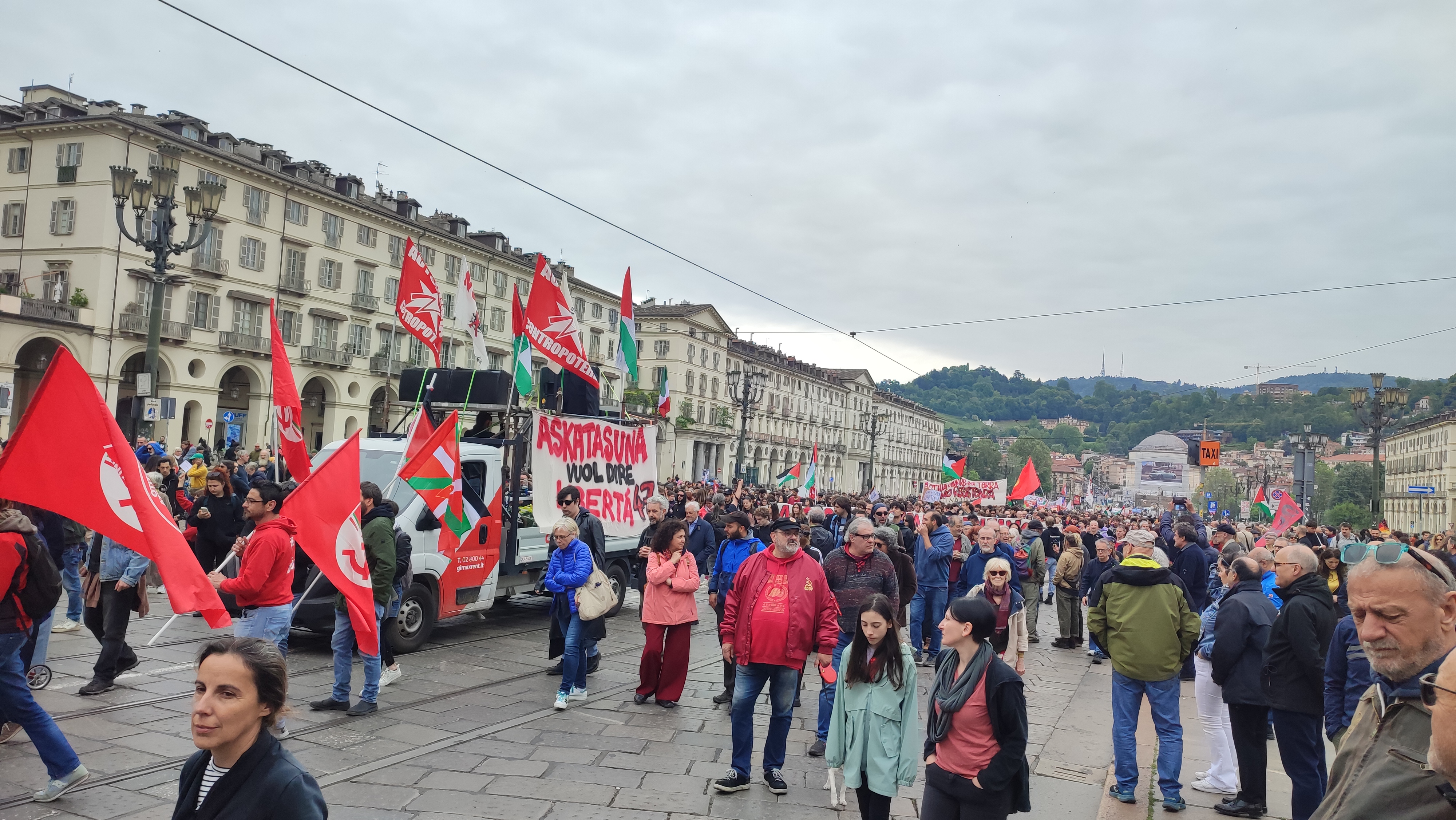
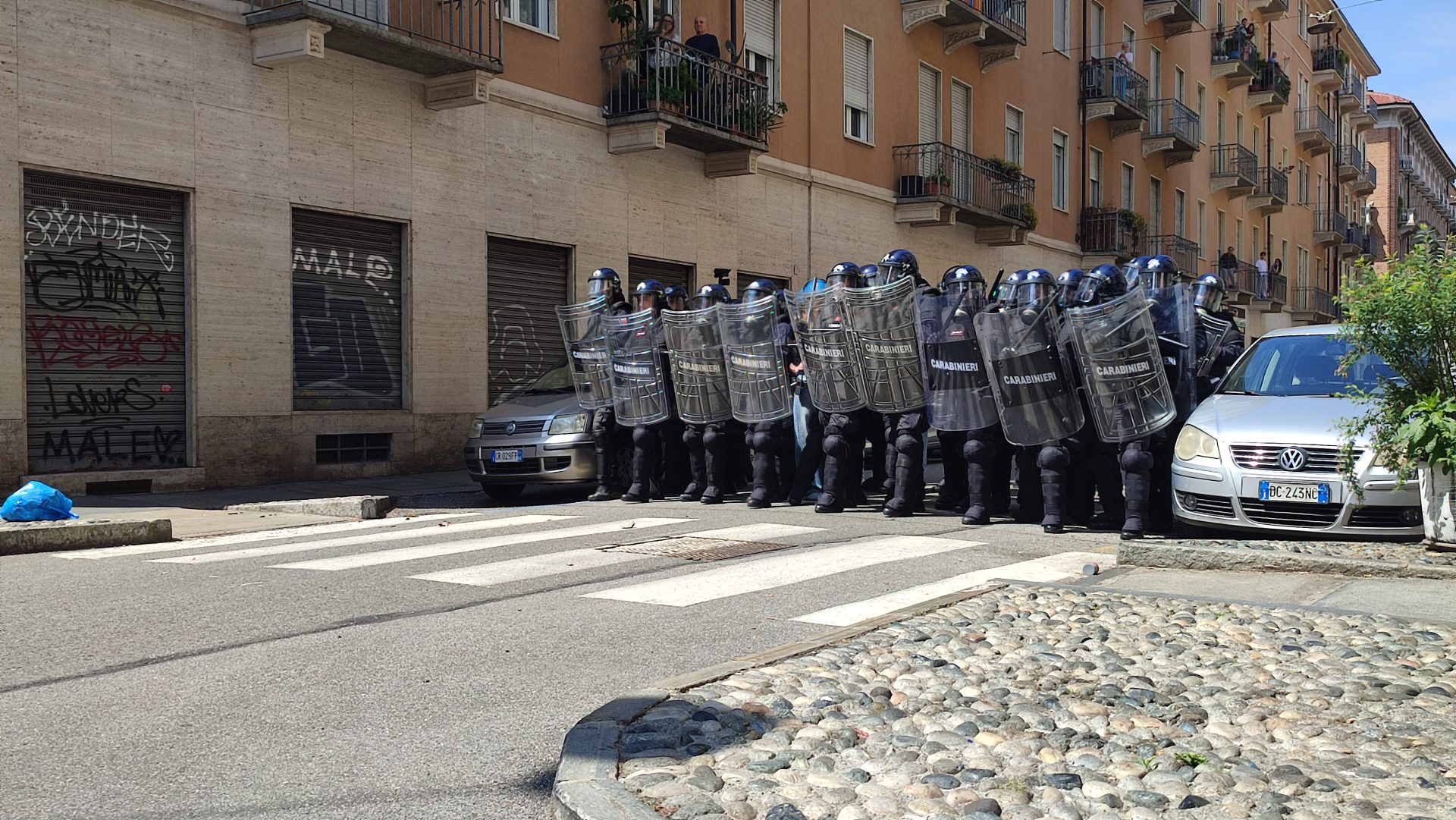
Then, on 18 December 2025, following orders issued by the Ministry of the Interior and coordinated by the chief of police, troops stormed the “Askatasuna” social centre at the heart of Vanchiglia and expelled all its occupants. It brought to an end almost 30 years during which the squat — the name means “freedom” in Basque — had become a meeting-point for environmental activists. There have been confrontations ever since. When I visited for the 1 May parade, Askatasuna supporters and the riot cops scuffled. It was shields and batons against flag-poles and beer bottles, and I took my compulsory shower from a police-van power hose.
Two distinct forces are lining up against each other: the authorities receiving orders from the Interior Minister Matteo Piantedosi, and groups of “autonomi” and “attivisti” trying to plant as many Palestinian flags as possible. The clash is asymmetrical because Prime Minister Giorgia Meloni is proving more durable than anyone expected. Elected in October 2022, she’s only a few weeks shy of breaking the record for the longest-serving government in Italy’s postwar history. Despite losing a recent referendum on judicial reform, and falling out of favour with Donald Trump, Meloni and her Brothers of Italy party seem firmly in control.
Yet if the clash is uneven, the outcome isn’t inevitable. “Governments are made in Rome,” Turin used to boast, “but fall in Mirafiori.” That’s a nod to Fiat’s mega-factory, south of Turin’s baroque heart, which used to employ over 60,000 workers. The city’s working-class heritage has vanished in recent decades, and the traditional Left is, anyway, scorned by the squatters from “Aska”. These activists don’t aspire to change a government: because they don’t believe in traditional democracy or even the political spectrum as such. Instead, they are attempting a ground-level associationism that echoes some of their city’s most radical traditions.
***
Turin is disorientating. Its overlay of four bending rivers on perpendicular boulevards makes it feel like a snakes-and-ladders board. With the Superga Basilica on the far side of the River Po, and royal palaces all around — the city’s dukes became Italy’s kings — it’s a grandiose but slippery place. Politically, though, Turin’s Left-wing credentials have always been clear, not least given the legacy of wartime resistance. Over 1,000 local partisans are buried in the “Field of Glory” in the city’s monumental cemetery.
Today, though, anti-fascism lacks definition beyond the obvious, and is anyway politically unhelpful: you can’t build the future on a negation. Besides, the mushrooming of citizen assemblies throughout Turin, not least in Vanchiglia, suggests the city’s radicals are now less inspired by Gramsci than David Graeber. The American anthropologist at the forefront of the Occupy protests, Graeber envisaged “a new, open-ended, pragmatic anarchism”, and spoke of occupied buildings as “an exercise in the politics of mutual aid, solidarity and caring. A simple, unauthorised act of love.”
In many ways, Italy pioneered autonomous spaces both in theory and practice. The first CSAs — “centri sociali autogestiti” or “self-run social centres” — were political squats organised by far-Left radicals in the Seventies. But as well as social centres, they also experimented with “back-to-the-landism”. As anti-mafia prosecutors began confiscating mob buildings and farms, many radicals won tenders to set up rehabs and farm shops.
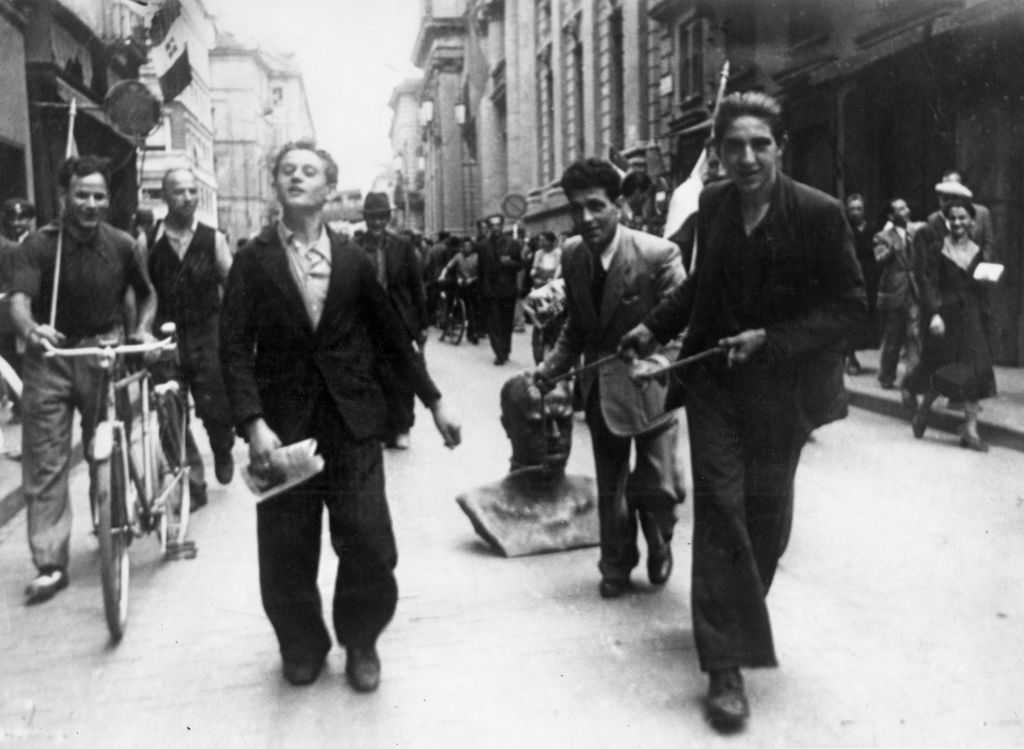
But if Italy has been at the forefront of anarchic congregationalism, it has also pioneered repression. In Genoa, in 2001, one man was killed and a school was raided by riot police looking for an illusory anarchist “black block”. Now, Meloni has increased the pace of the crackdown. In August 2025, in Milan, the Leoncavallo social centre was evicted on its 50th anniversary. In Genoa the previous summer, the Burrida, a similar centre named after a local seafood stew, was raided and evicted too.
Meloni may well be feeling pressure here from Roberto Vannacci, a former army general and looming threat on her own Right flank. Yet whatever the cause of her sweeps, it’s clear that the Askatasuna case is different, not least in how it’s long been at the frontline of protest far beyond Vanchiglia. Central to this activism is opposition to the so-called “TAV”. The Italian acronym for “high-speed train”, the project eventually promises a new rail link between Turin and Lyon. But with the Alps in the way, the pristine mountain valleys around Turin have been roiled by unrest, with pitched battles between “No-TAV” activists and riot police resulting in thousands of arrests.
Perhaps because of its environmental tinge, the No-TAV movement has also gained supporters beyond the radical Left. One insider, Martina, describes it as “truly popular”, bringing together “mayors, Catholics and ordinary people”. In recent years, meanwhile, the war in Gaza has also fuelled local outrage. The criminalisation of protest — with certain words banned altogether — means that many Torinesi are furious. “What have we got to do?” asks an activist named Karim. “Wait until they’re all dead before we say it’s a genocide?”
Turin’s distinctive architecture provides gathering places for these varied if overlapping groups. Because of mass immigration from the South during Turin’s postwar boom, this most industrial of cities has dozens of so-called case di quartiere (“suburb halls”), as well as a gaggle of circoli operai (“workers’ clubs”) and case del popolo (“people’s houses”).
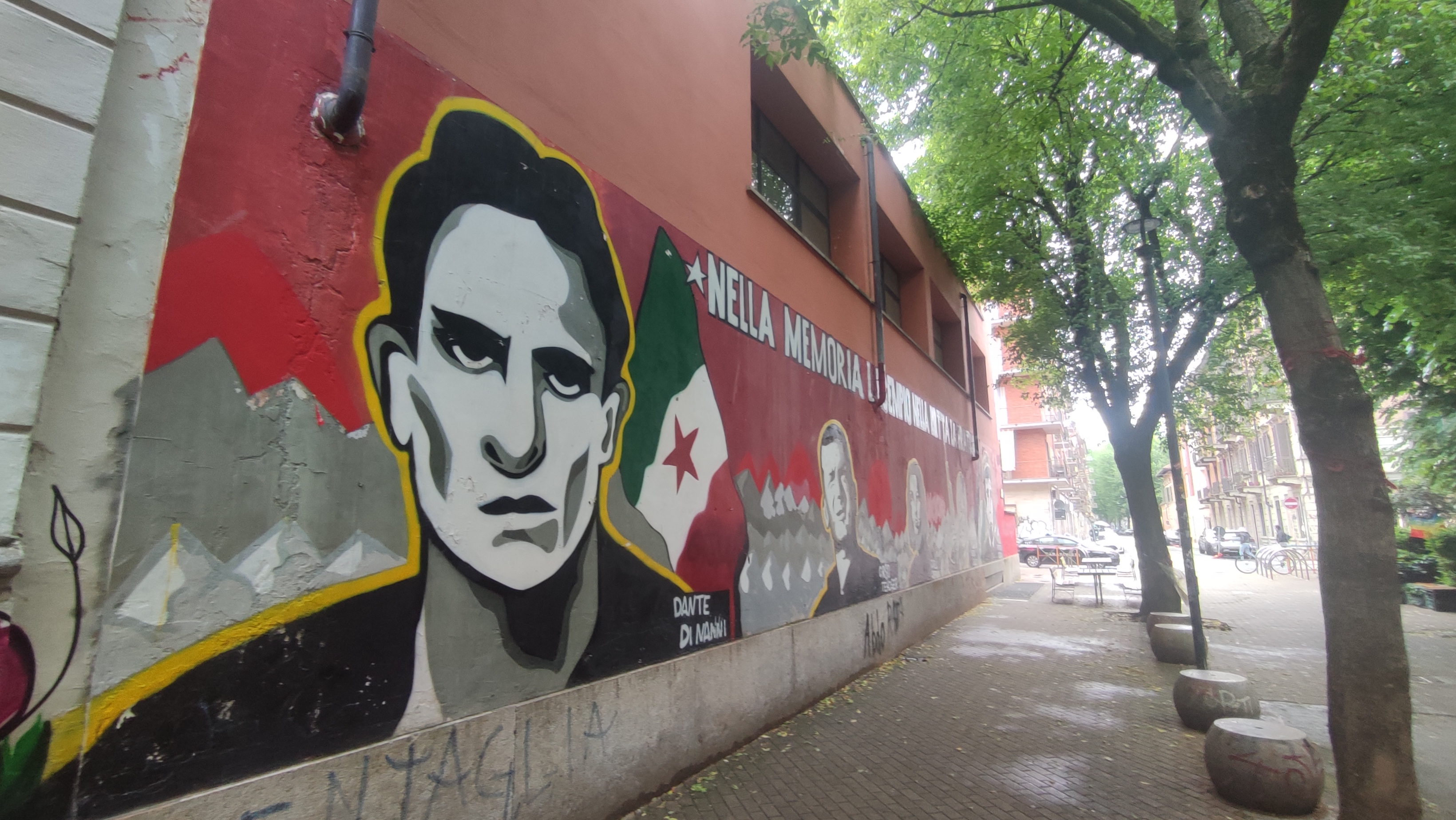
Askatasuna’s former building is only a two-minute walk from the banks of the Po. A vast, cherry-coloured palazzo, squarely facing the buzzing traffic on the Corso Regina Margherita, it’s surrounded by schools. Given the intense police presence, that forces parents and children alike to cross through checkpoints every day. Yet the area behind the building is pedestrianised, and it’s here, flanked by walls decorated with portraits of anti-fascist martyrs, that Askatasuna still does its outreach.
Riccardo arrived in 2006, 10 years after Askatasuna was first occupied. “This is where I found hospitality,” he says. He’s at the end of an open-air “laboratorio” about reimagining education. Thirty people — from children to pensioners — have sat in a circle all day. The Carabinieri, Italy’s militarised national police force, rev their engines at both ends of the pedestrianised zone, making it hard to hear.
At the end of the workshop, Riccardo describes Aska as a kind of “bring-us-your-needs” listening point, what he and his comrades call a sportello (“help desk”). People drop by with a problem, and the group helps to find a solution. A woman who can’t afford to fix a leak is put in touch with a pro-bono plumber. A victim of eviction is found emergency housing.
Gianluca Vitale, a lawyer who represents Mohamed Shainin and a number of No-TAV activists, says that marginalised suburbs like these — often with large immigrant populations — are being squeezed for reasons of “urban decorum”. Turin is gentrifying fast, largely thanks to tech start-ups and tourism, and pockets of “marginality”, paying low rent on precarious contracts, are easy targets for Fratelli d’Italia politicians urging “redevelopment”.
Throughout all this, the activists are passionately and ideologically opposed to involving the state in their affairs. “There’s a huge problem of drug-dealing and delinquency in our suburb,” admits one. “But we don’t call the police because I know my neighbour.”
***
At its postwar peak, Mirafiori covered three million square metres of Turin’s south side, or the equivalent of 420 football pitches. Inside, some 60,000 workers glued, soldered and riveted along almost 25 miles of assembly lines. What they made were cars: millions of them. Fiat was Italy’s most important factory, and the firm’s Agnelli owners were as rich as royalty. They also owned Juventus, the footballing jewel of Turin and Italy’s most famous team.
Born in 1943, in a small town west of Milan, Pietro Perotti left school at 11. He soon went to work in a baker’s, waking at 2am and working until midday. In 1969, not much taller than he was at 11, he moved to Mirafiori, working as a repair-man on the shop floor. One day, Perotti was moving between units when he saw Southern workers start an innovative form of protest. Some, he recalls, “picked up an empty oil can and started banging on it like a drum”. Others joined in, as word spread of an injury or complaint. These former sharecroppers, newly arrived from Sicily or Calabria and bewildered by Taylorist production lines, even used their tools to start “making trumpets and whistles and musical instruments”.
In all this, Perotti saw a recreation of the “saint’s festivals” in the South, “where the sacred and the profane coexist”. It was the turning point of his life, for he realised that the order of things had to be inverted through in-situ merriment. Perotti began drawing political graffiti in the bogs. His art — Marx hung on the factory frontispiece, Agnelli with his trousers down — was made on the shop floor.
But throughout the Seventies, the atmosphere darkened. During the Anni di Piombo — the “Years of Lead” of extremist terrorism of both Left and Right, with the Italian secret services squatting murkily in between — many idealistic workers were drawn towards bombings and executions. Perotti, for his part, joined both Lotta Continua and Avanguardia Operaia, two groups later accused of funnelling activists towards violent struggle.
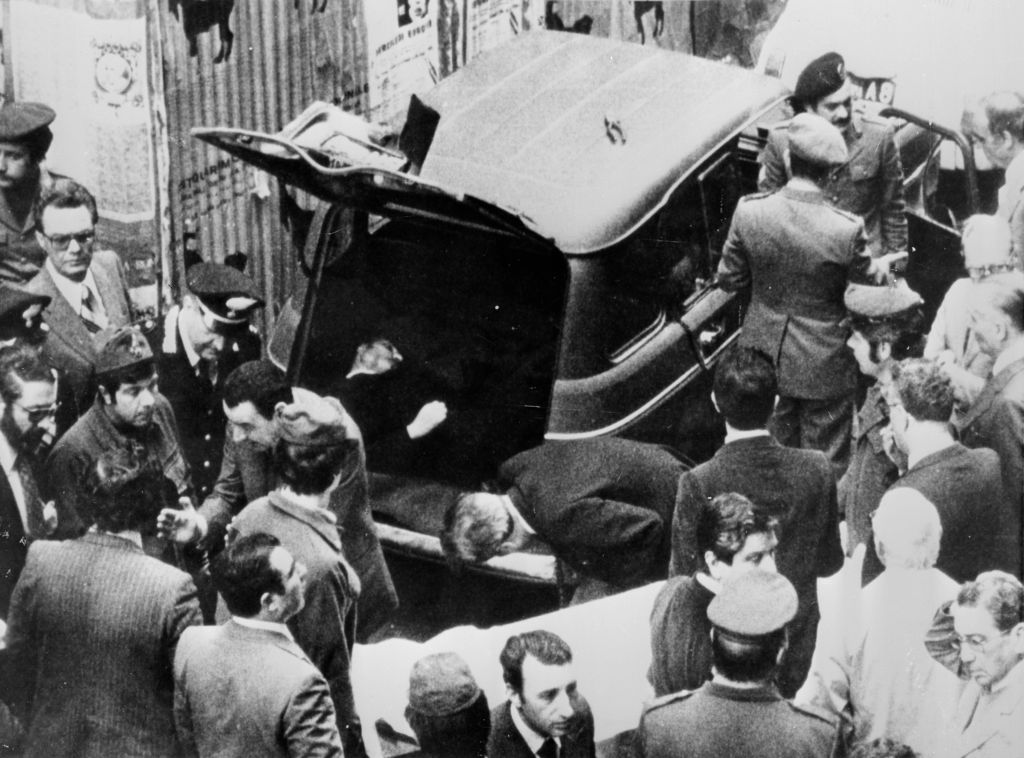
“Here, in Mirafiori, there were seven of us in a workers’ cell,” Perotti recalls. He was ordered to go into hiding but refused. Five of his band of seven ended up in the Red Brigades, the most infamous far-Left group of all, which in 1978 would kidnap and murder Aldo Moro, Italy’s former prime minister. As for Perotti, he stayed at Fiat until 1985, organising invisible protests like the “bodywork jump” — when for every 10 cars that passed through the production line, one would be ignored.
Perhaps because he saw the bloody Seventies, Perotti is frustrated by the confrontational nature of the Askatasuna protests. He instead argues that agitation needs irony, and that on the 1 May event, the protestors “should have taken the mick”, finding new slogans of disdain and giving “biscuits to the children to offer the riot police”.
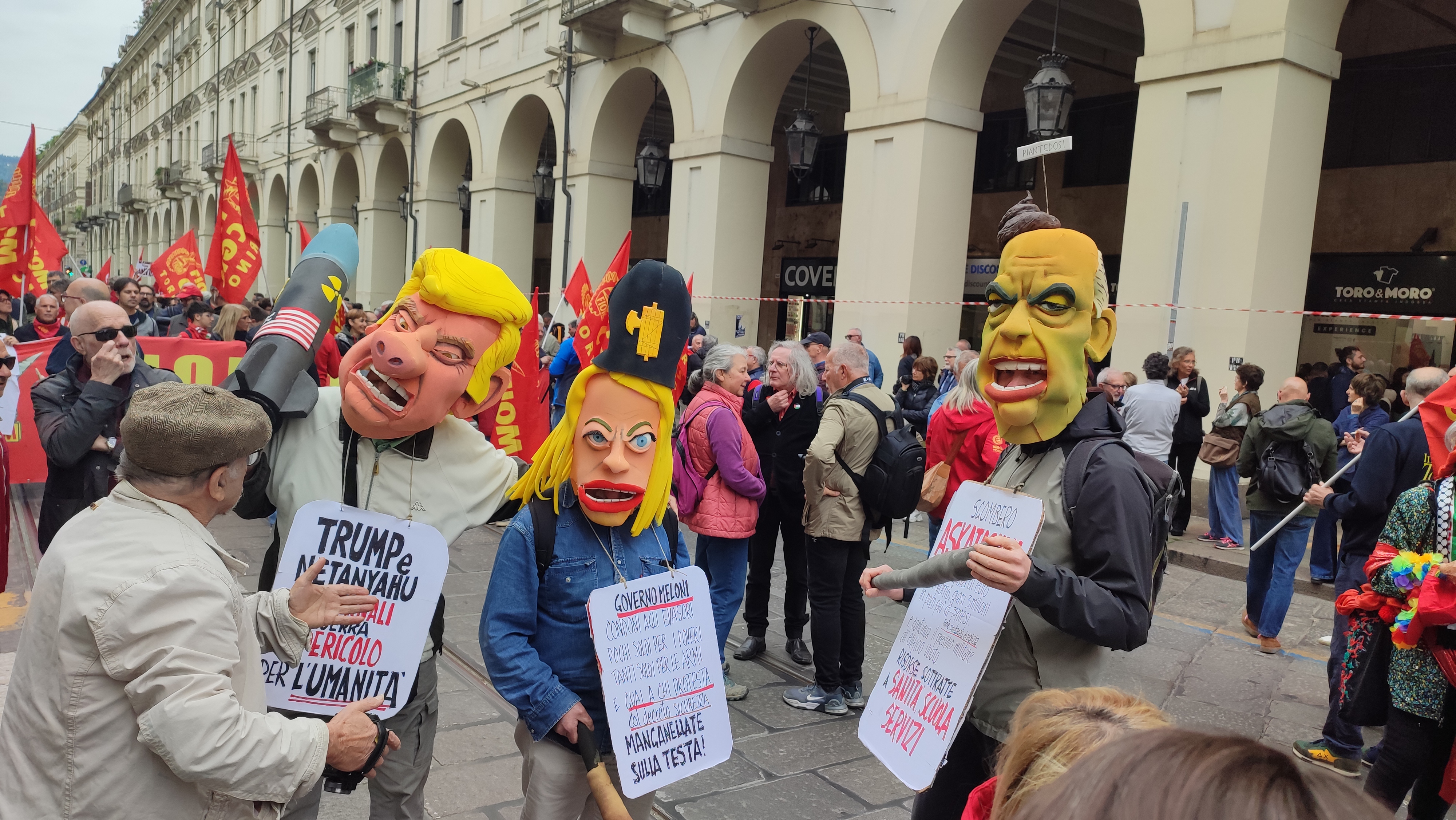
Certainly, Perotti is a wily manipulator of the contemporary political narrative. His foam puppets Trump and Meloni have often been published by newspapers, alongside the usual images of batons and tear gas. But he’s not the only one trying to channel rage in positive directions. Ortensia, part of the Comitato di Vanchiglia, another grassroots “committee”, is a psychologist who says that she and her colleagues try to find words “that land with everyone, that are gentle, and not use words like ‘battle’.”
But the mood is darkening. Ortensia describes “a polarisation” in which neither police nor protesters can back down. A friend of hers, an Englishwoman, tells me that, a year ago, the Comitato was only talking about flower-beds with the elderly; now they’re in a militarised zone having their papers checked.
At sunset, I stop in a casa di quartiere in San Salvario, a district of long streets and dense postwar apartment blocks. The casa itself used to be the old public baths, and is now another edgy village hall, all street art, table tennis, noisy teenagers, and grandmothers with pushchairs. There I meet Nicoletta, Rosa and Giulia, part of an informal organisation called Mamme in Piazza (“Mums in the Square”). These mothers — about a dozen in all — came together after seeing their children criminalised during the No-TAV protests. Their intent wasn’t to excuse crime, but to understand their kids and the anger animating them. “We don’t always share the practices of the struggle,” says Rosa, “but we defend the struggle against repression.”
These mothers talk a lot about anger: anger with their children, with their spouses, with themselves, with the state and its repression. But as usually happens when mothers take to the streets, they’re listened to because they have a language that, as Nicoletta puts it, “isn’t studied: it’s emotional, instinctive, naïve if you like about certain things”. The women have megaphoned outside the city’s prison, and have gone on countless marches with their banners. They perform regular balcony concerts. “We abstain from judgement,” says Rosa, “but we do see a loop. Exaggerated and frightening repression radicalises you. It fucks you off.”
***
The fact that even these peaceful mothers are swearing shows the degree of anger in the city. There’s a deep grievance about economic malaise and judicial persecution, and Turin’s radicals have receded from any faith that mainstream politics can offer solutions. The last time that happened, 50 years ago, many frustrated revolutionaries turned into armed killers. No one expects the chaos of the Seventies to return — but the issue of violence is where the debate almost always ends up.
For its part, the Right accuses protestors of a variety of crimes, pointing to the storming of La Stampa‘s newspaper offices, and a January attack on a policeman, as evidence that their movement is invariably brutal. But if you put that to Askatasuna members, the reply inverts the accusation. “For us,” says Riccardo, “‘conflict’ is a key term. But today, there is a system that inflicts daily violence on all the citizens living in our communities.”
Meloni’s much-trumpeted “Pacchetto Sicurezza” is meant to sort it all out. This new security legislation, passed in February 2026, allows for the creation of “red zones” with militarised presences, and legitimises pre-emptive arrest. Turin is key to this crusade. The first capital of a united Italy, and home to kings and Fiat, it can’t be seen to fail on something as simple as “public order”.
For Vitale, the lawyer, this is dangerous territory. “We’re talking,” he says, “about particularly sensitive topics and about the manifestation of a thought.” He maintains that “an opinion might not be endorsed [by you] but it’s an opinion. An opinion can’t be punished, it doesn’t represent a crime.” “It seems,” adds Vitale, “that in Turin we’re seeing a clash between rival visions of the state: either government legislation is submitted to what is legal according to the Constitution, or else the judiciary has to obey a legislative act.”
That clash between judiciary and executive is ancient, but for those in Vanchiglia itself, the situation feels bizarre. When you talk to mothers outside schools, dropping off their kids, they say they’re insulted by police. “You have the right to shut up,” one officer apparently told Ortensia.
On a street corner I bump into Alice Ravinale, a representative of the Left-Green Alliance in the regional parliament. “This is all just show”, she says, pointing at two riot vans with blue lights flashing. “Every day we ask ourselves what they’re scared of.” The answer, perhaps, is that they’re scared of people who refuse to acknowledge the need for them. That, as Perotti knows, is the best form of attack: not to take authority figures too seriously.
***
Additional reporting by Cecilia Rigattieri.