




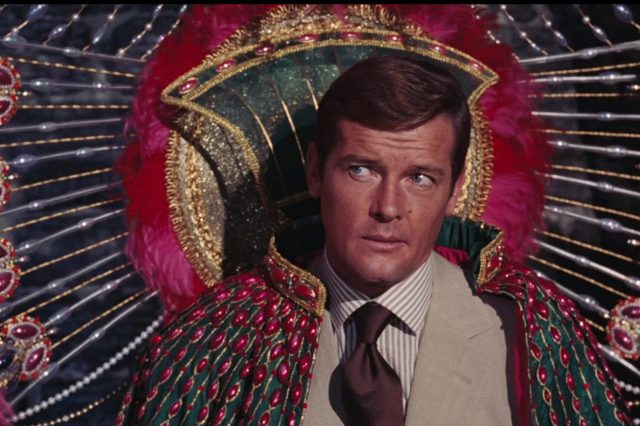
‘The cards say we will be lovers.’ (Live and Let Die, 1973/Eon Productions/YouTube.)





I spent a major slab of my summer slowly and luxuriantly reading a huge, dense, and astounding book. Meditations on the Tarot: A Journey into Christian Hermeticism was first published in French in 1980 — anonymously in accordance with the wishes of its author — and five years later in an English translation by Robert Powell. We now know that the author was Valentin Tomberg (1900-1970), an Estonian mystic and scholar whose lifelong quest for knowledge of the divine led him first into the Anthroposophical Society founded by Rudolf Steiner, and ultimately into the Catholic Church. Written late in life, Meditations is the summation of 50 years of study and practice at the outer reaches of belief — though really it reads like the fruits of more than one lifetime.
The first thing to be said to those wary of a book with “Tarot” in its title is that this is not a book about using tarot cards to foresee the future. Instead, it contemplates the richly enigmatic symbolism of the 22 Major Arcana — the trump cards — to reveal their compacted insights into spirit and psyche, death and eternity, faith and salvation.
The true subject of Meditations is even stranger than the Tarot: esoteric theology. Christian Hermeticism is a tradition that has quietly flourished down the centuries under the protective shelter of mainstream Christian thought. Insofar as a faith’s mystical dimension is its avant garde — a site of verification at the limits of inner experience — the Christian Hermetic tradition that Meditations at once summarises and adds to is an extensive body of occult science and speculative mysticism of often bewildering, astrophysical complexity. It originates with Hermes Trismegistus, the legendary author of antiquity whose esoteric texts were of great influence on subsequent Western esotericism. Christian Hermeticism fuses Hermes’ teachings with Christian theology.
As per the book’s subtitle, this really is a journey. The lands we traverse are otherworldly and replete with hyperdetermined symbols. Every reading nestles within it deeper readings still, a profuse flora of wildly sprawling interpretation. Comprising mysticism, gnosis (the intellectual comprehension of mystical experience), and “sacred magic”, Christian Hermeticism suggests a colossal supercomputer of occult intelligence humming in the walls of a faith-citadel more readily associated with universal love.
Unlike other books on esoteric topics, Meditations on the Tarot is well-regarded within the Catholic Church. A stamp-of-approval afterword is provided by the late Cardinal Hans Urs von Balthasar, who was nominated by Pope John Paul II and is regarded as among the leading theologians of the 20th century. To von Balthasar, the work’s author is “a thinking, praying Christian of unmistakable purity” who has achieved an intellectual synthesis unprecedented in the faith’s history.
I first heard about Meditations on the Tarot on the wonderful Weird Studies podcast, a cultural godsend whereon two amiable Canadian philosophers discuss ideas and art in a pally, digressive manner that counterbalances the seriousness of their agenda: to breach the boundaries of “official” philosophy in search of a more capacious, re-enchanted worldview. On one episode, the hosts venture a philosophical rationale as to why, against received scientific acceptability, Tarot cards, the I Ching, and other such divinatory tools can seem to actually work. What I took from it is that we might regard such systems as symbolic technologies at the interface between inner and outer worlds… which, to various modes of thinking outside of Western materialist (or physicalist) orthodoxy, are not as separate as we tend to believe.
Much has been made lately of a renewed interest in religion — itself surely symptomatic of a widespread ontological disaffection. Many people sense, often as a result of personal experiences unaccountable within the current philosophy, that the reigning scientific-materialist paradigm simply no longer holds. The reductive, ultra-rationalist outlook that emerged from the Enlightenment and reached its apogee with the 19th century’s mechanistic vision of the cosmos has grown as antiquated as monocles and top-hats. As the planet burns up in consequence of nihilistic science and myopic greed run amok, the world suffers too from spiritual asphyxiation. We begin to suspect that clues to a salvageable future may lie scattered in the past; that, for all the sublimity of its technological ascension, our psychotic civilisation may not have everything figured out after all. Traditions, techniques, and bodies of knowledge that once seemed unworthy of serious attention to modern minds exert a renewed pull. At the end point of a philosophical crisis, the horizons of the possible expand afresh.
Until recently, I had no interest in the Tarot. My partner, however, is a dabbler. For some time now she’s been drawing cards from her Rider-Waite deck — sometimes one, sometimes three — as a way to gain perspective on her dilemmas and life-challenges. I observed this with cautious curiosity until eventually I allowed her to draw a card for me. She did so on several occasions, always at moments of acute psychic tension on my part. Each time, the card drawn was clearly linked to interpretations that spoke in an uncannily precise way to my predicament. It was less like having my fortune told than having my psyche X-Rayed — less divining the future than peering into the deep structure of the now. While the most salient examples are too intimate to divulge here, suffice it to say I was startled. To the committed rationalist: all pure coincidence. To anyone with a touch more ideational flexibility — anyone not automatically loyal to strict, post-Enlightenment materialism — this demanded a sitting-up-straight. For the first time, I started really looking at the cards.
The Major Arcana of the Tarot include such archetypal figures as The Magician, The Emperor, and The High Priestess; elemental images such as The Moon, The Sun, The World, and The Judgement; and such famously ominous trumps as The Devil, The Hanged Man, The Tower of Destruction, and Death. Then there are the Minor Arcana — the more numerous cards divided into the four suits of Cups, Swords, Wands, and Coins.
For all the cards’ mystique, I might have gazed at those illustrations for a hundred years and extracted only a fraction of what the author of Meditations on the Tarot reads into them (he uses the older, Marseilles deck). Esotericism, after all, entails seeing beyond the surface to fathom the meanings at once veiled and revealed by the outward, the exoteric. To the Hermetic mind, in which consciousness is the ultimate stratum of reality, the world is not only the objects that comprise it: the world is a realm of symbols.
Each of the 22 chapters in Meditations is a letter addressed to an “Unknown Friend” — our correspondent is courteous, impassioned, and scrupulously religiously humble. To say the author covers a lot of ground is a laughable understatement. Even Cardinal von Balthasar’s broad theological mind flinches at the book’s conceptual maximalism: a “superabundance — almost too much”. There are finely parsed reflections on everything from Purgatory and the metaphysics of forgiveness, to hardcore occult practices like the generation of egregores (artificial demons), to the Akashic chronicles (an objectively real, quasi-digital recording of everything that’s ever occurred!). Valentin Tomberg appears possessed by a kind of inverse nihilism: there’s seemingly nothing he doesn’t believe in. Reincarnation or resurrection? Not only will he take both, he’ll restlessly subdivide each spiritual phenomenon into multiple strata, everything branching out and forking off and spiralling upwards, via the “cosmic Christ” and a whole Byzantine superstructure of dominions, Archangels and all the rest of it, to God. The author’s range of reference is suitably broad: he quotes extensively from Scripture; his Hermeticist forebears; Kabbalah and Buddhism; Christian-mystic Saints such as John of the Cross and Theresa of Ávila; and philosophers including Nietzsche, Bergson, Schopenhauer and Hegel. All the while he takes pains to display deference to Catholic orthodoxy. He insists that Hermeticism is but a special vocation within Christianity, and he has full sympathy for less rarefied forms of faith.
Such is Tomberg’s level of hermeneutic sophistication that his interpretations often have little to do with the more commonplace ones to be found online or in books about cartomancy. For instance, the awesomely creepy Devil card — on which the Black One looms over a naked man and woman chained at the neck — is commonly related to carnal temptation, materialism, addiction and obsession. (The Devil was in fact drawn for me during a bout of acute temptation towards compulsive, potentially destructive behaviours.) To Tomberg, on the other hand, the card symbolises the “intoxication of counter-inspiration”. Cue a rigorous, psychologically astute analysis of the dangers of identifying with evil — and of enslavement by demonic “tulpas” of our own creation.
The preternaturally authoritative voice expressing from the inside an abundance of intensely strange phenomena calls to mind the astonishing works of Henry Corbin — a celebrated French scholar of religion who discovered multiverses of spiritual wisdom in the works of Islamic mystical philosophers. Both authors can overwhelm with their arcane knowledge and remote, mountain-peak speculations.
But Meditations is far more than a treasury of metaphysical exoticism. Amidst its profusion, we’re never more than a page or two away from an incisive ray of wisdom that we’ll feel subtly recalibrate our inner being in the days and weeks that follow. Like all books on esoteric thought, Meditations on the Tarot is predicated on the belief that there are two worlds in one: the above and the below; the Visible and the Invisible. Wisdom, in this context, means the ever-deepening comprehension by which we may think, speak, and act so that the two move ever closer together and finally cohere — on earth as it is in heaven.
Rob Doyle is an Irish novelist, short-story writer and essayist. His most recent book is Cameo.
 RobDoyle1