





The Government is obliged to provide housing to millions; in response, developers carve up existing housing stock. (JG Fox)





Something strange is happening to the St James Estate. At first glance, it’s an ordinary-looking Bermondsey housing development — 182 unshowy, yellow and red-brick street houses.
Yet an unusual amount of building activity is underway here — years before the development reaches the end of its natural lifespan. Outside three of the largest homes squat three commercial-sized skips. They are filled with builders’ waste and discarded furniture. Insulation boards and other building materials are stacked up next to them. Workers move in and out of various rooms, the windows open against the stifling heat, the sounds of drilling and banging echoing around the estate. The homes are being gutted.
I stop and chat to a group of residents. Most have lived on the estate for decades, first renting privately from a local housing charity, then from Nationwide bank, and then from the commercial arm of the charitable housing association Notting Hill Genesis (NHG).
But in October 2025, NHG — under financial pressure — sold the £58 million estate to a company called BMR Group. BMR specialises in office-to-residential conversions: buying up offices and flipping them into homes. It then lets the rooms, mostly to people who have applied to the council as homeless and need a temporary roof over their head.
Residents at St James’ say that their new managing agent has told them that the company borrowed a large sum to fund the purchase. BMR is a small firm, with only two employees and £1.7 million in assets, according to its most recent accounts. It is eyeing significant changes to the estate.
Fifty residents were served with “no fault” evictions before the law was changed to ban them in April. Dozens more were notified of hefty rent hikes: one was told their monthly bills would increase from £1,185 to £1,900, and others were quoted similar amounts.
The existing residents feel certain that the new landlord wants them out and plans to convert their homes once empty into “‘houses in multiple occupancy”’ (HMOs). This way, the landlord could take placements from the local council, the Home Office and various other government bodies, making substantially more than they would renting to families. The residents say some homes have already been converted in this way, and that the skips and building work in the vacant ones represent further conversions.
Neither BMR or its managing agent, Freshview, responded to a request for comment by UnHerd. But Freshview has since told the BBC that it is “no proposal to convert the estate as a whole into HMOs”, and that it reviewed rent levels after finding those previously charged were “substantially below” market rates.
“I just don’t like to think about what will happen — if I do I get too upset,” says Mary, a 55-year-old mother of two. “I am sticking up for my neighbours, but I am afraid. I don’t know where I will live.”
This estate is an extreme example of something that is happening throughout lower income urban areas across the UK. At its most basic, an “HMO”, or “house in multiple occupation”, is any property rented to two or more separate households who share facilities like bathrooms and kitchens. But in 2026, it can also represent what one councillor covering the St James Estate describes as a “state-backed cash machine”.
This is because several government agencies — primarily local authorities and the Home Office — owe statutory housing duties to various people in need, which they need to discharge quickly and cheaply. To do so, they rely on a network of private sector middlemen who strike “guaranteed rent” deals with local landlords, who then take on the governments’ tenants.
As traditional private renting becomes more tightly regulated and less profitable, more and more landlords are moving to this model. But as they do, decent housing is cannibalised to make way, and family neighbourhoods slowly transform into more transient, more atomised places.
“You’ve got to think about what it does to the community,” says Danny Turner, who works for the housing charity Keep It Moving, which works with young people who live in HMOs in south London. “I don’t want to vilify the people who have complex support needs, but they have no space inside and often just end up sat out in the street. It contributes to a decline in the community, to people not feeling safe in the area.”
All told, there were an estimated 360,000 such properties in England and Wales in 2025 — although this only includes those large enough to be registered with a local council.
And what is most staggering is the rate of growth. In the absence of official statistics, UnHerd sent Freedom of Information requests to 50 of the largest urban areas in the UK. Among the 32 which responded, there were a combined 21,888 registered HMOs in 2020-1. By 2025-6, there were 32,099 — a 50% rise in just five years.
In some inner London areas the rise was sharper still. Haringey, for instance, had just 396 registered HMOs five years ago. Half a decade on, that figure had jumped to 1,871.
How, then, to explain the HMO boom? In terms of demand, the years since Covid-19 and the cost-of-living crisis have seen more people seeking out the cheapest possible accommodation they can find. In most instances, this will be a room in a HMO. The same pressures have sharply increased rates of homelessness — especially in London. When a homeless household is in priority need (due to poor health, fleeing domestic violence or having children), its local council is obliged to find them temporary housing. Again, this is often in a HMO. The Home Office also secures thousands of properties around the country to use as dispersal accommodation for asylum seekers awaiting decisions; meanwhile prison leavers, recovering addicts, people with complex mental health needs and even looked-after children can all find themselves in state-funded HMO housing.
And then there is supply. The new legislation protecting tenants from, say, no-fault evictions will mostly not apply when a resident is housed under one of these government schemes. Certain taxes can be skirted too. And in some instances, especially where public bodies are desperate or residents have additional needs, huge sums of money can be charged. This makes it good business for landlords.
The sums of public money on offer here are not small. Councils in England spent £2.8 billion on temporary housing for the homeless in 2024-5. The Home Office spent £2.7 billion on asylum seeker accommodation in the same year. Up to £130 million in housing benefit goes to landlords providing so-called “exempt accommodation” for people in particular need. Convert a street property into a HMO and you can get your hands on a big chunk of cash.
“There seems to be two things going on,” explains Susie Dye, who leads policy work on housing at the charity Trust for London. “One is about landlord business models. Some landlords are concluding that being a private landlord is too risky and they want to avoid the regulations. And the other is straight up tooth-and-claw capitalism — they are hearing about the money being spent on temporary accommodation and they are trying to increase their return.”
For private landlords, the most common model is some form of “guaranteed-rent” arrangement, with an estate agency acting as middleman and broker between the landlord and the state. The landlord will take a home off the regular private rented market, before leasing it to an estate agency. UnHerd phoned one such agency — Theori Housing Management Services — and posed as the owner of a newly-inherited three-bedroom home in east London. We were offered a guaranteed £2,000 a month for three years. This is less than might be made on the open private market in this particular area, but the guaranteed cash and removal of responsibility make it an attractive proposition nonetheless.
The private landlord receives this “guaranteed rent” from the agency, and effectively sees their involvement end. It is the agency that then finds a resident, charges the state-body rent above that which it is paying the landlord, and makes a tidy profit on the margin.
Steadily, these agencies — often backstreet affairs with a small number of directors, limited public accounts, and no real regulation — have become the major beneficiaries of state spending on housing.
One analysis of transparency data showed that the estate agent Stef and Philips, headquartered in an office near the northern end of the Piccadilly Line, was paid £3.49 million by London boroughs in a single month last year. In London, where there are an extraordinary number of homeless households seeking temporary accommodation, councils spend £5 million a day on this accommodation: equivalent to £200 a year out of the council tax bill of every single Londoner.
There is an argument that these landlords and agents are simply reacting to societal demands. “They are meeting a legitimate demand in what is a really problematic housing market,” says Dan Hawthorn, co-chair of the London Housing Directors’ Group. But London boroughs also struggle to find housing that is both affordable and good quality. As Hawthorn adds: “Never has so much public money been spent on such terrible outcomes”.
That’s clear enough across London. England’s Lane, in Camden, is a former interwar nurses accommodation with 162 rooms. Now it’s used by Southwark Council to house vulnerable families — including mothers with children, some of them very young.
A report by a tenant’s union that represents residents at the block raised issues with very high electricity costs. Tenants have to top up a cash meter every day, with most saying they had to pay between £40 and £60 a week to keep the lights on, including a daily charge. More than 60% said they go without power because it costs too much and skipped meals to pay for it. Many of them reported rooms getting too hot, with indoor temperatures reaching 40 degrees. “My child gets a recurring nosebleed due to excessive heat,” said one. Almost half told the survey there were problems with mould and pests. They said staff bullied them and were “rude beyond words” when they raised concerns. Property Playbook* — which manages the block — has taken £7.5m in rental payments from Southwark for it since 2020, according to a Freedom of Information request made by UnHerd.
I also visit Kap House**, a converted office property on a back street in the North London suburb of Harrow. There are 73 flats in the block, with each tenant paying around £600 a month in rent. That means the property pays out more than £40,000 a month to the landlord. Several of the doors I knock on have residents placed there by local authorities, meaning much of this money comes from the public purse. Others are renting privately — it is the best they can afford.
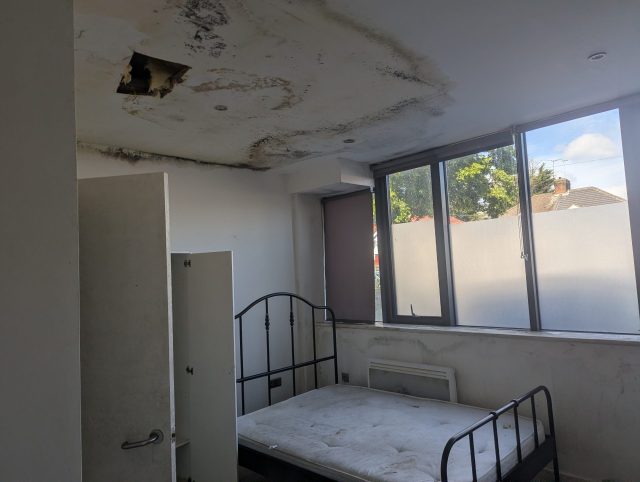
When UnHerd visited in June, in the hallway, a stack of residents’ letter lockers were battered, their doors hanging loose as if someone had raided them. A sign warned there was now CCTV coverage in the building due to “serious criminal activity”. I entered flats which had stains on the walls and stank of raw sewage. “I have had [serious health issues],” one resident explained. “I had to leave my old home because the landlord put the rent up. But I shouldn’t have to live like this, it’s inhuman.” One vacant flat — which a resident had recently been moved out of due to the conditions — had walls covered in mould and holes in the ceiling.
Not that these problems discourage agencies from being hard-elbowed about extracting even more money from local authorities. When, for instance, a council is desperate to find a home for a tenant in need at short notice, an agency will sometimes ask for “incentive” payments to secure a room fast. These can run to thousands of pounds. UnHerd has seen an email from letting agent K7 Residential asking Croydon Council to pay “an incentive requirement of £2,500” before allowing a resident have a viewing. A source familiar with the model says that desperate local authorities have at times been billed as much as £7,000 to secure a room.
All the while, agents have increasingly moved from agreeing long-term lease arrangements to demanding “nightly rates”, which are unsurprisingly much higher. In some cases, this has involved a peculiar legal fiction, where they effectively evict themselves from the property and re-let it.
Luke Sheldon, a solicitor who works with the community group Housing Action Southwark and Lambeth, says he attended a court hearing in April 2024 where ZFA — an agency which works across many London boroughs and receives millions in rental payments — was having possession proceedings brought against them and “persons unknown” by another company with which it shares directors.
“From seeing a number of similar cases,” Sheldon explains, “I believe the intention was often to end the current leases they’d agreed with the councils so they could be re-let at a higher nightly rate.” Though Sheldon and his colleagues normally can’t see how much an agency wants to increase the rent by, he says that in one case it surged by 40%. “I’ve got a client [in temporary accommodation] who’s been on a nightly rate for 10 years now, despite having been in the same property for that whole time.”
Bigger money has taken note. Large investment funds operate a “leaseback” model with local authorities. They purchase housing for use as temporary accommodation and then sign a long-term, inflation-linked lease deal with a council, which is able to use the bedspace for households in need.
“The investors that are coming into this space do seem to be getting bigger in terms of their backing,” says Samantha Grix, a partner at Devonshires Solicitors, which works on deals of this kind. “Enquiries are regularly coming from people looking to get into this area. Some are institutionally backed whereas others are existing property investors or family offices who have seen the opportunity. They see this as a potential investment portfolio where they can buy properties and use them for a good cause.”
Grix adds that securing longer-term deals could help councils move away from reliance on nightly paid accommodation to more strategic agreements. All the same, this may not make commercial sense; councils with huge waiting lists could easily be tempted into long-term deals that burden taxpayers for years to come.
In the meantime, so desperate are local authorities for accommodation that they will seemingly broker deals with anyone who can offer a room. Freedom of Information requests sent to a range of local authorities in 2024 showed a range of private individuals with no registered businesses receiving tens of thousands of pounds from various London boroughs. Several pubs received regular payments; Eastleigh Council had even spent money on “Bell Tent Glamping”, which provides yurts on a campsite outside Southampton.
As well as local authorities, there is the Home Office, which rents large numbers of rooms in HMOs as it seeks to move people awaiting asylum decisions out of hotels. The Home Office primarily uses three large contractors, Serco, Mears and Clearsprings Ready Homes, to source the rooms. These large contractors then work in the same way as the councils do when they are housing homeless families. They find an agency offering a bedspace, which is likely to have secured it from a private landlord with a guaranteed rent deal. This means three layers of business make a profit from the state: the landlord who owns the property, the middleman who signed them up to the guaranteed rent deal, and the large contractor who arranged it for the Home Office.
The homes can be miserable. A report by Refugee Action found whole families living in single rooms with no lockable front door for years. The report also referred to pest infestations, mould, flooding, overcrowding, infectious disease outbreaks, children going without education and families going without food.
Andy Burnham’s recent statement that all parts of the UK must “do their part” in housing asylum seekers signals that Home Office will find placements across a wider swathe of the country. Currently, most Home Office HMOs are located in the North West and North East, with 11% of local authority areas not having taken any placements at all.
HMOs are hard to escape. Residents who succeed in their application are given 42 days to leave Home Office accommodation and find somewhere else to live. Once they leave, often this means moving directly into another HMO. Croydon recently signed a £1 million contract with a firm called Reloc8 — which styles itself as a “London Relocation Expert”. The firm, this time based in a small industrial estate in a village in Derbyshire, finds rooms in towns around the country, which local authorities can offer to individuals and families in need of housing, including homeless households and those leaving asylum accommodation. Again, this sort of deal provides the demand which drives landlords in the receiving towns to set up HMO housing.

There are various other drivers of demand for HMO housing. People with complex support needs can claim higher rates of housing benefit to cover enhanced housing costs, but this so-called “exempt accommodation” has been seized on by some unscrupulous landlords who are simply warehousing recovering addicts and people with serious mental health problems in HMOs and cashing the cheque. Worse still are unregistered children’s homes, subject of a recent investigation by the BBC. These properties can become enormous money-spinners for those running them. After all, agencies can bill the council for the cost of staff to care for the children.
Danny Turner, from the charity Keep It Moving, supports young people in this position, some of whom have been freshly discharged from custody or prison hospitals. “They [the landlords] basically say, ‘Oh, we need more staff to take on this young person,’” Turner explains. “In extreme cases, this can end up with eight staff for one child.” These staff may have limited qualifications, and do little real work, but the council will pay for the lot. “These guys are printing money,” says Turner.
There are many other uses for HMOs — often the only option for those who cannot afford to rent elsewhere. HMOs originally grew throughout the 2000s in university towns where whole enclaves were taken over by students. Students still make up a big proportion of the HMO population in these towns. Moves towards purpose-built student accommodation have stalled recently thanks to higher building costs, and the market is reverting back to investment in HMOs. In November last year, Brookfield Asset Management, one of the largest owners of real estate in the world, spent £100m on a portfolio of 1,300 HMO rooms aimed at students.
All of this causes real problems. On the one hand, HMOs are simply a way of making housing cheaper — you rent a room in a house rather than a house. But they also come with problems. Individuals are more atomised. They tend to move rapidly. Bonds between neighbours fray. The homes are often overcrowded. There are longstanding concerns about sanitation and fire safety.
The growth of HMOs in coastal towns — where former B&Bs were converted in the 2000s and often used for homelessness placements — has been viewed as a major factor in their decline. A study of these places in 2012 found “high population transience and density; downgraded residential environments; and fragile community cohesion”. As HMOs march forward into a wider swathe of urban environments, such issues are likely to follow.
What are the solutions? A kneejerk response would be to insist that the state should not provide this kind of housing so widely. But where would that leave those in need? Grim as an HMO might be for a homeless family or a recovering addict, it beats sleeping under a bridge. And a room in a house with — at least — cooking facilities is better and cheaper than an indefinite stint in a hotel.
The rising demand for emergency HMO housing is the result of policy failures elsewhere. People are falling through the cracks in the support system, and this is the very bottom layer of the safety net left after much else has been stripped away.
Some hope that better protection for tenants in private rented housing will help many people avoid becoming homeless, and Burnham’s renewed push to build more council housing will provide better options for the homeless families who need a more secure home. But these hopes must be tempered by realism: there is a risk that enhanced renters’ rights will push more private landlords to move into the HMO space instead, where the profits are much greater; and council housing targets are a long way from being delivered. Recent funding of £39bn to build new social housing is impressive in recent terms, but will be spent across a 10-year period.
Perhaps the state needs to become smarter: it needs to procure better, know who it is getting housing from, ensure it is decent quality and pay more competitive prices rather than simply throwing money at the issue. Local authorities could surely deliver more of this housing directly rather than rely on multi-layered private lease deals that turn it into a cash machine.
More radical solutions involve the construction of quick, temporary factory-built structures — which, when done well, can be comfortable and secure. These are being piloted in some areas, but bump into issues with planning and cost.
Back on the St James’ estate in Bermondsey, residents fear they will find themselves homeless and then placed in the sort of HMOs which have forced them out of their permanent homes. As an encapsulation of where we’ve been going wrong in housing policy, the residents’ story is hard to beat.
“There are six primary schools in this area,” says Abigail, who lives on the estate and is campaigning against the eviction. “This is a community with a lot of families, and they are trying to get rid of us all. Everyone will be scattered out of London and beyond, and the schools will eventually close down.”
The yellow skips behind her as she talks are being filled with the remnants of a family home. It will soon be driven to an industrial tip and landfilled or incinerated. Without a fight, the community it was once a part of will be consigned to the scrapheap too.
* In a letter to UnHerd, Property Playbook said its records show residents pay around £35 a week for utilities (including gas, electric and water) and disputed the claims of higher payments made in the survey. It added that England’s Lane accommodates many residents who are satisfied with their accommodation, the management of the building and the support they receive. It listed various support services – including stay and play and family support services – which residents receive.
** On its website, a company named Kingsbridge Capital claims to have developed Kap House into residential in 2016, having acquired the freehold in 2017. When UnHerd contacted Kingsbridge for comment, it said it was not a freeholder and was not in any way a connected party to the property. It went on to say that the allegations about the property were “inaccurate, wholly unsubstantiated and rejected in their entirety”. It said none of the flats in Kap House were impacted by damp or mould, and added that it rejected that there was a sewage smell or water staining.
Peter Apps is a writer. In 2023, he won the Orwell Prize for his book Show Me the Bodies: How We Let Grenfell Happen. His latest book, Homesick: How Housing Broke London and How to Fix It, is out now.
 PeteApps