




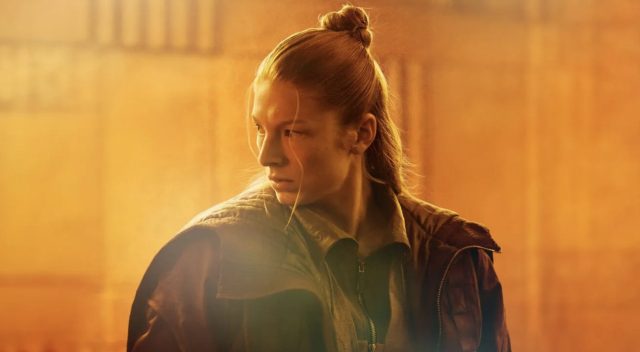
A new ‘Blade Runner’ adaptation asks: are you sure androids aren’t human? Credit: Amazon Studios





Last week, while vacationing in Lisbon, I found myself striking up a conversation at the hotel bar with a middle-aged couple who spoke English with a distinctly American accent (which is to say, my accent). Call them Frank and Laura. At some point, our small talk turned to that most American of topics: “So, what do you do?” Frank asked. I told them that I’m a magazine editor, and this prompted Laura to reveal that she, too, edits for a living. How wonderful.
Then came the details: Laura oversees product copy for an online retailer that serves as a platform for small, traditional craftsmen across Europe, people who’d otherwise struggle to reach markets beyond the local. Thanks to the website, anyone anywhere can order, say, wooden figurines of an old-timey Central European housewife threatening her drunk husband with a rolling pin as he staggers home from the tavern.
At one point, Laura’s job entailed manually translating the product descriptions, for which task she attained a decent facility with French, German, and Italian. More recently, however, her employer has outsourced the translations to — you guessed it — artificial intelligence. Yet this transition hasn’t rendered Laura redundant. For now. You see, the AI still can’t manage the sensitive judgment calls needed to make the local descriptions work for a global consumer base.
As Laura pointed out, for example, translated too literally, the description of the figurines — a wife beating her husband — might be mistaken for something, well, kinky. And that’s not to mention the quaint product descriptions’ treatment of racial minorities; terms like “oriental” still crop up with troubling frequency. Laura’s labor, then, is still needed. She provides a second pair of watchful human eyes looking over the AI’s shoulder (so to speak).
Astonishing, if you think about it: we’ve reached a stage in economic and technological development in which a human worker has to correct a robot’s unintended social blunders. Laura, I immediately thought, holds a job befitting a character straight out of a Philip K. Dick story. In 2026, marking the 60th anniversary of Dick’s landmark novel Now Wait for Last Year and awaiting a new Blade Runner adaptation from Amazon, we must admit that ours is the sci-fi master’s world — we’re just living in it.
Dick, more than any other author, understood that technology would soon confront us with new subjects that mimic human-ness. Halfway subjects, I’d call them, who can think and feel as we do. Or almost. These halfway subjects do two unsettling things: first, they undermine our faith in our special-ness in the cosmos; and second, they make ethical demands on us (precisely because their mental and emotional processes can resemble our own).
Dick didn’t wish away these possibilities. That was off the table for him. Things are going to develop a certain way, and it’s naive, he seems to have concluded, to imagine society restraining the appetite for efficiency and advancement. Against this backdrop, the really important question becomes: what’s distinctly human and thus worth preserving, if so much of who we think we are can be replicated by the nonhuman or only halfway human?
Dick’s answer cut against the solutions preferred by the current sides of the AI debate: the technophobic types prepared to take a pitchfork to the nearest data center, as well as the techno-utopians prepared to let it all rip.
The latter, the utopians, underestimate the costs — and not just in the form of the non-living lording it over the living. As I’ve argued elsewhere, Dick’s body of work stands as a warning about how prioritizing one path of technological development can foreclose others. Many of his worlds feature mind-blowing, highly advanced technologies alongside decayed material landscapes. A scientific society that can commune with aliens also features crumbling buildings, rampant crime, and long-abandoned infrastructure projects.
That could describe a Dick Martian colony in the year 2056 — or San Francisco in 2026.
But the technophobes don’t get off so easily, either. Fact is, the halfway subjects and simulacra are already here — in Laura’s world almost as much as Dick’s. “The work of human hands,” as the prophet Hosea puts it in the Bible, has constructed meaningfully human subjectivities. Or things that certainly feel like subjectivity. In response to this, a Dickian ethics, if there is such a thing, doesn’t seek to undo or halt technological development. Rather, it asks us to seek humaneness within or through the nonhuman simulacra.
Born in 1928 in Chicago to a family sadly destined to break apart, Dick grew up mostly in California. The Golden State of his childhood and youth was the point of convergence for many of the defining trends of his time: rocketry and the occult at Caltech; the emergence of a modestly prosperous middle class (whose precarious position he saw earlier than most); the egalitarian promise of the New Deal order and the contradictions bound to unravel it; the birth of noir in film and literature; the decline of the state’s high-WASP regency amid Okie and later Hispanic migration.
Formed by this raw material, his mind projected itself into our moment — almost like one of his own protagonists from Now Wait…, which concerns a hallucinogenic drug that allows users to travel in time: either to the past, the future, or parallel worlds unfolding simultaneously.
Yet Dick didn’t set out to become a prophet. His real dream, as a writer, was to portray the aspirations and miseries of his fellow midcentury Californians via the sort of realist literary fiction that, then as now, won most of the serious accolades. He never managed to sell his early realist work, however, and this impelled him into the lowly world of “genre fiction” — compensated (barely) per word, despised by the literati, confined to paperback.
His failure redounded to our benefit: it imbued his imagined futures with a moral and psychological realism missing from most sci-fi. Dick, in one sense, never stopped writing social-realist fiction. His protagonists remained the same grasping, frustrated Californians: put-upon repairmen, debt-addled technicians, arrogant union bosses, washed-up entertainers, lousy private detectives, addicts and drug warriors, sexually frustrated housewives and their cuckolded husbands, and the like.
Only, as his best interpreters (Ursula K. Le Guin, Jonathan Lethem, and Emmanuel Carrère, among others) have pointed out, Dick transposed these familiar figures onto a world of Martian colonies, cyborg servants, sentient taxi cabs, and time-travel drugs. It’s this collision — of a begrimed midcentury California and a fantastical future — that gives rise to the magic of Dick’s world, and its prescience.
It also accounts for his tragic sensibility. Like their real-world counterparts in midcentury California, Dick’s protagonists rarely pause to ask if the worlds they inhabit might be reconfigured along different lines. They generally don’t pose political questions. They don’t wonder if the technologies that determine the shapes of their lives might be altered or even restricted in the name of a better social order.
Rather, most everyone takes for granted, say, the “robants” in Now Wait… — flying android servants who assist in medical surgery and collect debts, among many other mundane tasks. Just as everyone accepts the slavery of the androids in Do Androids Dream of Electric Sheep? (1968); the pervasive, extreme monetization of the simplest aspects of life in Ubik (1969); and the capitalist police state that forms the social backdrop in Flow My Tears, the Policeman Said (1974). Any given novel begins with the protagonist deeply enmeshed in a world of unsettling new technologies. Only to him, these are just the facts of life; and his goal is to earn enough money to access this or that luxury, to allow him to satisfy a demanding wife, and so on.
Even if some characters object to the prevailing technological and economic logic, their resistance rarely takes the form of collective action or mass politics. At the risk of sounding like a “vulgar-Marxist” critic of a century ago, this I believe is a limitation imposed by Dick’s own petit-bourgeois background — common, as the Marxist cultural geographer Mike Davis pointed out, to many otherwise far-seeing genre writers of Dick’s time and place.
Dick in sci-fi — no less than Cain, Chandler, or Ellroy in noir — could diagnose social injustice or irrationality. But he couldn’t see a way out save for individual heroics or romantic failure. Also notable in this regard are the corruption and sclerosis that Dick ascribed to the mainstream labor movement in midcentury America. His only explicit “labor” character that I can think of, the union leader Arnie Kott in 1964’s Martian Time-Slip, is greedy and vicious, a slave to his petty privileges, and, anyway, no better than the capitalists with whom he presumably bargains.
Granting these class limitations, there still remain Dick’s insights into the halfway subject. These are acutely relevant to our anxieties about platforms like ChatGPT and Claude; and to an age in which human mental labor — or what remains of it — may involve give-and-take between the organic mind and machines that can replicate many of its capabilities.
Now Wait for Last Year is an instructive document in this regard. The plot isn’t easy to summarize; it’s among Dick’s most convoluted (though it all strangely fits together if you sit down to plot it on paper). Our protagonist, Eric Sweetscent, is a surgeon charged with keeping alive a single patient: the aged head of an industrial conglomerate that supplies key materiel to Earth’s armed forces amid an interstellar war.
Earth is allied with one alien faction, the humanoid-looking-but-devious Starmen, against the bug-like-but-actually-humane Reegs. That contrast reveals a great deal about Dick’s moral philosophy: the disgusting, nonhuman-looking creatures are humankind’s friends, while our ill-chosen, human-looking “allies” are prepared to occupy and enslave humanity.
Interstellar politics, however, are beyond Dr. Sweetscent’s ken. His all-consuming problem is a painful marriage to a striking femme-fatale wife, Kathy, who earns more money than he and who dominates him sexually; during an ugly fight, she insinuates that the doctor is a homosexual, driving him near-suicidal. (Nearly all his female characters are domineering and dangerous to the men who love them — a shortcoming or a piece of psychosexual reality, take your pick.)
Kathy, Eric knows in his inner places, will be his undoing. And sure enough, she at one point tries out a deadly hallucinogen, JJ-180, developed by the firm that employs both of them in order to poison the Reegs. Terribly addicted and gradually losing her mind to irreversible brain damage, she visits Eric at his workplace and slips a JJ-180 tablet into his coffee — out of spite and in the hope that he can find an antidote.
The long and short of it is that Dr. Sweetscent ends up finding the antidote to JJ-180 and, along the way, trying to broker peace between the humans and the Reegs. But what should he do for Kathy? By the story’s end, his wife has been hospitalized with brain damage, and lost the beauty and social stature that she once lorded over him. His bruised ego militates strongly in favor of deserting Kathy to her suffering (she did, after all, poison him).
But then Dr. Sweetscent hails a talking taxi — essentially, a flying robot that conveys passengers across vast distances and is also able to offer real talk like the best urban cabbies. This setup makes for the novel’s most famous scene.
“If your wife were sick—,” he tells the taxi, to which it replies: “I have no wife, sir. Autonomic mechanisms never marry; everyone knows that.” OK, well, nevertheless: “If you were me, and your wife were sick, desperately so, with no hope of recovery, would you leave her? Or would you stay with her, even if you had traveled 10 years into the future and knew for an absolute certainty damage to her brain could never be reversed?”
It could — almost — be a question posed by a Claude user today to the platform. So what’s the answer? “I’d stay with her,” the robot says. “Because life is composed of reality configurations so constituted. To abandon her would be to say, I can’t endure reality as such. I have to have uniquely special, easier conditions.” And so Eric Sweetscent stays with Kathy.
All along, Eric Sweetscent — and the reader — are perfectly aware that the taxi is an artificial intelligence. There is no “there” there, if “there” means soul or spirit or mind or consciousness. And yet, Dick suggested, there is something. The functional replication of soul becomes hard to discern from the “real” thing (and the scare quotes around real become obligatory). The line between nature and artifice becomes even blurrier if the halfway subject takes the form of a human clone, as in Do Androids…?, the basis of the Blade Runner film franchise.
Already, there are conversations taking place between human subjects and AI models that are almost perfectly patterned after Eric Sweetscent’s dialogue with his taxi-cum-therapist. “Shall I abandon my wife and kids?” “Should I tell my husband about my disturbing fantasy?” “Can I tell my parents about my homosexuality?” And insofar as today’s AI trawls the imprints of human subjectivity — in literature, psychology, history, and so on — to answer these queries, there is already something human in its responses.
By contrast, if a human’s job is to check the machine’s work against a sensitivity checklist — and let’s be honest, that’s what the Laura I met does for a living — it raises the question: who is the robot or android here, and who, functionally speaking, is more faithfully human?
Sohrab Ahmari is the US editor of UnHerd. His next book, on The Triumph of Normal, is forthcoming from HarperCollins.
 SohrabAhmari