




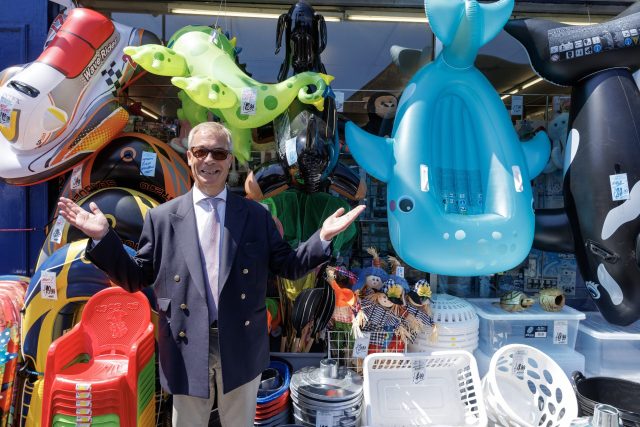
Lovable rogue or spiv with an inflated ego? (Dan Kitwood/Getty)





An opposition MP, just two years after being elected, announces that he’s leaving Parliament to trigger a by-election, in which he will stand again as a candidate, and some in the media are jubilant: “The contest will stand out in history as a great political landmark.” The quote was from the Suffragette newspaper, the MP was George Lansbury, and the year was 1912.
Lansbury came from a radical family, and he’d been campaigning for women’s rights since the 1880s. Then in the Liberal Party, he’d gone on to join the Social Democratic Federation, the country’s first socialist party, before being elected in December 1910 as the Labour MP for Bow and Bromley, in the East End of London. Once in Parliament, he was infuriated by the Liberal government’s refusal to extend the franchise to women and by its approval of force-feeding Suffragette prisoners on hunger strike. “You are beneath contempt,” he shouted, walking up to the government front bench. “You will go down in history as the men who tortured innocent women.” He was suspended from the chamber for that outburst.
He was equally angered by his own party’s failure to confront the government on the issue. Having exhausted all other tactics, he resigned his seat and called a by-election, asking his constituents “to endorse my policy of making women’s suffrage the beginning and end of my parliamentary fight”. It was a risky move. Bow and Bromley was a marginal constituency, and he’d only been elected in 1910 because the Liberals had declined to field a candidate and had backed him, giving him a clear run against his Conservative opponent. But it was worth the risk for one so committed to the cause.
The by-election that followed was noisy and atypical. The Labour Party was incensed by Lansbury’s actions and declined to give him official support, while the Liberals again refused to participate. Women’s groups from around the country campaigned for Lansbury, with public meetings addressed by the constitutionalist Millicent Fawcett, the socialist Ethel Snowden and the extremist Emmeline Pankhurst. Meanwhile, anti-suffrage opponents rallied under the slogan of “No Petticoat Government”, and the Conservatives tried hard to insist that this wasn’t a single-issue election.
The most effective poster read: “Lansbury is sick of Parliament. Bow and Bromley is sick of Lansbury. Vote for Blair and make everybody happy.” And on polling day, that’s what happened. On a 10% swing, the Conservative Reginald Blair took the seat and Lansbury was out of Parliament for a decade.
In the long run, standing on his principles didn’t do him any harm. When he returned to Westminster in 1922, again for Bow and Bromley, the number of votes cast had more than tripled, the electorate swelled by the enfranchisement of the working class and of most — if not yet all — women. It turned out that he’d been, in that curious modern phrase, on the right side of history. And when the Labour government split in 1931, and the party suffered a massive election defeat, he was the only ex-Cabinet minister left in Parliament, becoming leader by default at the age of 73. He held the party together in its darkest hour, his record speaking for him as a veteran campaigner for women, peace and the working class.
Nigel Farage, it hardly needs saying, is no George Lansbury. There is no issue of principle, or even of policy, at stake in today’s by-election in Clacton. And the difference doesn’t speak well of today’s politics. Beneath Farage’s thin-skinned petulance and posturing, there lies the media’s — and perhaps the public’s — fascination with electoral contests, rather than actual policy. Keir Starmer’s premiership was a time of flatlining productivity, of rising unemployment, of an incipient borrowing crisis (bond yields are higher than when Liz Truss “spooked the markets”). But the average voter could be forgiven for not noticing the parlous state of the economy as the drama of Andy Burnham’s by-election victory and unopposed coup played out in the press. This isn’t politics, it’s soap opera, and with the departure of Peter Mandelson, Farage is now the longest-standing character still in the show, in large part because he recognised the direction of travel early on.
It wasn’t always thus. Even if we consider the closest recent parallel to Clacton, that of David Davis in 2008, there was a serious point being made. Davis was the Conservative shadow home secretary and believed that a critical moment had been reached when the Commons voted in favour of the Labour government’s proposal to allow detention without charge for up to 42 days. This came in the midst of an attempt to introduce identity cards, attacks on the jury system, and increased surveillance by councils and quangos. As Davis pointed out, “600 public bodies have the authority to bug phones and emails and intercept the post”. So he resigned both his shadow cabinet job and his seat to fight a by-election in his constituency of Haltemprice and Howden in Yorkshire on the issue of civil liberties.
Then, as now, the other major parties didn’t contest the election. Labour, understandably, had no wish to defend its record, and Liberal Democrat leader Nick Clegg said his party supported Davis’s position and wouldn’t therefore stand against him. The whole thing became a farce. There was a record field of candidates — 26 in all — including the likes of David Icke, Mad Cow-Girl and Ronnie Carroll (the man who’d sung “Ring-a-Ding Girl” in the 1962 Eurovision Song Contest). There were so many of them that they weren’t allowed on the platform to hear the result, for fear of breaking the stage.
Davis won, of course, with an increased share of the vote, but it was a pyrrhic victory, both politically and personally. Gordon Brown’s government paid no attention at all. And Davis’s career suffered. Just three years earlier, he’d fought David Cameron for the Conservative leadership. Now, he looked a much reduced, peripheral figure. “If I was given my job back, I think I’d take it,” he said. “But I don’t think I’ll be offered it.” He wasn’t, and he didn’t serve in the Coalition government of 2010-15.
In retrospect, Davis’s by-election captured the moment when British politics became totally trivial. The question of civil liberties was genuinely important, and has become ever more so. But the chance to challenge the growing power of the state was ducked by the media, which had decided that soap operas were more fun. The Daily Mirror saw Davis’s actions as “a cynically disguised leadership challenge to David Cameron”, while the Daily Telegraph said it was “a challenge to Mr Cameron’s authority”. It wasn’t. It was an attempt to position the Conservatives as the party that would defend the individual. When it was turned into a circus, the opportunity passed and the direction of travel remained unchanged. The era of the police raiding people’s homes in pursuit of social-media rudeness was just about to dawn.
And now comes Farage in Clacton. He may not have distinguished himself in Parliament, he may have struggled with delegation and with running a political party, but he has proved over the last three decades to be a consummate campaigner, and calling a by-election looks like a retreat to his comfort zone. But it’s a path fraught with danger. To start with, he runs the risk of becoming a laughing stock, even more than did David Davis. Breaking the 2008 record, there are 34 candidates, ranging from the SDP through three separate representatives of the Official Monster Raving Loony Party, all the way down to Rejoin EU. It’s hard to retain any sense of dignity in these circumstances. Worse still, the focus on Farage’s finances risks giving the impression of him being a spiv, rather than the lovable rogue that has previously been his great selling-point.
These three self-triggered by-elections tell an unedifying story of political decline. Lansbury’s was an honourable position and it was seen as such. Davis was also a principled man, but he was treated as a joke. And now Farage reduces legitimate concerns about the probity of his funding to a caricatured gimmick of the electoral process.
Oddly, though, that comment from the Suffragette may yet be applicable. The Bow and Bromley by-election in 1912 does not “stand out in history as a great political landmark”. But if Farage is sufficiently damaged, then Clacton in 2026 may do.
Alwyn W. Turner is a cultural and political historian. His latest book is A Shellshocked Nation: Britain Between the Wars.
 AlwynTurner