




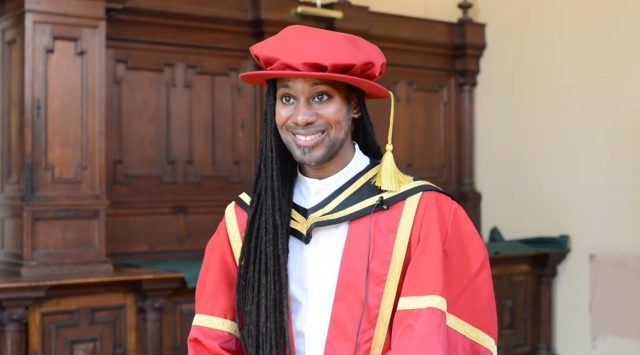
Jason Arday is part of a wider problem. (St Mary’s University, London/YouTube)





They say August is the silly season for news. Well, during this endless heat wave of 2026, in the hallowed halls of British academia the season is not so much silly as batshit crazy. The headline reason will already be known to readers beyond the Ivory Towers: accusations levelled at Cambridge Professor Jason Arday. But as we will see, there is more to it than that.
Now, you might well think that Arday’s is an open and shut case. After all, the evidence that he has committed extensive plagiarism, in his PhD thesis and at least two published articles, seems overwhelming.
Nonetheless the university’s response has been not only to defend Arday to the hilt, including a blanket dismissal of any claim of wrongdoing, but also to accuse anybody raising questions about him of racism. As of writing, Cambridge seems to be standing by its earlier statement that any questions are part of a “vile smear campaign to undermine his credibility”.
Okay, this much is widely known already. But what non-academics probably don’t know is the flip side of the story. And to understand why this affair has sent British academia into various shades of doolally, it helps to know where this all came from. You need to know about Nathan Cofnas, the man whose blog broke the accusations of plagiarism, unleashing the firestorm.
Although he is now employed at the University of Ghent in Belgium, Cofnas was previously a Leverhulme postdoctoral researcher based in Cambridge. Here we need to tread carefully. Cofnas was not employed by the University of Cambridge. That was his host institution, but he was funded by Leverhulme. However, while he was based in Cambridge, Cofnas had a College Research Associate affiliation with Emmanuel College (a separate entity from the university). This is a lot less fancy than it might sound: it basically gave him the right to put the College’s name on his personal website, and volunteer to do free work for them.
However, things exploded spectacularly when undergraduate students at Emmanuel discovered Cofnas’s personal Substack. We will come back to this in a minute, but what they read, they concluded to be racist. The students campaigned for him to lose his affiliation, and in the end he did. He later tried to take the college to court, but lost. (From what I hear, his attempt to paint Emmanuel as a hotbed of woke lunacy fell a bit flat, given that the Master of the College is currently Lieutenant General Douglas Chalmers.)
So, one major problem lurking in the background of the Arday story is that the first person to publicly accuse him of plagiarism, and trigger the current shitshow, is a man who has serious beef with Cambridge, and around whom suspicions of racism already swirl. To say that this is not helpful for those who are purely (and genuinely) concerned with the plagiarism angle alone is an understatement. If you read the mainstream news reporting on this affair, you will also not see Cofnas’s name coming up very often. I suspect that this is no accident: it’s kind of awkward to deflect accusations of racism if you are drawing on information provided by somebody recently accused of… racism.
But maybe we should back up a second. After all, is Cofnas a racist? Things get tricky here. He himself will tell you that he is “a race realist” who subscribes to “hereditarianism”. By this, he contends that in terms of statistical distributions across large populations, people of different races on average exhibit different characteristics. And, crucially, that this is not a product of socialisation, history, or culture — but is more or less hardwired into underlying DNA.
To some extent, this claim is uncontroversial. It is true that populations distributed across East Africa for tens of thousands of years now tend to produce humans that are the best at running marathons. Something similar is true regarding Jamaicans and sprinting (although for very different historical reasons). Where it gets controversial is that “race realists” like Cofnas think that the same is true of IQ. On the one hand, they will smugly tell you, it’s just true that East Asians are better at maths than European whites. But what they also want to tell you is that it’s just true that black Africans have lower IQs, on average, than everybody else. And the reasons for this, they say, are hardwired genetic differences.
Does this make Cofnas a racist? He would say no. He would say it makes him a realist, somebody who refuses to shy away from scientific fact.
A little while ago, before I ever heard of Jason Arday, I went away and read some of Cofnas’s published academic work. And here’s the thing: the scholarly quality is high. The first piece I read was a complex argument about our evolutionary history, and the constraints this imposes on morality. Not only was it good, I agreed with the argument. But this had absolutely nothing to do with race.
So I turned to his much more controversial philosophical defence of race realism as a legitimate scholarly enquiry. There he claims that the best explanations for variation in IQ are ultimately genetic, and that until social science accepts this fact, we will inevitably do bad social science. And the truth is, I’m not at all surprised that it passed the rigours of peer review at a proper academic journal. In this case, I had quite a lot of objections to his argument, but it was without doubt serious work. Whatever else you might say about Cofnas, the man is no intellectual fraud.
And then I read the blog.
The careful, rigorous, circumspect scholar I had discovered was nowhere to be seen. Instead, dreary pages of sloppy ranting: edgelord ragebait of the sort that abounds in the bowels of Reddit. There, you can find claims such as “blacks would disappear from almost all high-profile positions outside of sports and entertainment” if genuinely colour-blind criteria were applied. That “blacks would make up 0.7% of Harvard students” if they had to compete on equal terms for admission. Lots of denunciations of “woke”, plus armchair fantasies about how to usher in a hereditarian utopia. You get the idea.
Was Cofnas being an outright racist in his Substack musings? No. But sometimes, that’s not enough to clear the bar.
Should Emmanuel College have ended their affiliation with him? I’m genuinely torn. On the one hand, his personal blog is what academics and lawyers refer to as “extramural speech”. He wasn’t publishing it under anybody’s name but his own. Insofar as we think (and I do) that individuals should have free speech to say pretty much whatever they want in a private capacity, then as tasteless as his blogs were, Emmanuel should’ve just ignored them.
On the other hand, there is a case for saying that Emmanuel College is basically a glorified private club. And there’s no legal or moral obligation for private clubs to tolerate as members people they deem to be arseholes. I have never met Cofnas in person. But if his internet persona is anything to go by, he seems a real arsehole.
The result of all this is that British academia finds itself in a summer of farce.
Yes, we have what appears to be a fraudster and plagiarist, and indeed a serial fantasist. Both he and his employer shamelessly play the race card when anybody tries to question the very obvious holes in his story. This would be bad enough because many in academia watching this, if they are being honest, can tell by now that he is obviously not up to the job. It’s not just the accusations of plagiarism, it’s that his record is so obviously paper-thin that most academics couldn’t have got that position simply based on the CV. We all know damn well (even if only some of us will admit it in public) that politics and PR were crucial in this appointment.
The problem is, the first person to publicly accuse Arday has indeed been accused of being a racist — thereby vindicating his defenders up to a point. And Cofnas also has an axe to grind with Cambridge, which has allowed Arday’s defenders to underplay his (overwhelmingly plausible) claims.
Which leads us to another uncomfortable truth. Just last week, the Telegraph was using this affair as evidence that all the universities are broken “and hence maybe it is time to pack the whole thing in”. This belief that the universities are basically a scam on the public dime is growing, and Arday, with more than a little help from Cofnas, has added fuel to the fire.
The trouble is, significant portions of the humanities and social sciences have given up on serious scholarly inquiry, coming to see themselves primarily as activists, torchbearers for moral and political revolution. I know, because I’ve heard the mutterings about my status as an evil apologist for colonialism and racism due to my insistence that it’s good for students to read some of the books by some of the dead white men (but not only books by them!).
The result is an absurd situation where people who are supposed to have dedicated their lives to the fearless pursuit of truth do not know where to turn. Those of us who genuinely believe in the pursuit of knowledge, via the rigours of scholarship, are of course appalled by the Arday fiasco. Not simply because of the facts themselves, but because we know this is going to affect more than him, and more than Cambridge.
The knives are being sharpened, and it won’t only be the bullshit merchants who’ll suffer when the backlash comes. Likewise, one can only feel sympathy for serious scholars from ethnic minorities who will now be harmed by the spillover. But it would be a bad idea for us to therefore get in bed with Cofnas (who seems to think that until they adopt hereditarianism, universities are a write-off due to “woke” takeover). Likewise, his fellow travellers on the populist Right, who already seem out to destroy us.
During this long, dry summer of ’26, British academia has found itself stuck between a rock and a hard place. But a storm is coming. And when it hits, it is unlikely to leave either the rocks or the hard places where they were.