




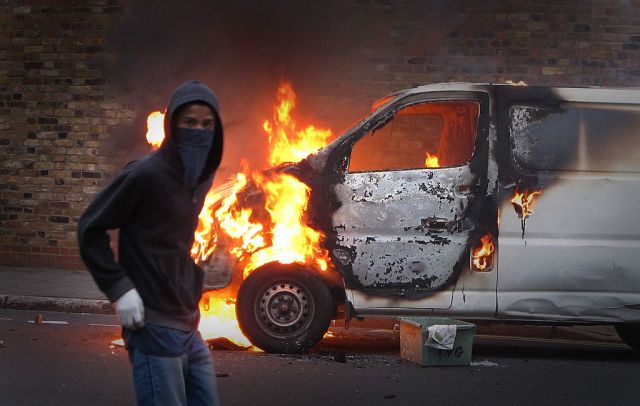
‘Few would argue that Britain’s social fabric is in a better condition today than it was in 2011.’ (Peter Macdiarmid/Getty)





This month marks a grim anniversary: 15 years since the London riots of 2011. Beginning with protests over the police shooting of Mark Duggan in Tottenham, the unrest spiralled into five days of carnage and looting in the capital and across the country. England’s urban centres, it turned out, were more of a tinderbox than most had realised. Once order had broken down, chaos metastasised at an incredible rate.
Few would argue that Britain’s social fabric is in a better condition today than it was in 2011. There have been further large-scale outbreaks of violence, like Belfast and Southport, but the spread of petty criminality is arguably as damaging. Consider, for instance, a recent analysis by Forecourt Eye, a security company, of the effects of the spike in fuel costs caused by the Iran war. The report claims that, in the five months since the conflict began, £200,000 worth of petrol and diesel has been stolen from British pumps every day. That figure is almost 50% higher than before the crisis started. No less striking is the variety of the people engaging in this theft. Forecourt owners say that, besides the hardened chancers and the black-marketers filling up jerry cans for resale, the thieves now include all manner of ordinary people, some claiming they can’t afford to pay. “It could be anyone,” a petrol station owner in Birmingham tells The Guardian. “They come right in front of you, because they have no fear.”
Three weeks into Andy Burnham’s premiership, it’s tempting to think that Britain is again settling into a strange kind of equilibrium. The country’s long-term problems continue to fester, but now that we have a prime minister with at least a basic degree of political skill, it already feels like the forces of inertia are reasserting themselves. Labour’s populist challengers appear increasingly unconvincing, and are duly subsiding in the polls. People have almost stopped noticing the boats. Some things will get a little better, others a little worse. There will be occasional hotspots of violent unrest, but no great conflagration. Burnham will keep releasing videos about pub snacks and football. And the country will move slowly, imperceptibly, down the path of managed decline, like a building which has partly collapsed but somehow remains habitable.
This impression is surely complacent. Like the recent epidemics of shoplifting and mobile phone theft, not to mention fly-tipping and fare-dodging on public transport, the sudden spike in fuel larceny raises the spectre of an increasingly low-trust society, where a failure to observe basic norms undermines goodwill and turns everyday life into a kind of gauntlet. It also implicates trust in the state, which people are liable to blame for the unaffordability of basic goods as well as the failure to enforce its laws. Even if such trends do not culminate in a 2011-style blowout, they can turn into more gradual cascades. Why follow rules if others don’t? Why act considerately towards strangers if your generosity is rarely repaid?
But petrol-pump raids illustrate another, equally important, reason that a fragile society is unlikely to remain stable. We live in a volatile world, and exogenous shocks such as the Iran war will continue to pile economic strains on these vulnerable bonds linking individuals, society and state.
Indeed, fuel theft could be seen as part of a much broader pattern of resource-related criminality — spurred by global disorder. In recent years, gangs have turned their attention to, of all things, the production of fake olive oil, meeting a demand created by crop failures and, ultimately, climate change. In 2024, Italian authorities intercepted almost $1 million worth of oil debased with substances such as chlorophyll, which was already being used in dozens of Roman restaurants. As the price of copper has been driven up by technological shifts, meanwhile, stripping, stealing and scavenging has surged around the world. In the UK last year, more than 100 incidents of copper theft from the railway network led to 130,000 minutes of train delays. Similarly, historic spikes in the gold price, a consequence of investors seeking a safe-haven from financial turmoil, have prompted outbreaks of illegal mining everywhere from Ghana to the Amazon.
These developments might lead one to conclude that the law is a weak barrier to the power of economic incentives. Yet history makes a mockery of the idea that criminal behaviour can be straightforwardly tied to material factors. During the first half of the 20th century, the average British person was much worse off than today, yet Britain itself was remarkably law-abiding. The prison population of England and Wales hovered around 10,000 throughout the Thirties and Forties, compared with over 85,000 today. The overall crime rate may have nearly doubled during the hardships of the Seventies, but it had also doubled during the economic boom of the Sixties. On the other hand, anyone arguing that the decline of traditional morality was responsible for these negative trends may struggle to explain why most forms of crime have been falling again since the turn of the 21st century.
A study of 1,620 of those arrested during the London riots suggested that a combination of material and social factors were at work. The rioters’ neighbourhoods were correlated with resentment towards police, poverty, and ethnic diversity (the authors posit that diverse areas are “less cohesive, and so adults are less able to prevent youth from rioting”). The rise of fuel theft alongside this year’s price hikes, or for that matter the shoplifting boom in the years since Covid, suggests that a similar cocktail of causes are involved in the recent rise of petty criminality. A useful concept here is that of “social crime”: an illegal act which people don’t in practice regard as criminal, or which is seen as a justified form of protest. As the historian and criminologist Clive Emsley noted, such crimes have a long history in Britain, and many involved illegally taking or supplying goods.
In 19th-century Manchester, before the arrival of domestic plumbing, people commonly helped themselves from outdoor taps without paying the requisite fees to the water company. Smuggling, too, could enjoy widespread consent when it circumvented unpopular taxes, such as the duty on tea in the 18th century. In Norfolk, one man sentenced for shooting livestock in 1839 delivered a memorable courtroom diatribe against the establishment of the day, complaining that “to such a state had they brought the poor of this country… that it was impossible for a poor man to live by honest means, and all this was to support big-gutted relieving officers”. (Some on the Right will be pleased to hear that this man was deported — that is, to a penal colony in Australia.)
The morality of social crime is complex: it depends on the circumstances of the act and the nature of the law being broken. The point is that our sense of what is acceptable often diverges from the letter of the law. It seems that, to some degree, various forms of theft are now becoming social crimes: those committing them do not really think they are doing anything wrong, or have perceived that those around them won’t judge them very harshly for it. This is where the issues of trust and economic pressure meet, for it is the stories that people tell themselves about the unfairness of society which allows them to minimise their actions, and the sense of being hard up which makes those stories more compelling. A classic example is the casual shoplifter who, seeing prices rise, feels that stealing is justified given that the money is just lining the pockets of greedy capitalists anyway. Another is the self-employed person who works off the books because they feel they are taxed too much, and, in any case, the corporations don’t pay their fair share.
Rioting is another phenomenon which has often been assigned to the “social crime” category. Many reports of the 2011 riots emphasise the participants’ shared grievances, such as the account of one rioter in Hackney who said they were “angry about the phone-hacking scandal; angry about the MPs’ expenses scandal; angry about the bank bailouts; angry about police corruption and the abuse of stop-and-search powers”. One policeman recalled many looters citing the Duggan shooting, leading him to wonder why they’d rob an electrical store because the police shot a man.
That’s shadowed by more recent examples. In April, The New York Times hosted a discussion titled “The Rich Don’t Play by the Rules. So Why Should I?”, in which the commentators Jia Tolentino and Hasan Piker declared themselves, in Piker’s words, “pro stealing from big corporations”. In case anyone doubted her good intentions, Tolentino added that when she stole from Whole Foods (the term “microlooting” was mooted), she was buying groceries for a mutual-aid group.
One doesn’t need to subscribe to Kant’s categorical imperative to see how such reasoning can go awry. Anti-social behaviour justified by the unfairness of the system does little to harm the fat cats. But it does create a depressing atmosphere of cynicism and anomie which undermines the basis of mutual decency in the public realm. In Britain, the Government itself has been guilty of encouraging that cynicism, opportunistically attacking supermarkets and petrol stations for the prices they charge (even though tax makes up a far greater share of fuel costs than forecourt profits do). This is obviously good politics, at least in the short term. At a time when hard-pressed consumers are making the political weather, who wants to stand up for big business? In any case, the populist Right has inconsistencies here too. Reform UK has long made the pacification of “Lawless Britain” one of its central campaign themes, yet the party’s own financial controversies are hardly likely to make the little folk want to play by the rules.
In the end, the problem of petty criminality cannot be fully addressed either by the “broken windows” policing model favoured by conservatives — coming down hard on minor infringements that corrode trust — or the liberal alternative of showering love on gangsters and funding youth centres. It is true that paltry legal penalties and nonexistent policing have encouraged the rampant theft of everything from bikes and phones to diesel. But to argue that a harsher state will suffice as a solution is to invite a future where pervasive facial recognition technology merely conceals the evaporation of authority and trust. Conversely, a compassionate approach which treats crime as an expression of victimhood is unlikely to dampen the tendency to think that some law-breaking is morally justified, or indeed politically virtuous.
Economic stress, material scarcity, a loss of cohesion and social trust: these are all part of the problem, and an effective response must account for them. What we are less comfortable acknowledging is that there is also a moral problem here, which requires a moral solution. Perhaps it can begin with a particular idea of pride. We ought to be more willing to find self-worth in a determination that, even if the world around us appears unfair, corrupt or selfish, we will not sink to its level. The source of this pride is not one’s own purity, but commitment to a public realm that depends on trust.
Of course, none of us, least of all me, will ever be flawless in this regard, so there is no use being sanctimonious about it. Yet morality, like social crime, is also a matter of shared attitudes and expectations, and it’s difficult to see how a new civic ethos could be cultivated in the tumultuous Britain of 2026. Robert Tombs writes of the Victorians’ successful campaigns against anti-social behaviour that “politicians, churches, charities, trade unions, schools, the police and ordinary people in their neighbourhoods co-operated”. These institutions hold even less sway now than they did at the time of the London riots, and social media is hardly famed for its wholesome role models.
In political terms, the pertinent question is how all of this might play out if global events, in combination with our less-than-resilient infrastructure, deliver more shortages and price-increases over the years ahead. There are reasons to think that Britain would handle outright rationing with greater steadfastness than many other countries: consider the acquiescence with authoritarian measures during the pandemic, the popularity of price caps, the ongoing support for egalitarian and welfarist principles. You can already imagine the daily updates from a sober but sensitive Prime Minister Burnham.
Yet the rise of casual crimes like fuel theft makes one wonder if Britain still has the reserves of solidarity that its leaders claim. The more burdensome the sacrifice that people are asked to make, the more widespread free-riding will shred trust in society and the state. Let’s hope we never have to find out how fragile Britain’s equilibrium really is.
Wessie du Toit writes about culture, design and ideas. His Substack is The Pathos of Things.
 wessiedutoit