




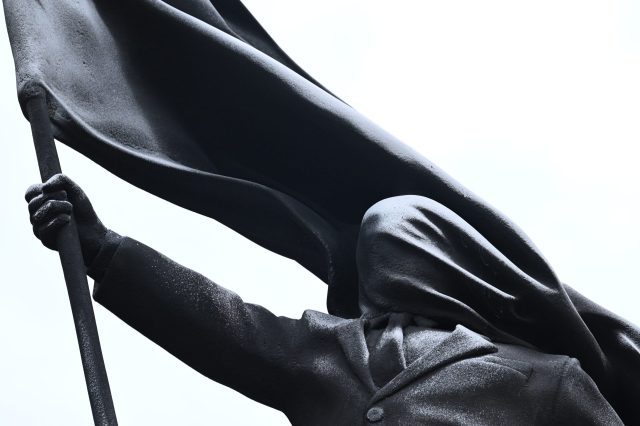
The next election will be decided on the question of common sense. (James D. Morgan/Getty)





In her classic 1974 monograph Portrait of a Greek Mountain Village, the anthropologist Juliet du Boulay offers a telling vignette. A peasant woman is readying loukoumi, or Turkish delight, before guests arrive at her house for a name-day celebration, and du Boulay offers to extract the sweets from their untidy-looking box, and display them in a dish for better decorative effect. The woman disagrees, saying “No, that’s not as it should be”. The anthropologist disagrees in turn, provoking the woman’s final word on the matter: “It’s not that you don’t agree, it’s that you don’t know.” The woman cannot explain why her instinctive, customary approach is correct and the anthropologist’s reasoned innovation is not. It is simply a matter of common sense, in the literal sense of the shared but unspoken assumptions, “the common body of values and beliefs” that make up the lifeworld of the community, such that “in every statement, judgement, and action which is referred to or is derived from this body of traditional beliefs, the individual who is speaking or acting does so in his capacity not as a solitary individual but as a member of the total community”. By not knowing the “correct” placement of the sweetmeats, in contrast, du Boulay is shown, in a superficially minor way, to be outside the community: she simply does not share in its common sense.
It is perhaps instructive in the wake of the Arday affair, in which both progressive commentators and sociology departments have found themselves in want of “common sense” as most of us instinctively perceive it, to further examine common sense as a concept within anthropology, sociology’s academic daughter and rival. For the influential cultural anthropologist Clifford Geertz, making explicit a long-implicit concern of the discipline, common sense is a “cultural system” which “can vary dramatically from one people to the next”, and “rests on the same basis that any other such system rests; the conviction by those whose possession it is of its value and validity”. For the anthropologist Michael Herzfeld, suggesting the idea first as a “mischievous” provocation and then entirely seriously, “Social and cultural anthropology is simply ‘the study of common sense’” which is itself “the socially acceptable rendition of culture, and is thus as variable as are both cultural forms and social rules”.
As Herzfeld remarks, “common sense — the everyday understanding of how the world works — turns out to be extraordinarily diverse, maddeningly inconsistent, and highly resistant to skepticism of any kind”. It is, indeed, precisely the cultural misunderstandings between the anthropologist conducting his fieldwork and the people who he lives among that reveal “the mutual incommensurability of different notions of common sense — our object of study”. What is anthropologically significant about common sense is not that it is sensible but that it is held in common. It is common sense for the Azande tribesman, stubbing a toe or breaking a pot, to ascribe his misfortunes to witchcraft, where the Western observer would point to what are for us more pertinent causes: the two common senses differ wildly, demarcating two different cultural worldviews.
We may never fully understand what attracts such journalistic and legal luminaries as Carole Cadwalladr and Jolyon Maugham to the cause of the late fabulist and self-promoter Jason Arday. Certainly the many fantastic and self-contradictory claims Arday made over the course of his first stratospheric and then tragic career are an affront to the common sense of the cultural community as a whole. Perhaps, we wonder, trying to make sense of their worldview through our own cultural priors, they have simply gone too far and staked too much of their reputations to accede defeat now, despite the nonsensical nature of the claims they still defend. Could it be pure cynicism, we wonder, defending positions they surely now know not to be true to establish their positions within a political community? But instead, borrowing a way of interpreting the world from anthropology, perhaps it is more fruitful to focus not on the sensibility of their claims but their commonality. For while it is common sense to us that they have settled on an absurd and intellectually indefensible position, it is clearly self-evident common sense to them that they are correct. Beliefs that seem bizarre and outlandish to us provide them with social meaning, reinforcing the boundaries and worldview of their culture and allowing them to make sense of a confusing world.
The common sense of our own culture would, for example, make even an ambivalent observer of the Arday affair think twice before claiming that the forensic Guardian investigation, by a black journalist, of Arday’s fabulism was an example of racist “lynching” by the “right-wing press”. But to this strange and nascent culture within our midst such truths are self-evident. Perhaps “racism”, or its presumed progenitor “whiteness”, those invisible but omnipresent forces whose malignant presence they discern throughout our society, function for them as witchcraft does for the Azande. As Geertz observes, “It is when ordinary expectations fail to hold, when the Zande man-in-the-field is confronted with anomalies or contradictions, that the cry of witchcraft goes up. It is, in this respect at least, a kind of dummy variable in the system of commonsense thought. Rather than transcending that thought, it reinforces it by adding to it an all-purpose idea which acts to reassure the Zande that their fund of commonplaces is, momentary appearances to the contrary notwithstanding, dependable and adequate.”
Indeed, Geertz continues, “the cry of witchcraft functions for the Azande as the cry of Insha’Allah functions for some Muslims or crossing oneself functions for some Christians, less to lead into more troubling questions– religious, philosophical, scientific, moral– about how the world is put together and what life comes to, than to block such questions from view; to seal up the commonsense view of the world… against the doubts its inevitable insufficiencies inevitably stimulate.” Rather than unsettling their worldview, as our common sense would expect, the effect of the Arday affair upon the progressive tribe has been to reinforce it, allowing them to double down on their beliefs and further elaborating their all-encompassing moral cosmology. Absurd to us, the entire worldview makes sense to them, and clearly serves a social function. One need not agree with their precepts, as Evans-Pritchard did not agree with Zande cosmology, to recognise their importance as social facts, and value as an object of study.
Gently placing the Arday affair to one side, we can apply such methods to the Right as well. It is, after all, a political tribe just as much as the progressives, and one which places greater emphasis on its worldview aligning with the common sense of the wider national community. The recent proposal to ban first-cousin marriage, for instance, aligns with British “common sense” — we know, without needing to be told, that we do not do such things here. Such marriage patterns are anomalous and alien to the cultural community. And yet, as the anthropologist Adam Kuper makes clear in his 2009 work Incest and Influence, first-cousin marriage was the preferential choice of the rising bourgeois class of early 19th-century England, giving rise to such powerful “clans” as the Darwin-Wedgwoods, and the Macaulay-Trevelyans, which would dominate English cultural life, through their descendant spinoffs like the Bloomsbury Group, into the mid-20th century.
Like the Mirpuri clans of Northern England who are the object of the current proposed legislation, such preferential marriage arrangements were undertaken to maximise the economic resources of what became corporate kinship groups, outcompeting rivals and creating mutually reinforcing networks of patronage and influence. This pattern was broken up by economic liberalisation, reducing the material necessity for such arrangements, and by the outsized impact of fatalities in the First World War on the upper-middle class, forcing eligible women to widen their pool of marriage partners.
That the first-cousin marriage taboo, like the racism taboo, may be relatively new does not make it less widely held or natural-seeming — even “common sense” — today. Like the progressive appeal to racism as a causative factor operating within our society, the present-day political currency of that anthropological staple of differing “common sense”, the kin marriage taboo serves a social function: to distinguish between “us” and “them”, by demarcating the differing values of two distinct societies. The logical solutions for the Mirpuris addressed by the proposed legislation are thus binary: to jettison first-cousin marriage, and become “like us”, or maintain it and become legally as well as culturally outside the boundaries of the national community.
Britain’s dissident Right is increasingly adopting quasi-anthropological frameworks to make sense of the modern UK. The fact that the values of the liberal, upper-middle-class Victorian “130+ IQ Anglos” they laud did not, historically, differ all too greatly in this instance from the immigrant populations with which they are contrasted does not detract too much from the inner logic of their project, any more than the aberrant relationship between objective fact and their worldview does from the progressive one. Much of the newly-anthropological outlook of the British Right has much to recommend it: what is “the blob” if not a governing caste, a cultural superstructure which uses bureaucratic and legal power, shared social norms, rituals and beliefs to advance its collective interests? These norms are enforced with powerful taboos, and fearsome tests of ritual purity which the Arday fall-out has greatly accelerated, to the discomfort of cautiously sceptical progressives like Novara Media’s commentators, compelled to submit their errant cosmologies to the judgment of the tribe. Rather than gaining new adherents, this caste seems to prioritise thinning its own ranks through ever-stricter enforcement of its social norms. Theirs is a political project, or a culture, which sets itself apart from the interests of the political community or wider culture from which it is sprung, and that sees its purpose as either dismantling or overturning it.
Whether we should view modern progressives as a culture, or as a politically-orientated social structure, reflects older fissures within anthropology. As a discipline, anthropology was historically divided between British Social Anthropology, derived from Durkheimian sociology, and with a politically-minded focus on the notionally empirical social structures of “societies”, and American Cultural Anthropology, derived, via Franz Boas, from contemporary German notions of discrete and holistic “cultures”, which make meaningful sense of the world in their own interpretative ways. What they share, and what sociology now apparently appears to lack, is the emphasis on cultural interpretation through fieldwork, the seeing the world “from the native’s point of view”, as Bronisław Malinowski famously summarised the discipline’s craft, which provides a constant check to the cultural assumptions of the anthropologist himself. An “insider-outsider” in an alien society, the anthropologist is forced, through encounter with its differing notions of common sense, to reflect on the partiality of his own. It is an in-built check to cultural solipsism that sociology, the study of advanced Western societies by members of those same societies, inherently lacks. The practice of autoethnography as practised by Arday and his Cambridge patron Hilary Cremin shows nominal social scientists conducting a form of anthropological technique briefly fashionable in the first flush of the discipline’s engagement with critical theory, but which was always predicted by serious anthropological theorists, as it has since proved, to become a solipsistic intellectual dead-end.
But this is not merely a matter of abstruse social-scientific debates. When Arday could blame “whiteness” for questions being raised about his credentials and competence by his academic peers as well as his students (as in this paradigmatic work of autoethnographic solipsism), while valorising, as his posthumous defenders do, his own blackness as a defence of his probity and moral worth, we have moved beyond an anthropological understanding of “culture” into the world of power politics and hierarchy: the meat and drink of social anthropology. Who is subaltern and who is dominant when Arday could set the police on the Times Educational Supplement, summon the legal power of London’s most intimidating law firm on sceptics of his manifold claimed achievements, and weaponise accusations of racism against his academic critics, just as his defenders today invoke this most powerful taboo to muzzle the press in advance of their own political power? These are political matters, relating to the fundamental distribution and exercise of power within our society, and are thus legitimate areas for intellectual enquiry and debate.
As the anthropologist Terence Turner cautioned in 1993, progressive “multiculturalists use the term culture in different ways, and for different purposes, than anthropologists”, as a political tool “of the cultural nationalists and fetishists of difference, for whom culture reduces to a tag for ethnic identity and a license for political and intellectual separatism”. Sniffily disregarding its intellectual output, Turner observes that “to the extent that it has developed a theoretical analysis, it is primarily a conceptual framework for challenging the cultural hegemony of the dominant ethnic group”, so that “Culture, as such, becomes a source of values that can be converted into political assets, both internally as bases of group solidarity and mobilization, and externally as claims on the support of other social groups, governments, and public opinion all over the globe”. For Turner, prefiguring today’s febrile discourse, at its worst all this is merely “an intellectual pseudopolitics that implicitly empowers the theorist while explicitly disempowering real cultural subjects”.
Yet in doing so, he notes, the essentialist claims on identity — on race, gender, religious belief — made by progressive multiculturalists for political ends mirror and thus reify those of the presumed dominant culture. Just as Kuper observes, multiculturalism preserves “insidious assumptions” on the organic wholeness of cultures long jettisoned by anthropology itself, which are put to fundamentally Romantic and reactionary ends, and are “distantly related to certain Counter-Enlightenment discourses about ethnic identity”. As Kuper notes, “how can one know whether a person’s cultural identity is authentic? Only if it is further assumed that identity is fixed by descent.” Arday’s Labour Party defender Dawn Butler, for example, is, by virtue of her apparently self-penned poem on the spiritual, physical and moral superiority afforded to her by her skin colour, in common sense terms clearly a racist. Yet her racism is surely an inversion of what she perceives as white racism, similar to the way medieval black magic was merely an oppositional inversion of Christianity rather than a coherent belief system in itself. If whiteness and blackness are parallel constructs of the colonial encounter then why should the modern progressive not deconstruct blackness, and drive it out of the academy?
These are questions, provocations that anthropology can pose but which it is not its role to answer: the mere destabilising of the culturally-specific assumptions behind them, the grappling with their own partiality and cultural boundedness is enough. Can sociology in its current parlous and solipsistic state pose these questions? One does not imagine that career advancement in today’s Cambridge Department of Education would result. This is where anthropology, with its broader and more quizzical perspective, comes in, for, as Turner claims, “much as St. Paul revealed to the Athenians the identity of the unknown god they had been worshipping, anthropologists might play a useful role in helping multiculturalists realize the revolutionary implications of the course upon which they have embarked”.
For just as academic sociology, taken as a culture, is marked by an aversion to “common sense”, which it broadly views as something to be overturned rather than a spur to deeper analysis (as it is for anthropologists), progressives have seemingly settled on a social system or political project — it is not entirely clear which of the two is preferred — set on the destabilisation, dismantling or total destruction of the “common sense” norms of the wider national culture.
As an object of anthropological enquiry, such a development is fascinating and worthy of study. As a political project within democratic conditions, it is obviously disastrous for its adherents, as our last prime minister found. The sheer hatred Keir Starmer inspired among ordinary voters goes beyond rational analysis of his strengths and weaknesses: he ruled according to the common sense of his own social and cultural tribe, and against that of the wider society. Laws, intended to produce positive outcomes, were followed zealously because they were laws, whether their outcomes were positive or not. Such a course of affairs was deemed so unnatural, such an affront to our common sense that Starmer became a folk devil quite out of proportion to his bumbling and incompetent nature.
It is in this literal culture war — a term, as Kulturkampf, incidentally coined by the German anthropologist Rudolf Virchow — that our new prime minister finds himself. Much of Andy Burnham’s recent messaging — on North Sea oil, or the Net Zero push — seems intended to position him as aligned with the common sense of the wider political or cultural community and against that of his progressive caste. The relentless northwestern messaging of the Burnham government is not because he is a provincial bore, though he may be, but because it correlates to widely-held stereotypes within the British cultural zone — commonsensical beliefs — about the no-nonsense pragmatism of Northern English culture. He is invoking, and appealing to, a different type of commonsensical worldview than Farage, who addresses himself primarily to the tradesmen of southeastern England. On some matters, the two groups may hold a shared common sense — and indeed the next election will be decided on this question.
What Burnham appears to understand is that, however intellectually interesting the cultural worldview British progressives have now settled on may be to observe from without, does not present a viable path towards political success. Insofar as, viewed from outside, their beliefs take a coherent form, it appears to be one of direct opposition to common sense, in which the most outlandish and bizarre claims are made precisely to alienate as many potential adherents as possible, and reinforce the purity of the in-group. When they have lost the Guardian and Private Eye, we can deduce, they have lost even the establishment centre-left, still tentative adherents to our society’s common frame of understanding the world. For the progressive part, even the Guardian and Novara are now “polluted”, in the anthropological sense, by their perceived contact with “the Right-wing”, the theodicy against which their moral world is constructed.
When we say that policies or outcomes are wrong or unfair, what we mean is that they violate our understanding of how things ought to be; they simply go against our common sense. The fundamental issue highlighted not so much by Arday’s various fables as by the political furore following his death is that the way in which our society is run in large part goes against the dominant cultural understanding of how our society should be run, to what ends and with what guiding beliefs. The belief systems professed by some within the highest ranks of the British establishment are, to most of us, as self-contained, unfalsifiable, and as alien as if they belong to an entirely different culture, a distant society we can only puzzle at from outside. It is common sense to them, but not to most of us. This creates a cultural disturbance inviting in, though not limited to, extreme political turbulence. The electoral collapse of the Left results not from the fact that progressives do not agree with us, but like du Boulay in her Greek mountain village, that they do not know: they are outside the bounds of the wider society.
But Burnham is not a social scientist: what is of meaningful interest to him is not what hidden patterns the opposing worldviews unlock about their respective cultures, but which sense is more common, and thus commands more votes. His future therefore rests upon whether or not he can re-align the Labour Party with common sense — in both the detached anthropological and our instinctive folk usages of the term.
