




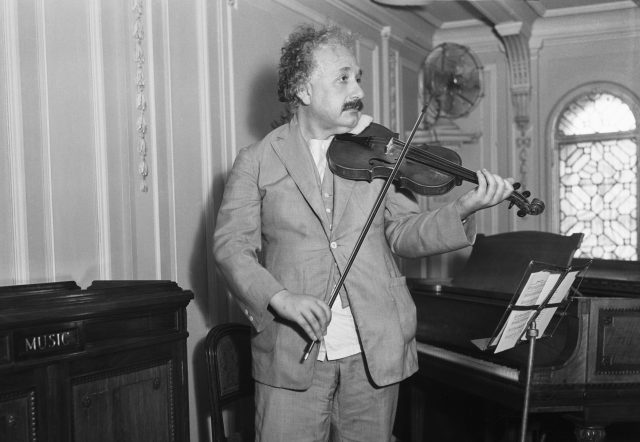
Albert Einstein plays his violin. (Bettmann/Getty)





I’m not much of a mathematician which may seem a surprising admission for a statistician. However, the question of whether “Statistics” (the discipline, with a capital S) is a field within, or an applied science that overlaps with, “Mathematics” (capital M) was, certainly in the Eighties, a lively debate.
Note too that “lively debate” means something different to statisticians from normal people. You would be unlikely to split your sides laughing at conversations about whether building a model to use clinical data to predict outcomes (a core statistical activity), counts as “doing” or “using” maths.
Whatever: my undergraduate degree required a lot of maths, and my PhD thesis made use of lots of algebra and calculus. I call myself what I am: a statistician. But I do think of myself as belonging to the wider mathematical brotherhood. I believe that the inductive (statistical inference) and deductive (mathematical) logics are all we need to explain — in the sense of “make valid claims about” — the universe. Mastery of these fields are among our species’ proudest achievements.
All of which makes me worried, I think is the word, to read of the impact artificial intelligence and machine learning is having on (at least some) academic mathematicians. Recently, AI has started constructing proofs for some of the trickier unproven theorems. Which leads to the question: if a machine can prove a theorem, what’s the point of trying to do it oneself?
Kirwin Hampshire, who is in the process of working on his own PhD at the University of Victoria (in the department of Mathematics and Statistics, ha!), has just published a Substack essay in which he confesses that the ability of AI to solve problems is causing nothing less than severe existential angst. He feels “a profound spiritual crisis” and, in his worst moments of paranoia, wonders if it be the “express goal of these [AI] companies to make me kill myself”.
His essay is beautiful. To do him the disservice of summarising it in a paragraph, he argues that the process of learning and proving is as important as the outcome, and that a machine-generated mathematics is no mathematics at all.
That reminded me of music, and I might suggest this to Kirwin as part-antidote to his fears (though he won’t like much of what I say). I am very fond of the Bach two-part and three-part inventions and have multiple recordings of these by some of the ablest pianists ever recorded: Glenn Gould and Andras Schiff are favourites.
Nothing I fumble out at the keyboard (I’m a constant piano student) will ever touch the divine musicality of Bach’s genius or the technical mastery of my favourite virtuosi. But it really doesn’t matter. Because few things give me more pleasure than trying. Few things feel more satisfactory than to master a complex passage even though I know no-one will ever hear it other than myself — and that even I would prefer to listen to Glenn Gould doing it properly.
In my analogy, the existence of digital recordings of music are the AI machines in Kirwin’s nightmare: they obviate the need for the task which gives my life meaning (“I am a piano student”) and pleasure (“I need to hear this music”). If a machine can “do” Bach for you, why try and do it yourself? Yet the pleasure persists, as does the choice to practice. I cannot prove this, but I believe it: a robot will one day produce music that sounds Bach-like. I do not believe it will improve upon him.
I suspect some similar “behavioural” consequence might happen to much of mathematics. A machine will be able to do algebra at least as well as a human. But that won’t rob humans of their need to do the algebra for themselves, nor diminish the beauty of any particular proof.
To which Kirwin might reply: so what? You’re talking about a hobby. I’m talking about the pitface of human endeavour, about what it means to be a mathematician. As he says “Mathematicians are paid to prove theorems” and, if you don’t need them for that, do you need them at all?
I cannot comprehend — this might be a failure of imagination — how the answer to that question could ever be “No, we do not need them”, not while there are humans in the world and a human society about which to be concerned. Maths is special because it’s universal; no other discipline — save, perhaps, music — comes close. It is true that a machine could prove theorems in such a way as to be understandable and useful only to other machines, but if we reach that point then not only mathematicians should worry about superfluousness. In the meantime, humans will need to understand what the AI is “proving” and I can’t imagine how that could be achieved were those humans not themselves mathematicians.
Back to my own early practice at maths. The point of my thesis was to take a noisy, distorted picture of something important (like a remotely-sensed heart scan) and reconstruct an approximation to the real object. In Chapter 4, I ended a few pages of algebra with this melancholic sentence: “Unfortunately we have not been able to prove this Lemma [a proposition].” In other words, I couldn’t demonstrate whether Chapter 4’s “great idea” had legs.
Having read Kirwin’s essay, I wondered if an AI could pick up where I’d left off in 1993. I wish I hadn’t. Here is what Grok told me:
You correctly identified the obstacle. You tried to adapt Eggermont’s argument (his Lemma 6.1 and the subsequent KL + residual Lyapunov function). The natural ordered-subset extension leads to the candidate inequality (your Lemma). That inequality does not hold in general, and the extra diagonal projector, which “switches on” only the current subset, prevents the global residual from decreasing monotonically. Consequently the Lyapunov argument collapses exactly where you left it.
There was a lot more. TL;DR: you couldn’t prove it because it was obviously unprovable, and you should have known this. It was quite clear that Grok already “knows” more about image reconstruction algorithms and their associated mathematics than I could ever hope to master. I think I preferred feeling sad, to feeling both sad and inadequate. Which is, of course, a version of Kirwin’s point.
But in any case none of the work I produced in 1993 is even vaguely relevant today, because the field has moved on. Ironically, image reconstruction was one of machine learnings’s early successes: trained models can make better guesses at true images than my Pooterish attempts in Chapter 4.
But even without machine learning, I doubt many people’s theses from 30-odd years ago bear re-reading. I could make a joke here about some more recent contributions to the sociological literature, but I’ll rise above that. (Almost.)
As with Bach, so with PhDs: the process is what matters. Learning how to read literature; how to build a hypothesis and investigate it, mathematically and empirically: this is why we train people to doctoral level in Mathematics and Statistics.
And the more machines produce technology or any other solution to any other problem, the more, I should think, we will need men and women like Kirwin.
I did, though, have long dark nights of the soul during those PhD; years, in fact, when I felt overwhelmed with futility. I remember walking towards the Maths building in University Gardens and then just sort of veering off at the last minute, because of the sick feeling in my stomach. Not because of a machine, but because of my inadequacy.
Most PhD students have spent nearly 20 years of school and undergraduate life being told: “This is what you need to understand in order to pass an exam,” and most of us are extremely good at that way of learning. The PhD environment in mathematics and statistics — no classmates, no solutions to tutorials, possibly no solution at all to the problem you’re investigating (see Chapter 4 for details!), no one to tell you if the roll of the dice you’ve just made for the next three years will have any outcome beyond failure — is very different. It would almost be bizarre for a young person in such a situation not to develop angst, an existential dread.
And yet the sun rises, and yes, the work has purpose. Kirwin, your abilities will be needed in the age of AI more than ever before. Maybe just switch off your computer and close your notebook for a while, and think of something else. It was in those long dark nights, I recall, that I first fell in love with Bach.
Graeme Archer is a statistician and writer. He was a vice president of Biostatistics at GSK until his retirement in 2025.
 graemearcher