




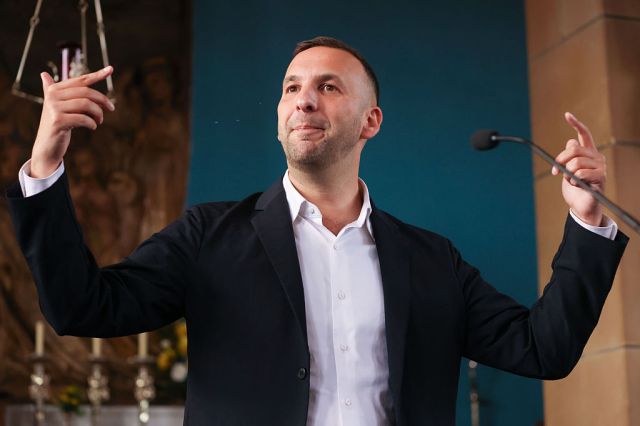
Enter stage Left. (Jon Rowley/Getty)





Unlike the new Prime Minister, who likes his T-Shirts plain, Zack Polanski prefers his decorated with political messages. In a photoshoot earlier this year, the Green Party leader donned one with the slogan “god save immigration” emblazoned over the Union Jack. A few days ago, he was sporting one that said “Beware the Green Menace”, a headline attributed to the “Daily Fail”. On the Green Party website you can buy a full wardrobe of T-Shirts bearing such slogans as “Hoarding Wealth is Weird”, “Nation of Neighbours”, and “I’m a Mothin Ally”. The most fetching screams “ZACKTIVIST”, with three different pictures of Polanski smiling in a statesmanlike way, his signature tacked on for good measure.
Polanski’s Green Party is a party for the heirs of the student activists of the Sixties and Seventies, for whom it was an article of faith that “the personal is political”. And so it’s fitting that a slogan T-Shirt should have caused the greatest crisis of Polanski’s leadership so far. On Monday, he shared a post on Instagram showing one of his supporters wearing a black T-Shirt with a guillotine on it — with the caption referring to the XTC song, “We’re only making plans for Nigel”. “If I were to post anything as inciteful”, responded Nigel Farage, “then I would expect to be arrested, and so should Polanski”. Polanski was quick to delete the post, which he shared just 19 days after Ann Widdecombe’s murder, and to declare that he “unequivocally does not support this type of dangerous message”. But the police are now looking into it — and free-speech hypocrisies aside, Farage is surely right to sense a double standard.
It’s tempting to see all this as just another sign of Polanski’s immaturity, of a piece with his goofball grin and his Hackney house share. That’s true — but what’s even more striking is how his callowness has endured into middle-age. He may not look it, or act it, but Zack Polanski is 43 years old. That makes him seven older than Alexandria Ocasio-Cortez, and nine older than Zohran Mamdani, with whom he is often flatteringly compared. He may be old enough to have some faint memory of Thatcher, and certainly remembers Section 28. If, by some strange stroke of fortune, Polanski were to become prime minister at the next general election, he would enter Downing Street about the same age as John Major did in 1990. The Green Party is achieving most of its success among Gen-Z. But its leader is only a millennial by the skin of his famous teeth.
Aside from making his wardrobe even more embarrassing, that gives Polanski something rare in politics — a life before. Since he burst onto the political scene, the picture of that life has been gradually filled. What we find is a protean creature, a sentient Ship of Theseus. His first name changed and his surname changed, for independent reasons. When David Paulden became Zack Polanski, really he should have become Zach Polinsky: Polinsky was the ancestral Jewish name, and Zach, not Zack, is the Jewish character in Goodnight Mister Tom. Between that first reinvention and his election as Green Party leader in 2025, there was a phase of Corbyn heckling, Conference gospel singing, and Clegg-Cameron Coalition boosting. But across all this — and his infamous chapter as a hypnotherapeutic breastmaxxer — there has been one constant thread: Zack Polanski was an actor.
Acting is what turned him into a political animal. Studying drama in Wales and then in Atlanta, his political approach to theatre goes all the way to a country whose current politics Polanski admires, and with which he wants Britain to form an alliance to replace Nato: Brazil. The Brazilian dramatist Augusto Boal developed the Theatre of the Oppressed back in the Seventies. It was based upon his compatriot Paulo Freire’s book Pedagogy of the Oppressed, which was published, as one might expect, in 1968. A long-haired Leftist with a New York education, Boal was kidnapped in 1971 and tortured by Brazil’s far-Right government. He was then able to develop his theories of drama and politics during a 15-year exile. He then returned to Brazil on the collapse of the dictatorship, before being elected a city councillor in Rio de Janeiro. There he introduced something called “legislative theatre”, a form of participatory democracy where stakeholders and policymakers share a stage to “co-create innovative and effective solutions to complex challenges, promoting equity, creativity, and fun”. Government by “participatory theatre”: has a more obnoxious regime than this ever been devised?
In Boal’s plays, the spectators give way to “spect-actors”, who interact with the actors on stage. Regular spectators in regular play are, you see, passive, bovine, clouded by false consciousness, if you are an orthodox Marxist, or mauvaise foi, if you are of a more existentialist persuasion. Spectators have no power: or, rather, they do not know what is in their power. “Spectator”, Boal concluded in his manifesto, “is a bad word! The spectator is less than a man and it is necessary to humanise him, to restore to him his capacity of action in all its fullness”. For him to become a real man, he first has to act; the spectator must become spect-actor.
This, then, was the apprenticeship of Zack Polanski, his rehearsal for revolution. The Green Party website declares proudly of its leader: “Before entering politics, Zack worked in community theatre, specialising in Theatre of the Oppressed with marginalised communities to help them tell their own stories”. He first joined the Liberal Democrats, in fact, because the Theatre of the Oppressed somehow opened his eyes to the injustice of First Past the Post. Polanski’s theatrical politics gave him the impression that politics is, so to speak, all for show; politics is a morality play, where a scenario of oppression awaits its interruption by a do-gooding “spect-actor”. When he is asked to summarise his outlook, he reaches for the phrase “radical compassion”. It is not enough to “be kind”; the spect-actor has to be kind, radically.
In practice, though, this also means that the only imperative in Polanski’s politics is to be (radically) compassionate to others. There are no conflicts, no trade-offs, no difficult decisions. In many ways, his worldview is as anti-intellectual as it is anti-political; there is no room, really, for serious ideas. If only the billionaires and the Israelis and Donald Trump were more compassionate, if only Britain would prove its compassion by stripping its wealth for the benefit of the global south, opening its borders to more immigrants, and promptly dissolving itself, then all will be well. It is, in short, an immature worldview — and one shallow enough that it can be displayed on a T-Shirt.
“When people ask for solidarity, the only authentic response is to give it”, as Polanski says in the context of trans rights. The obvious follow-up — that sometimes the interests of different people can collide, and therefore that choosing where to give “solidarity” is necessarily political — simply wouldn’t occur to him. The old binary between actor and spectator was collapsed in favour of another, a binary of justice and injustice, where the dividing line could be easily drawn by any “spect-actor” endowed with the requisite powers of compassion. Even before Polanski, the Green Party liked to fantasise about “citizens’ assemblies”; there is more than a whiff here of Boal’s “legislative theatre”. It is always assumed, and with Polanski it is no different, that such assemblies would move towards something resembling the Green Party platform.
But Polanski’s “compassion”, his “solidarity”, only extends to the right kind of people. The guillotine T-Shirt makes that clear. In the end, his anti-political posturing gives way to a bracingly political worldview: he knows to extend “solidarity” to his friends and to withhold it from his enemies. He arguably shared the guillotine image because he’s inured to that strain of abrasive humour so common on the Left: “Eat the rich”, “Punch a TERF”, “the only good fascist is a dead fascist”. If so, he wouldn’t be the first Leftist to land in trouble once such slogans have escaped containment. One young Oxford student is currently awaiting trial for chanting “Gaza, Gaza, make us proud, put the Zios in the ground”.
This is the underlying power of Polanski’s anti-political politics. It gives you, clearly enough, an enemy. With the other parties, with the unjust status quo, he tells you, you really are a mere spectator of the world, a plaything of a venal class of billionaires. You are a passive audience. You yearn, if not for revolution — if not for the guillotine — then at least for that classic 1968 watchword: “agency”. Little wonder Polanski likes to describe himself as an eco-populist; and he has learned certain lessons from the Right-wing populism he is reacting so viscerally against. The message of the Theatre of the Oppressed, and of Polanski’s Green Party, is ultimately to “take back control”. Polanski is dressing up that old formula in such a way as to appeal to people like his younger self: recent graduates floating about, guided only by a vague sense of “social justice” and a lingering artistic ambition. The only way to escape the matrix, Polanski tells them, is to become “spect-actor” instead of “spectator”, to get up on stage. They must, in the end, become political — even if only by throwing on a T-Shirt.
