




Fuel shortages should keep him up at night. (Contributor/Getty)





Few things symbolise late Soviet decay like the queue. I remember, in 1991, walking to the grocery store from school so I could hold a place in line for my mother when she returned from work. Our Russian queues were never for anything exciting, unlike the lines that now form around fashionable Brooklyn brunch spots. More of a meat-and-potatoes line, not always with meat.
Now, the queue is back, and this time the commodity is gas. In some regions, fuel for ambulances is running out; elsewhere the garbage trucks have stopped running; and, across the grain belt, farmers are heading into harvest without enough diesel for their combine harvesters. Russia now being a land of capitalism, a small-service economy has sprung up around the queues, with professional paid place-holders and crowdsourced maps showing which stations still have fuel. Yandex searches for “how to siphon fuel” are up more than tenfold. In one viral video, a man slowly pours gasoline into his lawnmower from a jerry can and deadpans: “What riches. Who can afford this now?”
Everyone knows the immediate cause: Ukrainian drones have spent months methodically pummelling Russian refineries. The 10 largest have been hit this year, the latest attack coming only this week. Perhaps 40% of the country’s refining capacity is offline.
So the debate is not about the causes of the shortage but its consequences. What does this mean for the Russian regime? The optimistic reading is that this is the worst energy crisis of Vladimir Putin’s reign — and thus the beginning of the end. More cautious commentators point out that Russia has had similar gas shortages before, and that the whole thing remains, in macroeconomic terms, manageable.
Still, more revealing than the shortage itself is how the Kremlin has chosen to respond. Russian fuel prices are kept down by an elaborate subsidy apparatus, which pays refineries to sell domestically below market value. This costs the government a lot: two-and-half-trillion rubles last year (approximately £23 billion), roughly half the federal deficit.
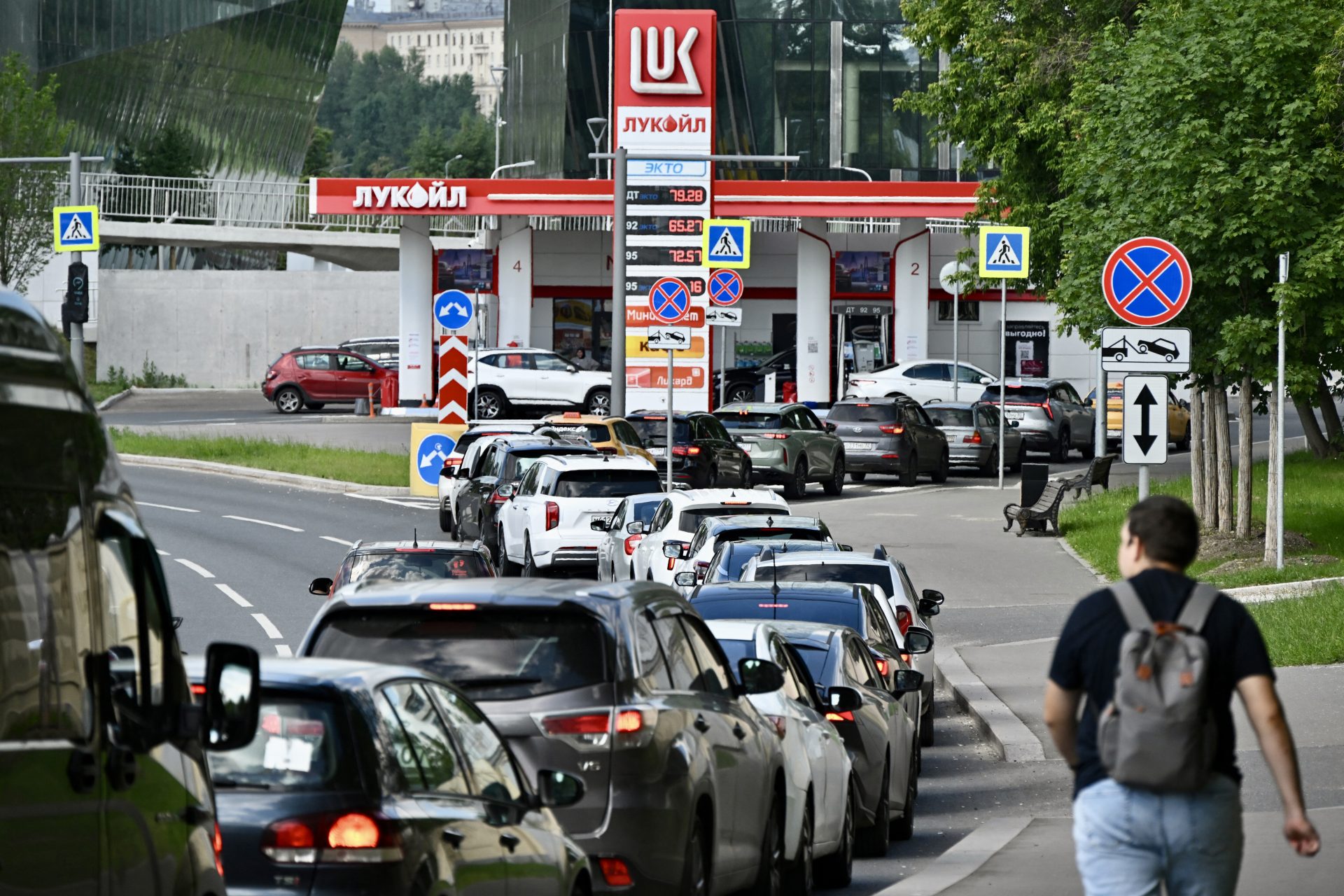
When you keep gasoline artificially cheap in the middle of a fuel shortage, obviously you will get huge lines at the pump. So why not loosen the prices, let them float upwards a bit to dampen demand?
The answer, until recently, is that while fuel shortages can be blamed on Ukrainian drones, higher gas prices will only be blamed on the regime itself. The Kremlin had faced a choice between higher prices or long lines — and has chosen the latter. Prices have generally crept up, but by less than cumulative inflation.
But that’s no longer a feasible choice. You learn a regime’s real priorities by what it clings to when it can no longer afford to — and the government held the price cap well past the point where it made sense. But over recent months, the strategy has begun to come apart: Russian retail petrol prices have jumped 20% in a year. In Crimean Sevastopol at the start of July, prices rose 30% in a week. Wholesale gasoline in European Russia is selling for roughly 1.5 times the official retail price.
So the regime did not, in the end, get long lines instead of higher prices. It got both. This was likely unavoidable, since past a certain point no subsidy conjures back a missing chunk of your fuel. But it highlights the difficult spot the regime has found itself in, with rising prices on top of the queue.
Neither higher prices nor long lines are popular. But of the two, the long line is the one that should keep Putin up at night, because of its dreaded public aesthetics. The Kremlin has spent years constructing a war that’s real but distant. Moscow life has proceeded as normal, and nearly all information about the war arrives pre-filtered. But this carefully managed veneer cracks a little more with every intrusion of the war into everyday life, whether it’s a refinery burning in Moscow’s outskirts or a long line of frustrated drivers on its roads.
Unpopular autocratic regimes survive by preference falsification; private doubts stay that way because every sceptic has to assume they’re alone, so they keep quiet. But the gas line is the opposite: a very public assembly of everyone privately doubting their government’s capacity to provide basic necessities. When RFE/RL reports that the shortage is “the only thing they’re talking about”, that should worry the Kremlin more than any capacity statistic, and surely explains why a ban on fuel exports has now been extended into 2027.
In a poll conducted this spring, even before the worst of the shortage, 60% of Russians said economic conditions were worsening. That’s a 20-year record. Trust in the military, in the government, and in election integrity all saw the largest annual declines ever recorded. The fuel crisis has arrived in a country already more anxious than at any point since the three-day “special military operation” began.
The US had its own fuel shocks in the Seventies, and it saw similar line-ups of frustrated drivers. Those too were a policy choice: President Nixon’s price caps turned the embargo shock into a shortage, following the same electoral logic. But an American waiting for gas in 1974 was suffering something new. A Russian in 2026 is watching a rerun of the bad old days, with all the visual markers of shortages and hoarding that Putin promised would never return. This was the deal he offered to Russians exhausted by the Yeltsin years: “stay out of politics, and I will keep the shelves stocked and your savings intact”. But the promise of predictability in exchange for a free hand, already damaged by the invasion, is now dissolving.
Even beyond the Soviet Union, Russia has been here before, with local gasoline crises made worse by peak summer driving seasons. Each faded by autumn. But this is different. The drones are getting through because Russia’s air defences are being hollowed out by a methodical Ukrainian campaign against the radars and interceptors that once protected Russian refineries. The numbers are hard to confirm from the outside, but a careful look suggests Russia has been using up its interceptors faster than it can replace them, partly because it’s repurposing them into offensive missiles aimed at Ukrainian cities.
The American oil shocks of the Seventies had political consequences, sinking Jimmy Carter and helping give Ronald Reagan his victory in 1980. That queue’s political frustration had somewhere to go. But in Russia, Putin has spent a quarter of a century welding the release valves shut. That’s why the regime appears so worried about the September Duma elections. Senior officials floated postponing the elections due to the drone campaign, and one Duma deputy has warned that the fuel crisis will cost the ruling party seats.
“No remote e-voting or three days voting periods will save certain people,” she concluded gloomily. Despite all the carefully stage-managed results, there is only so much you can do to cover up spreading public dissatisfaction. You can falsify a ballot. But you cannot falsify the queue.