




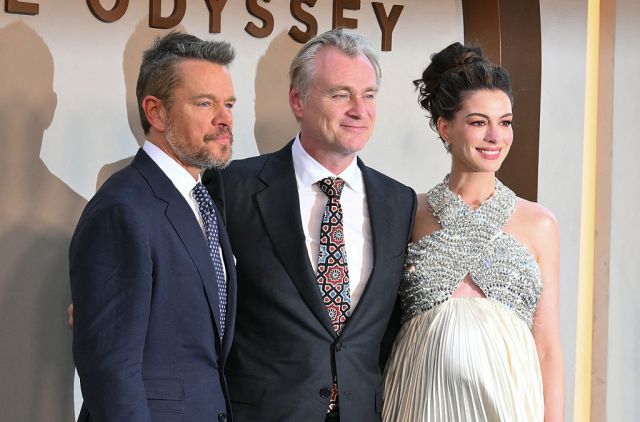
Christopher Nolan (centre) with Matt Damon and Anne Hathaway. (Angela Weiss/AFP/Getty)





I held off on seeing The Odyssey. I wasn’t sure why. Maybe I was flinching from the thunder of publicity — crammed with promises of spectacle, the unspeakable and the momentous, before the bogus and the bombast set in. Respectable newspapers were sounding off about the cinematic tradition of Homer, and the introspection of Christopher Nolan. So I held back (as Odysseus might have done).
I waited six days. But still the theatre was packed (my wife and I had to sit in the front row, and she clutched my hand in the Polyphemus scenes where poor Bill Irwin was doing his technological best to scare us — chewing live Greek soldiers, et cetera). The audience seemed ready for a large Wow! But there was an odd silence, as if some subversive word had got around. It can be fascinating to watch an audience watching a film: and it’s unmistakable sometimes, the way respect can turn to regret.
Anyway, our full house sat through it, as dogged and drained of passion as Matt Damon’s weary, soured college professor Odysseus. But, like Matt, we weren’t with it — and if you’re going to cherish large audiences at the movies you have to hope for a kind of communion. It’s like the crowd on a roller coaster, learning how every looming Up precedes a wipe-out Down. Great movies teach us their rhythm so that we may ride along on the thrill and the dread.
Consider the opening of Jaws. That film does not compromise with our attention: we are given no freedom. From the outset, there is the pulsing music (a rite of summer) and the relentless forward motion of some underwater hunter presence. The credits come up on top of this shot — as if to say, for a moment, don’t worry, this is the usual thing, the way movie stories begin. Be calm, like the ocean late on a summer evening.
We see a group of kids hanging out on the beach. We hear their vague chatter. We appreciate that a boy is looking at a girl, in the same old way. She gets up; he follows her. He calls out to “Chrissy”. The camera pans, left to right, just as it did in showing us the beach and the group. In silhouette the youngsters are stripping off as they run to the water. We know where they think they are going. The knowledge builds like arousal. That sea is so wet in the moonlight. We are taken over by the force of desire. So when Chrissy, in deep water, is startled by some mouth tugging at her, we are ravished, too. It is as if the god of cinema is sweeping us away. Before the story can start, we have been consumed by the divinity of the force. It is with us.
What on earth, or at sea, am I doing, apparently assigned to The Odyssey but talking about Jaws? I am trying to explain the gods — no, not the scenario in which big-G God struggles to keep his place. I mean the Greek gods, the cruel arbiters of fate that lurk beneath the surface of the Homeric story, and who have nothing to do with the strained moral aftermath of our God-nostalgic culture. Forget that trite scheme of apprehension — we are most gripped by music, a forward tracking shot and the certainty that our participation has been hijacked by the force. There is a god of cinema, and we like to feel it is a shark coming after us.
If you’re making a movie from Homer, that is the required state of helpless belief, like terror. In which case the face of Odysseus has to have a nobility that is growing older before our eyes; an erotic attention — because this film must be about watching and desiring; and a fatal, flawed power in him that is cunning but tragic. And that is not quite Matt Damon.
You can say you are showing the 10 years after the fall of Troy when Odysseus does not go home; you can string together a series of fanciful adventures, with or without special effects; you can make a pretence of saying, well, please understand that Odysseus is upset by that war he won, as if in grief or some convenient PTSD. You can ask Damon to put on armour, a helmet, a beard and guilt; you can give him tin lines when every time he opens his mouth he should utter music and existential anguish. “Oh gee,” says Matt, “I can’t do that. I’m only Matt Damon.”
Not that being Matt Damon is unworthy. He has been an ingenious, valuable supporting actor — that’s how Nolan used him as General Groves in Oppenheimer. That’s how, for 10 minutes or so, he was so electric in Courage Under Fire (1996) as Ilario, a liar who is coming apart. And there are many other pictures that place Damon highly as a professional. But it is in his straight-forward modesty that he will not be able to hide from us or himself that he doesn’t know what he is doing trying to be Odysseus. Matt is smart. He got into Harvard even if he didn’t finish there. But he cannot lose sight of how Penelope is more central or more now instead of tempests at sea and horrors in the caves.
Penelope is the wife of Odysseus. When he went off to Troy (and that was 10 years before the 10 years in which he pretends to be coming home), he left her with their son, Telemachus, as queen of Ithaca. And in what amounts to 20 years, Penelope has grown older, more rueful and intense in her longing for her husband. She is besieged by suitors who tell her Odysseus must be dead so won’t she marry them instead. Whereupon, the cunning wife — truly, they are suited — says she cannot take a new husband while she is weaving a shroud for her lost father-in-law. Thus she weaves, only to undo her tapestry at night while the suitors are asleep.
That is a beguiling narrative device (so close to the Scheherazade method) and it is a marvel, or proof of his thinness of imagination, that Nolan hardly attempts to show it. It is as if he fears tapestry will bore us — so let him play at the travails and adventure, frantic scenes of battle, and the infinite landscape of journeying. Did the director decide that his audience would lose interest without lavish swordplay, terrifying monsters et cetera? Did that distract him from the remembering face of a woman growing older yet more confirmed in her feelings of love (because love flowers best when it is not realised)?
The pity of this failure is that Anne Hathaway seems capable of being a mature Penelope. The actress is 43 now, and brave enough not to magic that away in so big a picture it could determine the rest of her career. Hathaway looks her age. She has consented to what can be a fatal candour in an era of so many new lies with screen skin. This is all the more admirable in that the same screen offers Lupita Nyong’o in only a few shots as a plausible version of “the most beautiful woman in the world”. And then there is Charlize Theron as Calypso.
Theron is 50 now, and she does not look it. No need to ask how that has been accomplished. Let’s just say that she is there or thereabouts in this incoherent narrative as a woman on the beach in a nice line of après-swim wear (off the shoulder and off the soul), wistful with longing for Odysseus. We get the point — that he and she have been exploring their inner lives for five years or so. (We guess the screen Penelope has been seeing them in her dreams, sewing and resewing the tapestry.)
To be blunt about it, in screen terms — or in what we actually feel struggling with the ramshackle narrative — Odysseus has not gone home because Calypso is such an obliging lay. Nolan does not need to show the engineering of their coupling. The best bodies in this film belong to the Trojan horse and the ship that Odysseus sails. Give that designer an Oscar — the only one the film deserves.
Am I being too facetious in treating a movie project where gods have withdrawn to leave room for the $250 million budget? That money is a god as fierce as anything in Homer. So the picture goes to so many tourist-ready locations — you can imagine cruise ships following the itinerary. It thrills to the Trojan horse (so Nolan films it in every way he can count). It exults in the ship, no matter that it is several centuries too modern. It still leaves room for inexplicable things — what is Zendaya doing in the film? Yet it cannot inhabit the mystery of a marriage where the spouses are most in love when far apart and worrying over reunion. Fix on that and the picture might not need the sprawl of its 172 minutes.
A few years ago, another film, The Return, understood the sad poetics in Homer and presented Ralph Fiennes as an Odysseus exhausted by nobility as well as his journey. Juliette Binoche was Penelope. That film was only 116 minutes long, but its passage of time was more palpable. The Return is instructive because it drops most of the gaudy adventures to stress how Penelope does not quite recognise Odysseus on his return. She has to learn him again, and that is poignant because Fiennes and Binoche have a history on screen: The English Patient and a Wuthering Heights.
I am not offering a conventional film review. But I’m prompted by the busy emptiness of this Odyssey, such that it is only worth writing about if one can suggest some remedy or alternative. Nolan is adorned now in reputation and budget, but he has a history of missing the point. On Dunkirk, he neglected how Germany let so many soldiers escape on the hard beaches, instead of driving them into the sea. On Oppenheimer, he had no time for the refugee mathematicians making the Bomb sweet, or the Washington that approved the venture, so “Oppy” became the fall guy. And so with The Odyssey, he overlooks how a modern film might make the story gripping.
Would it be compelling now to take the difficulty in believing in the Odyssey as your subject? Imagine a film unit roaming the world to film “adventures”, with pliant actresses on every beach. Then think of the director’s wife at home in Beverly Hills, wondering how her god is doing in IMAX, while studio suits come calling to take her to Palm Springs for the weekend. And Hathaway is halfway there already. But Odysseus needs a late middle-aged irony, and the hip asides of a droll director who sees how fatuous and tiring the Odyssey is. And maybe Penelope does succumb here or there — in the way Odysseus does what any guy is likely to do on the loose. Think of George Clooney as this distracted director. Do I see a comedy? I think I do. Something to jostle the stupor of this aimless epic. When I saw it — in that packed theatre — as it ended a couple of people tried to applaud. Their clapping died a death as no one else joined in. The movie was greeted in silence — not the quiet of deep emotion, but a mix of fatigue and disbelief. We’ll see how long its glory lasts.
I’m thinking of a movie about smart careerists who can’t understand why they’re making The Odyssey. Not when the locations they go to are ravaged by fire, flood and famine so that it’s all the director and the actress can do to swap a wisecrack in the morning. When the budget of the picture is such a Polyphemus it has become the film’s true subject.
It might have its moments, as when Odysseus wonders if “home” will be there still, let alone his wife; or when Penelope is about to undo her tapestry once more, with fingertips raw from the needles, and recollecting how a god once warned her not to get into secretarial work or sewing. Whose is the face she keeps putting in the weave?