




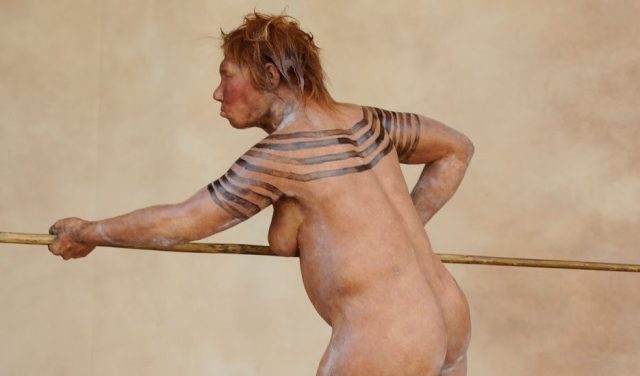
An artist’s rendition of a Neanderthal woman. (Joe McNally/Getty)





To become a father is to be plunged into a world of stories. Dragons, tigers, talking bears — some of them half-remembered, from when they were read to me — every night before bedtime. No parent needs an anthropologist to tell them there is something primordial about putting your child to sleep. But could there be something more? Can we make out in our stories, like smudged handprints on a dark cave wall, clues to our deepest history? For the past two years I’ve been reading board books, I’ve kept wondering: are all those giants, wild men and ogres a flicker of memory of the Neanderthals?
“The fairy tale,” wrote Walter Benjamin in 1936, “…is the first tutor of children because it was once the first tutor of mankind.” You don’t need an academic to see ancient fears of predators and strangers in the woods, bundled together in stories like “Little Red Riding Hood”. But what academia can do is begin to date these narratives. This has allowed us to trace “Little Red Riding Hood”, and its close variants like “The Wolf And The Seven Kids”, back at least 2,000 years to the Eastern Mediterranean. From there, it spread through the Roman world into Europe, down the Red Sea into East Africa, and along the Silk Road to East Asia, to be told again and again, what must be millions of times a day. Modern academia can also help identify patterns: like the fact a hominid-like wild man from the Himalayan Yeti, to the Australian Yowie, to the Scandinavia troll or the Old English woodwose — exists in practically every culture.
This is eerie given what we now know. The idea that these could be the faintest of imprints of lost hominids has crept into plausibility as our understanding of humanity’s deepest past has changed. The first Neanderthal remains were only discovered in Germany in 1856, and only in the last 20 years have new remains and a revolution in genomics revolutionised our understanding of ancient humanity. The familiar graphic of humanity’s evolutionary lineage — first a chimp on all fours, before rising over his stooped hairy predecessors a man standing tall — has collapsed into a final group photo before an abrupt extinction of other hominids that left sapiens alone on Earth.
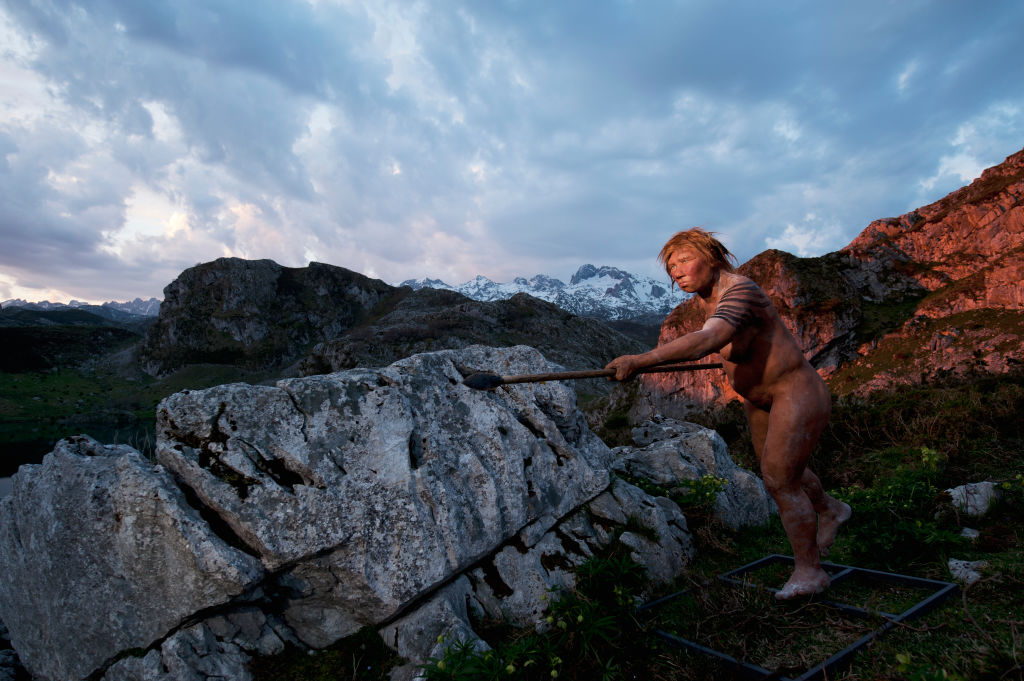
It’s now clear that we shared Earth with at least four other branches of the genus homo — with which we interbred. This startling discovery was made as recently as 2010. These were the Neanderthals in Europe; the Denisovans in Asia, only discovered in 2008 from a single finger bone, and of which only a dozen remains have since been found; and two ghost populations in Africa inferred from modelling. This revelation — that we were a wider humanity, a species with sub-species — has been accompanied by breakthroughs in archeology. This began in 2003, after yet more hominids were found in South East Asia, and which overlapped with early man. One such individual, the hobbit-sized Homo Florenesis in Indonesia, caught the world’s imagination with his diminutive size.
More to the point, these archeological developments have transformed our knowledge of Neanderthals. They were more “human” than we realised: using fire, smoking hides, distilling birch tar, wearing jewellery, ritually burying their dead, even practising a kind of primitive dentistry — closer to many old folktales than to apes. At a distance, it would have been hard to tell them apart wearing furs and ponchos. But there were giveaways. They were a bit bigger than us, their eyes around a fifth larger under a ridged forehead, with little chin, and they were probably light skinned: unlike our own ancestors. It would have been an unsettling mirror.
How long were we together? Paleoanthropologists divide human history between anatomically modern humans, who emerged around 300,000 years ago, and behaviourally modern humans showing signs of art, symbolic thinking and sophisticated tool-making — gradually building up over 150,000 to 50,000 years ago. Drawing on fragments and hypotheses, we can only ever date fuzzily in deep history: with margins for error spanning tens of thousands of years. But we can deduce from our anatomically modern history that we shared the world with other humanities for nine tenths of our existence.
How constant our contacts were with the African ghost populations we simply cannot say. Perhaps habitual. Maybe fleeting. But of the Eurasian humanities, this would not have been a constant contact: Neanderthals and Denisovans were occupying vast territories as yet unexplored by sapiens. But there was contact in frontier zones like the Levant, where we know that Neanderthals interbred with sapiens: both from dating our DNA, and from the burial of a 140,000-year-old half-Neanderthal child, some 90,000 years before Europe was systematically colonised by sapiens. That colonisation, as caves like Grotte Mandrin in France make clear, was not a single obliterating wave — but a 12,000-year period of overlap between Neanderthals and ourselves made up of successive expeditions.
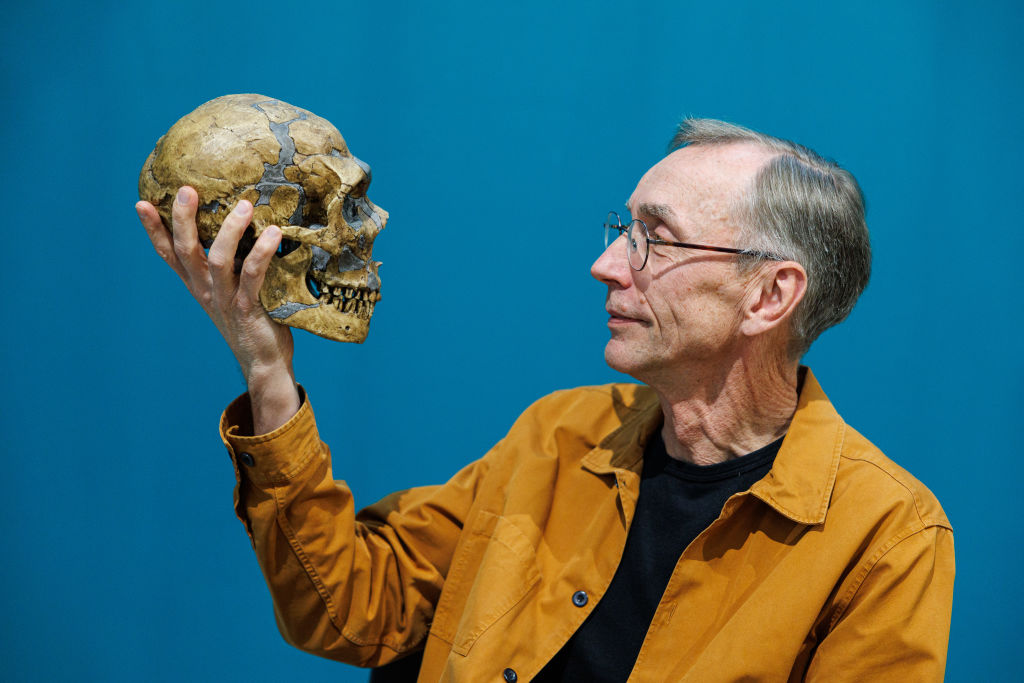
Our ancestors, then, for perhaps most of our behavioural modernity, needed to be aware of Neanderthals. But can we faintly remember them? This requires us to date their disparition. The French archeologist Ludovic Slimak writes hauntingly about the archeological record — “Neanderthals are there and then they are no longer there” — some 40,000 years ago. There is something unsettling sensing their final encounter with sapiens settling Europe sifting through tens of thousands of ancient flints. We see the Neanderthals’ distinctive tool-knapping technique: each slightly different, as if following the rock, compared to the brutal and identical sharpness of the humans, indistinguishable from the slopes of Levant to the Rhone valleys. This is what an encounter with a super intelligence looks like, and it is unnerving as we face our own at the dawn of AI.
“Neanderthals were not a civilization,” writes Slimak. “They were hundreds of civilizations collapsing like dominoes.” Never very numerous, destabilised perhaps by the ferocious temperature oscillations of the late Ice Age, Slimak believes Neanderthals were broken up into small groups and outcompeted by us in a way instantly recognisable to anyone familiar with modern colonisation. Their last possible traces — not bones, but those distinctive flints — can be found in the two furthest corners of the continent: above the Arctic circle in the Urals plateau, and in the caves of Gibraltar, some 29,000 years ago. The same fate awaited the Denisovans, and perhaps the hobbits of Flores.
But do we in the faintest way in our stories remember them? This begs the question of how long can we remember anything. Here, recent research by Professor Patrick Nunn in The Edge of Memory is revelatory. Our world has changed enormously since behavioural modernity. We not only live in an empty world but a drowned world, one utterly reshaped by massive coastal flooding from the end of the Ice Age. Yet Nunn has documented 21 Aboriginal stories which recount exact locations off coastal Australia there is no way modern inhabitants could have known about. From vanished islands to marshes and land bridges — not least the one to Tasmania — these memories of what must have been sudden and shocking sea-level rises can be dated to between 7,500 to 12,000 years ago.
But we do not have to go all the way to Australia to find ancient memories. Nunn’s recent research has concentrated on the west of the British Isles, where countless examples of old Cornish, Welsh and Irish storytelling, like tales of the lost land of Lyonesse, recall vanished coastlines stretching out into the Channel and Atlantic. Our geological research has now caught up with the storytelling. These were not, as the archaeologist Osbert Crawford first suggested, the fantasies of “the dreamy Celt”. Rather, the geological record suggests a faint memory of the traumatic loss of the Ice Age coastline — with some tales being able to pinpoint bits of the Scilly Isles lost some 9,000 years ago.
Intriguingly, in the East of England, where the loss of the vast plains of Doggerland stretching towards Germany was even more dramatic, there are next to no folk tales of lost lands, despite fishermen for centuries picking up mammoth tusks and tree trunks deep out at sea. Historical genetics gives us the answer why: while the population in those western regions are largely the descendants of those living there during those cataclysmic sea-level rises, those on England’s eastern coastline were largely replaced by Angles, Saxons, Jutes and Danes in the Dark Ages.
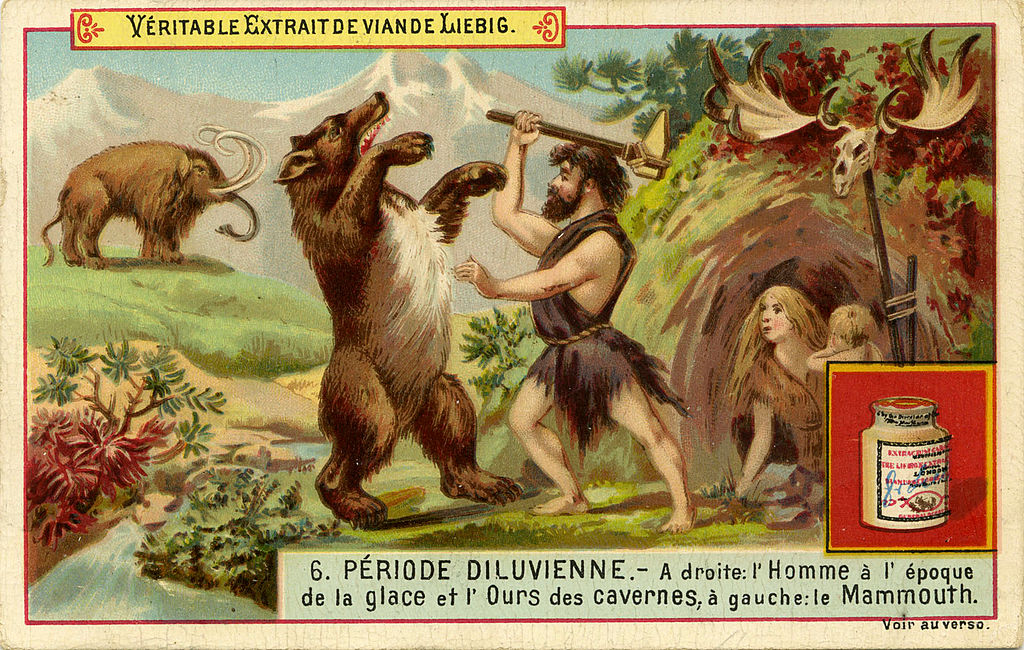
The edge of memory when it comes to events seems nowhere close to 20,000 years ago — and far short of the last traces of the Neanderthals. But there might be another explanation for our ancestors’ fascination with wild men, ogres and giants: their encounters with the fossil record. Because if you have never seen a woolly mammoth or a gigantic extinct cave bear — let alone a dinosaur — and you dig one up and try to arrange it, what comes out looks rather like a monstrous giant.
In her brilliant book The First Fossil Hunters, Professor Adrienne Mayor compares fossil deposits to Ancient Greek and Roman accounts of the discoveries of gigantic bones and heroic skeletons. In so doing, she shows that these finds convinced our ancestors that there had once been a time of giants. During what she calls the “bone rush” of the 7th and 5th centuries BC, the Spartans found the massive remains of their hero Orestes while the Athenians dug up Theseus and gigantic bones attributed to Ajax in spots we can now pinpoint as rich with fossil deposits. Not only did the Emperors Augustus and Tiberius gather chambers of wonders of gigantic bones — which must have been fossils — they also gave instructions on how to bury giants’ bodies that suddenly were exposed in what we know are rich deposits.
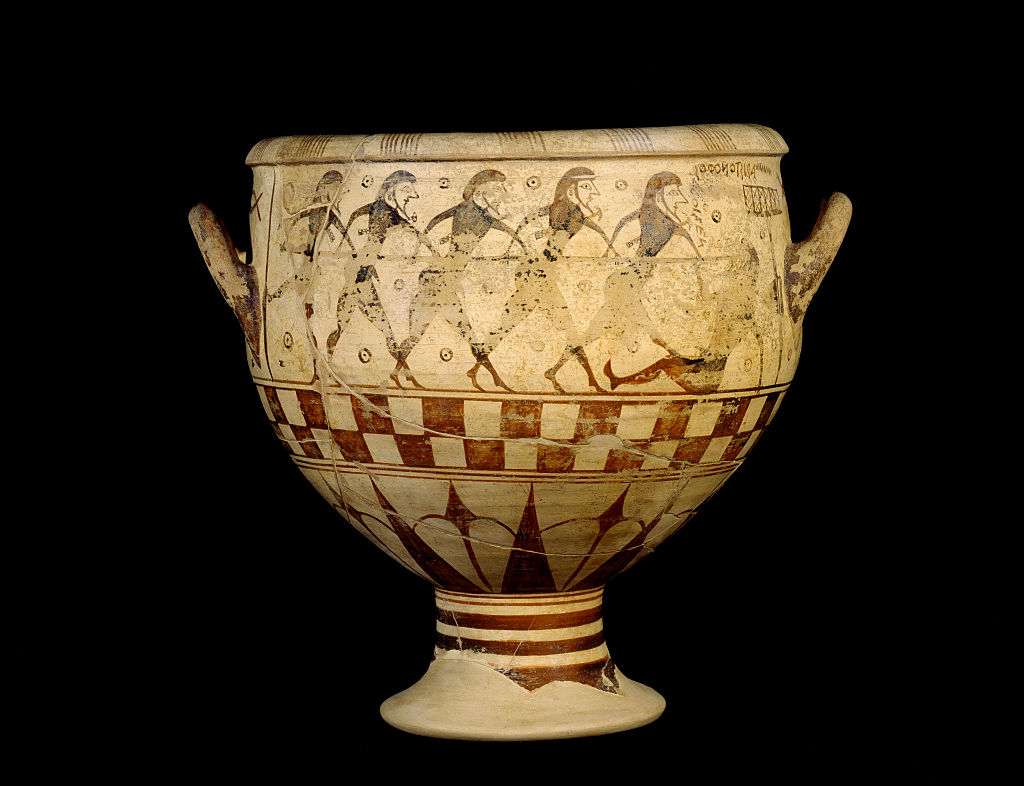
We now know, in other words, that the temples of the ancient Mediterranean were in fact full of the kinds of tusks and bones that you might today find in the Natural History Museum. Not only is moving giant bones mentioned in the Epic Cycle about the Trojan War — where Trojan seers prophesied the Greeks could only win if they found the bones of the hero Pelops, whose giant shoulder blade they promptly dug up — there is clearly a fossilised skull, depicted as the beast of Troy, on a 6th-century BC Corinthian vase. These assumptions lingered, as a drumbeat for belief in the background, until modern archeology offered an alternative. And we have extensive evidence of this: from Herodotus and Pausnias inspecting curious bones, to Boccaccio watching Sicilian peasants dig out the skeleton of a giant in 1371, to the important paleontological discoveries made in Chinese drugstores selling “dragon bones” in the 19th century. But if our hominid stories are only fantasies from bones, why the specifics and persistence of Yetis, Yowies and wild men?
Flores in Indonesia is the island where we might find an answer. Here, on an island where apes never trod, not only have archaeologists found the hobbit-like remains of Homo Florenesis — anthropologists have also found an incredibly rich and naturalistic storytelling tradition about ape-men. There is something so specific about these tales, recalling cave burnings to smoke out very violent ape-men, that they just might be recalling some memory of living side-by-side with another species. Could this be where the edge of memory touches our lost cousins? This is especially possible when the rarity of fossilisation doesn’t preclude the idea that there weren’t lingering Homo Florenesis thousands of years past the dates of their last known remains. We don’t know. Only archaeology, and time, might eventually tell.
Yet the fact these stories endure today suggests a third explanation: buried deep in the psyche. There is something uncanny about reading accounts of the Flores ape-men, with their tellers even believing they’re still out there, spotted thieving food or by field huts, found dead at the roadside or glimpsed in the higher forests. Might our minds, after so long evolving together, be so strongly wired with the pattern recognition to spot other hominids that we will hallucinate them until the end of our days? Fairies die out only to be replaced by aliens. Hominids from space, this time, not from the forests and caves. Phantom limbs, phantom siblings, still living with us forever in our stories.
