




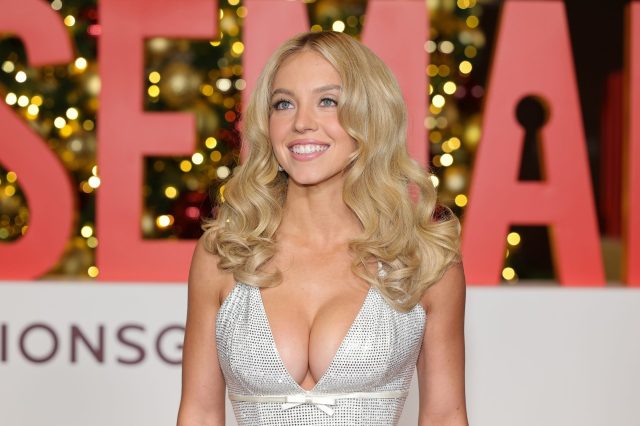
Sydney Sweeney: MAGA? (Dia Dipasupil/Getty)





In 2021, a professor of psychology at Stanford called Michal Kosinski downloaded one of the many basic open-source facial recognition software programs from the web and applied it to a massive set of images of people’s faces. Kosinski had collected clear, naturalistic images of nearly 1.1 million people from the US, UK, and Canada of all ethnicities: the largest sample, of 860,000, came from a US dating website, and the rest came from Facebook profile pictures. He trained this off-the-shelf facial recognition software on those images and asked it to predict the political orientation of the people in them by comparing them to another large database of faces that belonged to people whose politics were known.
Chance would give you a correct result 50% of the time. Humans, when they’re asked to say whether a face is conservative or liberal, do slightly better and get it right 55% of the time. The software Kosinski used was able to accurately guess the political orientation of the people represented 73% of the time. In statistical parlance, that represents a “large” effect size. Nor were the results country-specific: when the algorithm was trained on US faces, it could still distinguish between liberal and conservative faces in Canada with 68% accuracy, and in the UK with 67% accuracy. Some demographic markers are pretty obvious — in the US, white people, older people and males all lean slightly more conservative. But even when Kosinski excluded that data, the accuracy only dropped a fraction. Working off tiny visual cues like head pose (the roll, pitch and yaw of the head) or facial expressions such as surprise or happiness, the algorithm could still tell a person’s politics from their profile picture with 71% accuracy.
Our minds influence our faces. There are obvious ways in which our make-up choices, or our hairstyles, or our particular style of facial hair or jewellery also reflect our values. The assumptions we make about the politics or aesthetic preferences of someone in goth or emo make-up, or the clean-shaven young man with a perfect Fifties side-parting, are probably fairly accurate. But our faces also affect our minds.
When I was in my early twenties, an old friend invited me to a political meet-up for young Eurosceptics organised by some friends of his in the Conservative Party. I had already been to lots of similar gatherings, but for the much poorer and smaller, centrist Liberal Democrats: fundraisers, policy events, even a couple of party conferences at second-rate hotels in down-at-heel seaside towns. My expectations of a political meet-up were bad lighting, the kind of snacks you’d find at a petrol station, and cheap white wine in a box.
Not this political meet-up. The young Conservatives had commandeered a 15th-century cloister in Westminster Abbey. Beneath the medieval fluted arches and ornate coats of arms, they entertained each other with tales of European corruption and technocratic overreach. There were canapés on trays served by waiters in uniform, and wine that came in bottles. And the women were beautiful — lucid complexions, advert-ready hair, a sense of poise, and elegance, each cloaked in a halo of perfume. A pretty strong incentive to switch political allegiances.
I reasoned with myself. These young people were just polished. They were just rich. They could afford good clothes and decent hairdressers. They could afford healthy food and expensive skincare and smart cologne. But the thing is, they were beautiful — at least by my standards. Their faces did seem more symmetrical, their bodies looked like they adhered to some golden rule of aesthetics. They were just more handsome than the political types I was used to over on the other side of the political spectrum.
I filed that slightly galling experience under “Conservative Honeytrap” and didn’t think about it again until I read an article in the Guardian in 2018 that triggered the memory. Rather bravely, it informed its Left-leaning readership that a large scientific study proved that attractive people tend be Right-wing.
The researchers Rolfe Peterson and Carl Palmer analysed two large surveys from the Fifties and Seventies in the US which, apart from testing for personality and political and social attitudes, had also rated each of the 15,000 participants on a five-point scale for attractiveness: from 0 — which they euphemistically described as “homely” — to the “strikingly handsome or beautiful” at 5. They found that the dreamboats and the heartthrobs were more likely to identify as conservatives and Republicans than their less attractive counterparts. It wasn’t a one-off: lots of other studies have shown that people with traditionally desirable physical traits — tall men and women, men with high natural upper-body strength and women with symmetrical faces — tend more conservative. Conventionally attractive people tend to gravitate towards conservatism, and there’s a very simple explanation why.
Beautiful people live in a slightly different world from the rest of us. It’s a kinder world; people assume better of them and strive to make things easier for them. Beautiful people are less concerned with inequality — perhaps the central issue of Left-leaning politics — because they have experienced less of it, have felt it working against them less. On the contrary, it tends to work in their favour.
Strangers are kinder to people who are good-looking. At birth, babies with symmetrical features receive more direct eye contact and warmer treatment from their parents than their plainer siblings. It’s even at work amongst people we know aren’t models of probity — attractive criminals get lower sentences. Being good-looking also means people attribute other nice qualities to you. From their earliest years, attractive people are seen, without evidence, as more intelligent, more honest and more competent. Teachers pay more attention and give better grades to attractive students. Employers pay attractive people more and promote them faster: there is a “plainness penalty” on salaries of between 10 and 15%.
Teenagers call this “pretty privilege”. Winners of the physiological lottery spend their lives surrounded by people who treat them nicely, assume the best of them, and have confidence in their ability to achieve great things. Their looks help them do better at school and at work, as well as on the social and dating scene. All of which can lead attractive people to see the world as a wonderful place that provides opportunity and rewards those who work to deserve it. Just like them.
Some beautiful people are riddled with anxiety and self-doubt regardless of their beauty, and some are doubtless riddled with anxiety and self-doubt because of it. There are lots of extremely attractive Left-wingers and liberals all over the world, not least many of the stars of Hollywood, who are predominantly Democrats. But, on average, beautiful people tend to the Right because they are the winners of a certain type of inequality — they start the game of life with a superpower they don’t even recognise themselves having.
| All body types are beautiful |
 |
Because they live in a world that has offered them opportunity and success, attractive people can easily assume that the experiences of others have been the same. It makes them stronger believers in meritocracy (even if a big part of their “merit” is just being good-looking), more individualistic, less understanding of the underprivileged, and less likely to support government redistribution to address inequality. We can see from Parlia’s data (above) that their relative attractiveness also, perhaps unsurprisingly, correlates with being more interested in beauty standards.
We are, of course, talking averages and generalities, but the principle remains. Beautiful people vote differently in part because their politics are responding to a lived experience of the world that is simply different. They inhabit different realities from the rest of us, all because of the particular arrangement of their facial features.
Extracted from Why We Think What We Think: The Unexpected Origins Of Our Deepest Beliefs by Turi Munthe (Hutchinson Heinemann; £22).