




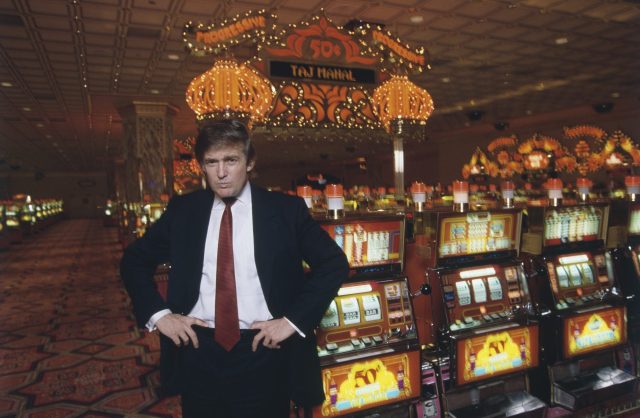
‘Even in an environment as tightly controlled as the White House, the borders of confidentiality are porous.’ (Rick Maiman/Sygma/Getty)





School’s out for summer — and for one White House staffer, months of seaside lolly-licking beckon. Yes, Gabriel Perez’s schedule is wide open now that he’s been placed on unpaid leave after the online prediction market Kalshi snitched to federal regulators. They alleged that Trump’s beloved teleprompter operator “Gabe” had placed bets on what the president would include in his speeches, the scolds. Karoline Leavitt, Trump’s press secretary, called the situation “a disgrace”; ABC News revealed last Thursday that Perez had allegedly won more than $100,000 by taking positions on speeches which he would seem to have had access to ahead of time — including the State of the Union address — in the so-called “mentions” market which bets on particular phrases cropping up. Kalshi recently introduced a requirement for bettors to disclose their employment; naturally, its policies prohibit insider trading.
Perez’s pratfall, if Kalshi’s allegations prove true, may seem the consequence of brainless opportunism. But the explosion of such sites portends the creep of betting logic into public life, moving from the bleachers (with sports-betting platforms like DraftKings or FanDuel) to pop culture, global conflicts and the Oval Office. At the time of writing, Polymarket — Kalshi’s cheekier, younger cousin which is crypto-native, decentralised and more regulatorily creative — allows you to bet on how many times Elon Musk will tweet in a week (160 to 179 posts is the most popular guess); whether the US will confirm aliens exist by certain dates (upwards of $63 million has been traded on this, and the odds roughly point to a 2.5% chance that the government will do so by 30 September); and on which dates Trump may “publicly insult someone”. You can bet on the next prime minister of Ethiopia (a de facto dictatorship, as it happens), the front page of The New York Times (“shocking”, “woman” and “rigged” are all popular punts) and the phrases said in the next episode of House of the Dragon (“raven”, “sword” and “wine” are all up there). You can bet on the next Banksy artwork or the end of the Strait of Hormuz blockade; senatorial primaries; Bitcoin prices; Love Island. In other words, every arena of our culture now springs up its own gamified markets, mushrooms in the dank crags of public life.
This in itself is nothing to cry about. Religious and moral objections to gambling are a question for another time, and there is little evidence to suggest that these new, diverse markets are roping in scores of new consumers, causing people to lose their homes over a bad roll of the dice on Taylor Swift’s baby names. There will always be “pigeons” to be suckered in. What is rather perplexing is the effect on the subjects of the markets themselves — the national or global events which matter to us and yet also now matter in a new, monetary way. The case of Gabriel Perez will no doubt chasten those looking to cash in on their proximity to public life, but for how long? As prediction markets swell — Kalshi is now valued at $22 billion, and Polymarket at $9 billion — what other “insiders” might spy the opportunity to turn a buck?
Even in an environment as tightly controlled as the White House, the borders of confidentiality are porous. Think about it: every day, every person of influence is likely to encounter an army of auxiliaries who at any moment could overhear privileged information. Bank tellers, family counsellors, pharmacists. For a nice little earner, wedding planners could short a celebrity marriage, security staff have a flutter on which stars will show up, and soldiers gamble on the capture of a Venezuelan strongman — except that’s already (allegedly) happened. Closeness to major events transforms being “in the know” into possessing insider alpha; with these new incentives, secrets become stranded assets. He who dares is not gambling on uncertainty — his privileged access means he knows the direction of travel — but rather on the likelihood of being rumbled. Taking that risk could set him up for life, and could far outstrip baseline salaries for clerical or flunky work. You can see the appeal.
Within the present White House, the temptation would seem to be irresistible. In the spring, administration lawyers probed whether anonymous five-figure Polymarket bets on the Iran war had come from within the Counsel Office; as it happened, the originators were impossible to identify. Three such accounts made more than $600,000 from wagers on the April ceasefire. What is it about this government that seems to be upping the ante of staffer venality? Arguably the problem is top-down; the president himself has, alongside his family, personally profited from the first year of his second term, pocketing upwards of $1 billion in crypto dealings and going so far as to sell high-speed access to his most influential Truth Social posts (the White House denies conflicts of interest). And even Pete Hegseth’s broker at Morgan Stanley looked to make money off the Iran war. Stories like the Perez scandal have created the unfortunate impression that Trump’s underlings are on the make; perhaps the ironically amoral and hyper-online young Republicans wheeling around today’s West Wing are especially suited to the prediction-market boom — or perhaps such (alleged) subterfuge would have gone on under a Harris administration, too, had it coincided with the betting boom. Insiderism is as greasy in Georgetown bars as it is in Westminster pubs, but monetising access seems likely to put rocket-fuel under the issue — remember Fayed’s cash-for-questions fiasco?
The “Kalshi-fication” of public life introduces new moral hazards. For one thing, the young men who are these markets’ ideal targets — risk-inclined, sports-betting fluent, forever “monitoring the situation” — are likely to bleed money they don’t have. Prediction markets don’t have the same state-by-state restrictions as traditional gambling in the US; they are classed instead as commodity futures trading, more aligned with stock, oil or metal markets than football scores. The polished language of these pinstriped pursuits buffs out the traditional sweaty desperation of your average high-street horse-racing punters, blinking back tears as they stumble skint out of Betfred. Much better to fuss about “positions” and “event contracts” than grunt over vig, kitty or bets on tick. Once, a boxer might have had to have his face turned to mincemeat for the sore promise of “throwing” a match; now, having your hand on the scale is as simple as clicking through an app. No clandestine meetings, no dodgy dealings.
Yet the grubbiness is the same. These markets shine a blacklight across public life, showing just how many of its constituents have newfound leverage, the satellites to power, the tiny hedge funds. And just as match-fixing ruins sports, betting on outcomes in politics feels undeniably rotten. The halls of power are venal enough; these sites only introduce more moral variables. The inevitable result would seem to be crushing paranoia that the choreography of governments is lashed to profits on an app. How can we be sure it isn’t — especially when dealing with the less accountable, crypto-led regulatory landscape of sites like Polymarket? The Oval Office is not a casino floor; no Caesars Palace should have nuclear codes. And the invisible stagehands who run it should not become market-moving insiders — a state of affairs which is up to both prediction sites and governments themselves to prevent.
Chillingly, too, this shadow economy casts a pall over public trust — of course it does. When we monetise bombings, oil shocks, climate disasters, they transcend their real meaning and must be inspected for peripheral contracts, fingerprints. There’ll be a run on tinfoil hats among a public already nerfed by anti-media paranoia: there’ll be corrosive speculation about things being slipped into speeches, about the blurred lines between prediction, participation and authorship. Citizens watch history and traders watch positions; when these two ways of looking atrophy and combine, the result is suspicion. In Kalshi-fied America, the stakes are not just dignity, sincerity, discretion: they are conspiracy and cold, hard cash.
