




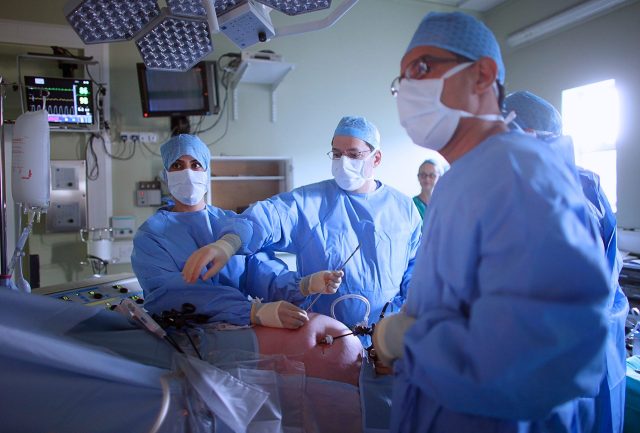
‘Every pound a consultant pockets from a Friday afternoon meant for the NHS is a pound the taxpayer has paid for’. (Christopher Furlong/Getty)





On 1 March 2019, managers at Basildon University Hospital needed to find one of their most senior obstetricians — fast. The Care Quality Commission was in the building asking pointed questions about the women’s and children’s department, and Dr Moboladale Ojutiku was supposed to be there. He was not. He was, it later emerged, 40 minutes away at Chartwell Private Hospital, seeing patients on the taxpayers dime.
Readers might be shocked, surprised, or even disgusted by this. I’m not. As an A&E consultant, I occupy the relative moral high ground here. Almost nobody moonlights in my speciality: there is very little private emergency medicine in the UK. In my 20-odd years of practice, I’ve never once had to weigh a patient’s care against my own bank balance. But I have spent two decades watching how normal it is for colleagues in more lucrative specialties to fund school fees and second homes by drawing supplementary salaries in private medicine while being paid to work for the NHS.
Ojutiku’s, subject of a Medical Practitioners Tribunal in June, is a case in point. Between April 2017 and May 2019, he undertook 44 private clinics on Friday afternoons for Ramsay Health Care, for which he was paid £24,000. The tail end of the working week also saw him paid £5,000 by the local NHS trust for “Supporting Professional Activities” (SPAs) — the block of contracted time set aside for teaching, audit, research and administration rather than direct patient care. The tribunal found the conduct dishonest and suspended him for 12 months. He had already retired from the NHS by the time the case concluded.
That’s just the tip of the iceberg. Though the NHS doesn’t collect data on the work that doctors undertake outside the public sector, a 2022 health department report suggests that “90% of UK private practice specialists work in the NHS as consultants”. Yet it’s equally important to stress that consultants doing some private work alongside a full NHS commitment is not, in itself, the problem. It is normal, contractually permitted, and arguably part of what keeps many senior doctors in the NHS rather than emigrating or going fully private.
However, every pound a consultant pockets from a Friday afternoon meant for the NHS is a pound the taxpayer has paid for, but unwittingly forfeited. And every patient on that consultant’s NHS list who goes unseen because their doctor’s attention is
divided — is unwittingly paying a price that nobody asked them to shoulder.
Crucial to understanding the problem at those SPAs, especially the way they’re seldom scrutinised systematically. Nobody walks the corridor at 4pm on a Friday asking to see a consultant’s audit report. Some colleagues treat their SPA sessions as a standing joke, free money that exists on paper and nowhere else. Ojutiku’s defence was that his SPA obligations were being completed elsewhere and at other times, so his Friday afternoons were his own. The tribunal didn’t buy it, not least because his trust had put explicit reminders in writing as far back as 2016 that no private work could happen during SPA or on-call time.
More than the money, that reaction is the part I recognise most. Whenever I’ve challenged a colleague for taking on private work, the response is never “fair enough, that does look bad, I’ll do better”. It’s always some shoulder-shrugging variation of not understanding what the problem is, followed by business as usual. That’s despite the fact that the rules being abused, bent and broken are hardly obscure. The department of health’s code of conduct on private practice, in place since 2004, makes clear that private practice should be declared and reflected through a consultant’s agreed job planning, and that it mustn’t prejudice NHS patients or NHS time.
What is unclear, though, is how often that gets enforced, because in every case I’ve dealt with personally, detection has depended on luck rather than any systemic check. I can think of two orthopaedic consultants I’ve worked alongside in the NHS who maintained enormous private practices. I rarely saw them. Their registrars and senior registrars managed their NHS patients for them. Eventually, one of my colleagues confronted one of them about the fact he constantly went missing and left his juniors to do his job for him. There was an awkward silence — and then, nothing happened. Elsewhere, I once had to track down a registrar’s consultant over a deteriorating patient by working my way round the switchboard and assorted secretaries until I finally reached him mid-session at his private rooms. I was told, more or less, that it was my patient and thus my problem to manage.
One of the most notorious examples of an NHS consultant abusing his position right across the public-private healthcare spectrum is that of Ian Paterson. Paterson lied to hundreds of healthy patients, terrifying them into believing they had cancer so he could perform unnecessary, invasive, and deeply damaging surgeries. On actual cancer sufferers, he conducted “cleavage-sparing” procedures that left behind breast tissue, often resulting in the return of cancer and, in some cases, the deaths of his patients.
In April 2017, he was convicted of 17 counts of wounding with intent and is currently serving a 20-year prison sentence. Over his career, he performed unnecessary operations on more than 1,000 patients for the Heart of England NHS Trust and at private hospitals, Spire Parkway and Spire Little Aston. These included hernia repairs, varicocele operations, and needless mastectomies, leaving his victims violated, mutilated, and psychologically traumatised.
As the judge pointed out in Paterson’s case, he was driven by “greed, self-aggrandisement [and] power” — a trifecta that motivates a dangerous minority of rogue consultants.
There is a structural point buried in this that goes well beyond individual doctors behaving badly. Most independent hospitals in Britain do not employ consultants directly. Instead, they rely on NHS consultants, who hold practising privileges to undertake work which is supposed to sit outside their NHS commitments. That matters more than it sounds, because it means the private sector isn’t adding new medical capacity to the country at all; it’s effectively renting the NHS’s own capacity back to whoever can pay for faster access to it.
Colleagues in the surgical specialties describe something they call the “conversion rate”: the proportion of patients seen in a private clinic — an outpatient consultation, distinct from the follow-up review of an existing case — who go on to be booked in for a paying procedure. A clinical examination or review earns very little, while a procedure earns a great deal, and I have heard more than one consultant admit that their threshold for operating is lower in the private sector than in the NHS clinic down the corridor, because that’s where the serious money is.
There’s no single authoritative, up-to-date figure for what moonlighting doctors earn. Private earnings aren’t centrally reported the way NHS pay is, while consultants bill privately as self-employed income or through a personal company and declare it via self-assessment. But we can make some educated guesses. According to April 2026 statistics, the basic salary in England for an NHS consultant runs from £113,565 to £150,570 depending on seniority. Including non-basic NHS pay elements, average annual total NHS earnings across all consultants are an estimated £161,600 for those with a full-time contract. That’s NHS income only.
When it comes to private income, meanwhile, estimates are much softer, since there are no equivalent national numbers to the ones cited above. But colleagues and industry intel suggest that additional private earnings come in at around £50,000 to £150,000 a year on top of NHS pay — if not even higher — concentrated heavily in a handful of specialties like ophthalmology, orthopaedics, cardiology, dermatology and cosmetic-adjacent surgery.
As most private hospitals bill for the total package — hospital stay, anaesthetist, theatre, consumables — rather than what a consultant actually pockets, the surgeon’s own fee is usually a separate, smaller line within that package. The Private Healthcare Information Network (PHIN) publishes these prices broken down by procedure, which gives an idea of the package price versus the surgeon’s own cut. Orthopaedics, by far the biggest “conversion rate” earner, prices a replacement package between £11,000 and £17,000, with a consultant’s fee typically running into a few thousand pounds within that. Cataract surgery, in ophthalmology, costs about £2,000 to £4,700 per eye per package, depending on provider and lens type, with premium London clinics charging over £4,000. In general surgery, gallbladder removals come in at £5,500 to £8,500 per package, while hernia repair is around £3,200 to £5,500.
The average NHS consultant is capable of knocking out dozens of moonlit procedures a year — so you can see where the temptation comes from. Many consultants I know opt for the private coin because, like everyone else, they suffer from status anxiety. As one colleague once remarked to me, “That Bentley isn’t going to pay for itself.” I know of a case in which a surgeon, working across an NHS trust while simultaneously working at a nearby private hospital, had his private caseload reviewed and was suspended. A substantial share of his procedures were deemed to have been unnecessary or requiring further scrutiny. Nothing was ever proven at tribunal, and the case remained a serious allegation rather than a finding of fact — but it again illustrated the conflict that exists between NHS and private practice.
The private sector’s ability to offer a patient an appointment within a matter of weeks or even days, when the NHS list for the same consultant runs to months, is not an independent achievement or an advertisement for free-market efficiency. With an NHS waiting list totalling 7.3 million, a significant number of patients in need of specialist procedures, and a median waiting time of 13.3 weeks, moonlighting consultants are having a field day. Remember: it’s a finite pool of around 107,000 NHS consultants potentially redirecting themselves toward whoever can pay to jump the queue, with medical demand far outstripping clinical supply.
Patients can easily spot this hypocrisy — and the British Medical Association’s own ethics guidance is candid enough to name it outright. A patient who pays for a private consultation can, on returning to the NHS, join the waiting list at the point their clinical need dictates, gaining a real head start over someone waiting for an NHS referral to the same specialist. I have sat with a patient on my own ward, admitted with a gallbladder problem, while the surgeon looking after her mentioned, in passing, that she could see him privately the following Tuesday and be operated on before the following weekend, saving months of waiting. He was doing his NHS ward round at the time. Nobody in the room seemed to think that was worth remarking on except me. Certainly, very few other professions can market their own side-hustle so shamelessly.
To be fair, the powers that be aren’t totally blind to these issues. In its latest report to Parliament, the Medical Practitioners Tribunal Service (MPTS) concluded 185 substantive hearings in 2024, down from 250 in 2023. Of those hearings, 77% resulted in suspension or erasure (permanent removal from the medical register), compared with 68% in 2023. The figures show that fewer cases are reaching tribunal, while a greater proportion of those that do result in the most serious sanctions. The statistics alone, however, do not establish whether tribunals have become more punitive, or whether less serious cases are increasingly being resolved before reaching a hearing. From 24 November 2025, the MPTS introduced new tribunal guidance with formal sanctions bandings, intended to improve consistency and transparency in decision-making.
To put this in context, at the end of 2023 there were 378,054 doctors on the UK medical register, 10,031 of which the General Medical Council (GMC) had concerns about, of which 814 met the statutory threshold for investigation. In other words, the overwhelming majority of concerns never get to tribunal for a plethora of reasons, including colleagues exercising their own form of omertà. Ojutiku’s case was only uncovered because a hospital in crisis happened to need him for something else on the wrong Friday. Much like police officers, lawyers, politicians and other professions built around trust and hierarchy, doctors quickly pull ranks to protect their own. Loyalty within the circle often trumps any ethical concern about what’s being protected.
That leaves one more question — to what extent does all this actually affect patients? As far back as the early Nineties, Parliament and the Commons Health Committee debated whether consultants’ private practice was affecting NHS waiting lists. Apologists argued that most consultants worked well beyond their contracted NHS hours and that chronic underfunding, rather than private practice itself, was the real driver of delays. Both claims were probably true then, and both are probably still true now. What has changed is the scale of the incentive. With the Government leaning further into private-sector capacity to hit its elective care targets, the pool of NHS-employed consultants with a foot in both systems, and a financial reason to blur the line between them, is only going to grow.
It would be wrong to read one tribunal ruling — or a few consultants grumbling from the sidelines — as evidence that NHS doctors are, as a rule, taking the taxpayer for a ride. Most colleagues I know declare their private work properly, job-plan it as the rules require, and take the distinction between the two systems seriously. But the honesty-based framework that is supposed to police the boundary depends almost entirely on a colleague being willing to report what they’ve seen, and on nobody being unlucky enough to need the doctor in question when things go belly up. One only has to think of how a reluctance to speak out has led to multiple scandals — and tragedies — in maternity healthcare, for instance, to conclude that silence is often akin to complicity.
That silence has a cost that patients pay in full — and too many doctors capitalise on, sadly. It rears its ugly head as longer waiting times, a rushed clinic, a specialist going M.I.A. or a complication that might have been caught if the consultant treating you hadn’t been stretched across two systems at once.
That Ojutiku was, after all, not undone by an audit or a whistleblower, but simple bad timing, should worry patients more than it worries doctors. Every consultant quietly running a parallel private income on NHS-contracted time is a consultant whose clinical judgement carries a financial incentive their NHS patients never see and never consented to; and every patient who pays to skip a queue is skipping it in front of someone who cannot afford to. Most of my colleagues would never behave the way Ojutiku did. But the system has no reliable way of telling the honest ones from the ones who haven’t been caught yet, and until that changes, patients are right to wonder whether the doctor in front of them is treating them fairly, or fitting them in at a price.