




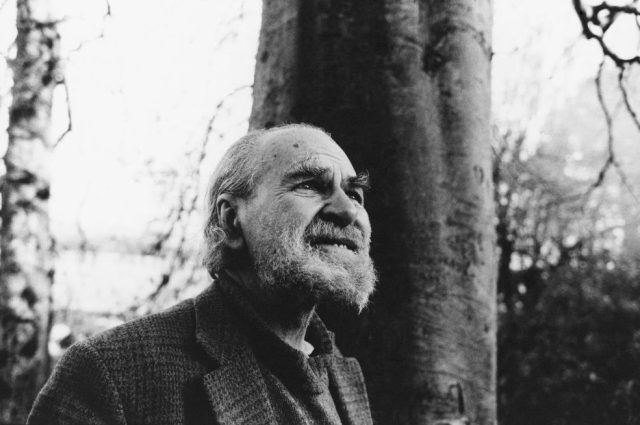
Basil Bunting in 1970. (Neil Libbert/Getty)





On Monday we said hello to Britain’s first born-and-bred Northern prime minister since Harold Wilson. It would be fair to say that Andy Burnham has not been shy in heralding this fact. In his speeches, interviews, and campaign literature, references to New Order and the Stone Roses, Northern Soul music, and the poetry of Tony Harrison are never far from the surface. Meanwhile, in a more concrete, structural sense, tackling regional inequality with schemes like No. 10 North looks set to be the grand theme of his premiership.
Though Burnham is probably unaware of it, there is in fact a striking literary precedent for his pro-North viewpoint in the figure of the 20th-century modernist poet Basil Bunting. An older, less accessible figure than Harrison, Bunting was one of the inventors of the idea of “the North” in the modern sense. Against the backdrop of the Burnham moment, and on the 60th anniversary of Bunting’s masterpiece Briggflatts — a milestone that has been met with oddly little fanfare — the example of his life and work is worth exploring.
Born in Tyneside in 1900, “amid rejoicings for the relief of Ladysmith in the Boer War”, Bunting, who would die shortly after the end of the Miners’ Strike in 1985, was a sort of avant-garde Forrest Gump whose life embodied the modernist century. Raised a Quaker, and sent to Leighton Park School in Berkshire as a teenager, Bunting divined early on that his Northernness set him apart from Edwardian England and its regional power dynamics. During one severe bout of homesickness, he wrote to his Leighton Park headmaster identifying a “grand underlying difference between North and South which makes people with Northern manners comfortable & easy to deal with, but people with the Southern manners… ‘impossible’ & hateful.”
This feeling of antagonism towards the English centre would combine with Quaker principles to motivate Bunting’s refusal — on grounds of conscientious objection — to take part in the final months of the First World War, after a call-up when he reached adulthood in 1918. As Bunting’s friend the actor Denis Goacher later put it, the subsequent abuse he suffered as a “conchie” in Wormwood Scrubs, “coloured all he thought about England, about the Establishment, the ‘Southrons’ as he called us… this experience embittered him for life”.
Bunting’s embrace of a cosmopolitan strand of literary modernism after his release from prison in 1919 was clearly in some sense the outcome of his rejection of English tradition. Crucially, he met the radical modernist provocateur Ezra Pound while playing a “swashbuckling kind of chess” in a Paris café in 1923. When Pound bailed Bunting from a Parisian jail a few weeks later after a drunk-and-disorderly episode, their friendship was firmly set.
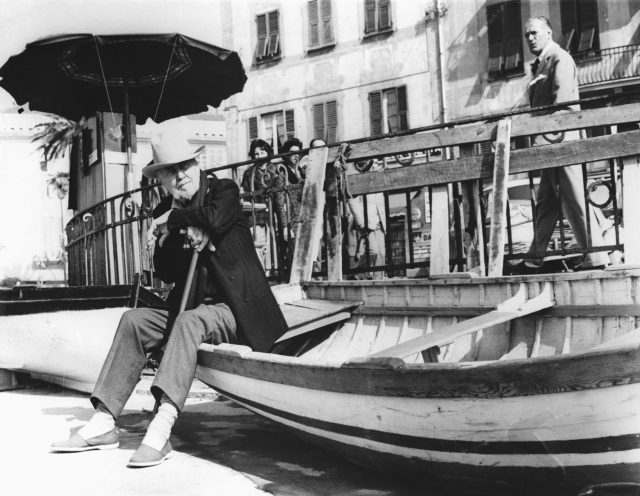
But in choosing to side with the strident anti-English experimentalism of the “Ezuversity” — a Pound-centred expat community based in the Italian seaside town of Rapallo — Bunting was further distancing himself from mainstream Anglophone literary culture. Though this was the creative making of his mould-breaking early poems (admirers included William Carlos Williams and W.B. Yeats), Bunting’s association with the uncompromising avant-gardism of the Pound school meant he was effectively blacklisted by the Thirties London literary set and its publishers. After some years of dwindling prospects — and a climactic 1938 quarrel with Pound over the latter’s Mussolinian fascism and antisemitism — Bunting stopped trying altogether. Over the next three decades, his life as a poet would be exchanged for work as a sailor, RAF officer, and journalist.
Bunting returned to the North East in the postwar years, where he worked unhappily at the Newcastle Evening Chronicle and seemed destined to retire in what the literary establishment deems to be “provincial obscurity”. But then, in the mid-Sixties, came a sudden declaration of independence. After a fateful encounter with the teenage poet Tom Pickard, a self-identifying “dole walla” from working-class Tyneside, Bunting became a leading figure in the Morden Tower poetry scene in central Newcastle. A repurposed room in the city’s medieval town walls, Morden Tower was developed as a countercultural “omphalos” by Pickard and his partner Connie from 1964. It would eventually treat its Geordie audience (in Bunting’s estimate: “half academics, half teenagers, with a sprinkling of thugs”) to live offerings by Allen Ginsberg, Lawrence Ferlinghetti, Robert Creeley, and Alex Trocchi, among countless other beatnik luminaries.
In a country where London’s hold over literary discourse was and is hegemonic, the happenings at Morden Tower were in themselves a rare victory for Northern civic empowerment. But it was Bunting’s revitalised literary output after this Sixties awakening that would suggest an imaginative starting point for a new form of Northern regionalism — a mostly undeveloped entity prior to this point.
The sounding shot in this Northern rising was Briggflatts. A modernist “short long poem” loosely resembling T.S. Eliot’s The Waste Land, Bunting’s masterpiece was published in the first weeks of 1966 — an annus mirabilis for radical English anomalies of all kinds. It quickly became a cause célèbre in the Anglo-American counterculture, and indeed in the more hidebound English literary scene that Bunting had hitherto been excluded from, bringing a passionate assertion of Northern English identity to a global readership.
In the mythopoeia Bunting elaborated in Briggflatts, “Northumbria” worked as a shorthand for Northern England as a whole. The unique stylistic texture of the poem, first announced in a memorable opening stanza, incorporates a modernist pastiche of Old English alliterative verse. Bunting uses this mode to evoke a pastoral idyll, ostensibly a remote corner of the Yorkshire Dales (the land around the seminal Quaker site at Brigflatts [sic]):
Brag, sweet tenor bull,
descant on Rawthey’s madrigal,
each pebble its part
for the fells’ late spring.
Dance tiptoe, bull,
black against may.
Ridiculous and lovely
chase hurdling shadows
morning into noon.
May on the bull’s hide
and through the dale
furrows fill with may,
paving the slowworm’s way.
As the poem progresses, we abandon this youthful arcadia for a more epic regional canvas. Interwoven with a personal story of Northern exile and return is a Waste Land-esque collage of Northumbrian history: as well as the glimpses of early-20th-century Brigflatts in the poem’s opening section, we encounter the ghosts of legendary Border shepherds (the Wilsons and Telfers); the warriors of the ancient Welsh poem Y Gododdin (which is set mainly in what is now North Yorkshire); and the creators of the beautiful Lindisfarne Gospels. At the thematic heart of the poem, Bunting inserts a diptych embodying Northern good and evil: the vainglorious “last Viking king of Northumbria” Eric Bloodaxe, and his angelic counterpart Cuthbert (the 7th-century patron saint of the original Anglo-Saxon kingdom).
Having drunk deep from the well of Northumbriana while constructing this regional fantasia, Bunting would devote much time in his later years to a sort of pro-North cultural programme. In a late-20th century context where Scottish and Welsh nationalist movements were surging — Bunting was a close friend of Hugh MacDiarmid, the militant godfather of the Scottish Renaissance — he tried to work out how far a Northern English analogue might be taken. In large part, this was a case of teasing out the cultural examples spotlighted in Briggflatts. During his brief Seventies tenure as president of the funding body Northern Arts — an organisation founded by the controversial Newcastle politician T. Dan Smith, another ardent localist — Bunting put forward the Lindisfarne Gospels and other ancient northern landmarks (such as the Bewcastle Cross and the poetry of Wordsworth) as a basis for a distinctive Northern imaginary.
But though Bunting’s focus was largely an aesthetic one, he would also take steps to make clear the wider political implications of this project. At the same time as the first substantial modern discussions around English devolution were gathering pace — culminating in the half-baked constitutional recommendations in the 1969 Redcliffe-Maud Report — Bunting would talk, only half-jokingly, about setting up passport control at the Humber. He offered discount rates for poetry readings inside Northumbria’s ancient boundaries, and spent much time researching historic rebellions like the 1569 Rising of the North as he sought to compose a follow up to Briggflatts (as it happened, no such work was forthcoming prior to Bunting’s death in Hexham in 1985, though a handful of shorter lyrics did see the light of day).
What to make of the legacy of all this? We should probably start by acknowledging the limits of Northern English devolutionary schemes that go too far down the road of nationalism proper. There were elements of essentialism and chauvinism — even if often tongue-in-cheek — in Bunting’s literary King of the North schtick, which his contemporary heirs would do well to avoid (Bunting’s late-period reading style, for example, was based on a rather affected old Northumbrian accent, which many listeners have found to be slightly ridiculous). Bunting’s “Northumbria” took in most of the North, but its southern border was the Humber-Ribble line (because of a rather arbitrary linguistic technicality). Such footnotes highlight a familiar problem with attempts to construct regional polities within more established national frameworks: the fact that no-one can agree where the North ends and the South begins (let alone the yet more ambiguous Midlands).
Nonetheless, Bunting’s vision for greater Northern cultural empowerment remains pertinent because the contexts that inspired it have not gone away. When it comes to literary publishing — and the same is true for culture and indeed politics more broadly — England is still an astonishingly over-centralised country. In an overwhelmingly urban nation, the vast majority of publishing houses, media organs, and political institutions are still based in just one of our dozens of cities (the so-called Big Five literary publishers, for example, are all headquartered in London). The fact that this reality has been exploited and worn-down to a cliché during a decade of chatter about the “left behind” and the “metropolitan bubble” does not mean that it is not still an urgent problem.
If Burnham’s critics are perhaps right to say that he doesn’t know exactly how to achieve regional devolution in the long term, then neither did Bunting. But then again, it is much harder to envisage a fairer, more equal future than to be critical of the status quo. In the end, Bunting’s example reminds us that when it comes to imagined communities, it is the imagination that must lead the way. As a poet and lone individual (rather than, say, a prime minister with a large parliamentary majority), Bunting was inevitably circumscribed in what he could recommend when it came to plans for Northern political renewal.
But his cultural assertions were surely enough. Writing to the Scottish poet Gael Turnbull in the late Sixties, Bunting described a “tree of life” carving on a medieval tombstone in Hexham Abbey:
“It is very beautiful, and if it really is as late as the 12th century, it shows how the life goes on, underneath all the suppressions and oppressions.… [This is] my kind of art: the firm line, the counterpoint, the essence, not the illusion, the intricacy, not the confusion. I want more of it, a Northumberland as fertile as any land you can mention.”
As these comments suggest, Bunting believed that in working out how to construct new political realities for the North of England — realities that might put an end all the “suppressions and oppressions” — we should take inspiration from the “firm lines”, “counterpoint”, and essential vitality of the artefacts buried in its deeper history. A “culturalist” suggestion this might have been. But there is surely something to be said for the idea that the starting point for political reform must be a realisation of cultural heritage — in other words, of the collective consciousness that makes regional identity meaningful in the first place.
In this light, all the cynicism directed at Burnham’s Northern cultural offering in recent weeks seems misplaced. Maybe he is onto something by kicking off his premiership by dad-dancing to New Order’s “True Faith”. There is a long, arduous road ahead for the devolutionary schemes that will likely define the Burnham government. But perhaps the new prime minister is right to grasp that a transformative political project must begin not with exhaustive policy documents, but with the sort of unifying, emotional, imaginative foundation for collective praxis provided by art, poetry, and music. Bunting at least would have agreed.