




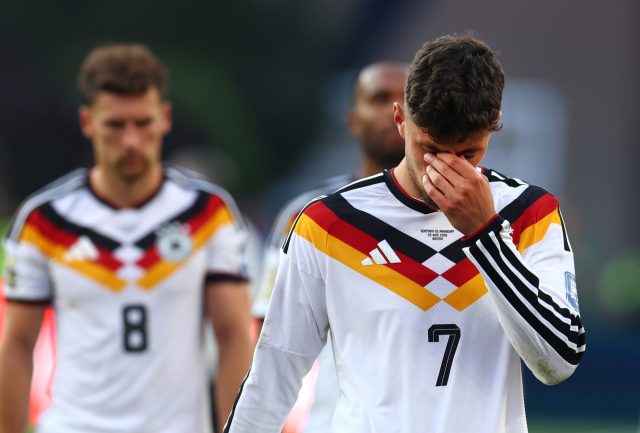
Welches Spiel, Friedrich Merz? (Robert Cianflone/Getty)





Can it be a coincidence? For three World Cups in a row, Germany has failed to make it to the last 16. For the 16 previous tournaments — from 1954 until 2014 — it never failed to reach the quarter finals. You can be unlucky once, or even twice, but three times? Especially when we see a similar pattern in the Euros, this failure can’t be explained away by the glorious randomness of football.
The year of the 2018 World Cup also marked a turning point for the German economy. Until then, it was considered one the most successful in the world, a reputation it had enjoyed almost without interruption since the Second World War. I spent a lot of time back then warning that Germany’s strategy was not sustainable — even if it superficially seemed to work. From 1945 to 2018, after all, Germany was Europe’s manufacturing powerhouse. The last eight years, though, have been marked by deindustrialisation, price spikes, and persistent economic disappointment.
In short, the parallels between the pitch and the boardroom are hard to miss. But there is one important difference: those in charge of German football are at least starting to act. They fired the coach, Julian Nagelsmann, and have started talking to Jürgen Klopp, probably the most famous German alive. The former coach of Liverpool and Borussia Dortmund wants to change the entire way the German national football is organised, and seems to have the backing of all the influential people in the country’s footballing establishment.
Alas, Friedrich Merz is no Klopp. He has difficulty tapping into the basic mood of the nation, let alone building a successful team. “What a game,” he tweeted blithely after the Nationalmannschaft lost to Paraguay on penalties last week. “With your commitment and team spirit at this World Cup you have thrilled our country.” Many Germans were left wondering whether their Chancellor had even been watching the same game. Welches Spiel (“which game”) soon trended on the country’s social media.
To be fair to Merz, he’s not so much the cause as the symptom — of a country that’s too old, too inflexible, too corporatist, too bureaucratic. There’s no one of Klopp’s calibre in German politics to speak truth to power, and put the economy on a different path. Besides, even if Klopp were to succeed in transforming the national team, it would take him some time to drag it back to its glory days. Achieving this for the German economy is incomparably harder.
The biggest thing that happened to Germany in the last 40 years is that it’s turned from one of the most innovative countries on Earth into a nerve centre of Luddism. Germans were the champions of 19th-century industrialisation, during which their scientific discoveries and engineering breakthroughs, not least the invention of the motor car, transformed the world forever. These days, though, Germany is one of the least digitised advanced nations around.
Of course, Germany isn’t alone here. France is hardly a beacon of technological innovation either. Still, France is one of the very few European country with an AI foundation model, even if recent rankings put Mistral, the firm in question, between 50th and 100th place in global league tables. The UK is also doing comparatively well, thanks to Google’s Deep Mind and its offshoots, but can hardly compete with the Silicon Valley giants.
The frustrating thing here is that Germany should have had a particular interest in digital technologies. Certainly, the German car industry should be at the forefront of AI research: autonomous driving will become the big earner for the sector this century. But the world leaders in this segment are American, Chinese and Israeli. The Germans tried to develop their own systems, but they have not succeeded.
Germany’s decline is to a large extent a “typewriter-versus-computer” story. In other words: they bet on the wrong technology. Fax machines still rattle in German doctors’ offices, and the country’s broadband connections lag far behind its peers.
There are other reasons for German decline too. China has been pursuing an aggressive policy to build up its manufacturing capacity. And, until 10 years ago, these developments complemented Germany’s own industrial strategy. The Chinese made consumer goods, while the Germans sold them plant machinery. That has since changed. China is now competing head on with Germany in segments, like cars and chemicals, that used to be German specialities. Not that I’d blame China for Germany’s decline, which is due mostly due to its own complacency, arrogance, and resultant lack of investment.
That’s also the story in football. One of the team’s apparent problems was a lack of training — and too much leisure. The successful teams of previous generations spent much of their time locked in training bootcamps. This is not a football-specific issue, but reflects shifts across society at large. In a recent survey of advanced industrial nations, Germans had the lowest number of working hours per year: 1,331. The country with the highest, at 1,898, was Greece. Of course, this is contrary to how Germans perceive both themselves and others, but the old stereotypes of hard-nosed Teutons and feckless Southern Europeans no longer hold.
When nations, companies, or football teams decline, delusion and denial often play an important role. I was in Germany after the first match in the group stage of the World Cup, when they beat Curaçao 7-1. After the victory, most Germans thought they’d already won the trophy. Ahead of the second game against Cote d’Ivoire, a local radio station in North-Rhine Westphalia asked listeners to predict the score. Around 100 people took part in the poll, and every single respondent predicted victory, with many expecting a romp. Germany won the game in the end, but it was close — not the kind of victory that should have warranted such a high degree of certainty. Against Paraguay, the final game, one fan-site poll had 89% in favour of a German victory. The reason the shock of defeat was so profound was the same reason Germans think Greeks are lazy: ignorance and arrogance.
Finger-pointing is a natural first response to a shock. In the football, everyone blamed the coach. Lothar Matthäus, a former World Cup winner, blamed the wives. They were a distraction, apparently. But neither the wives, nor the coach, can explain the phenomenon of three consecutive failures.
Same in politics. Germany’s decline didn’t start recently. In 2024, I published Kaput, a book on the German economy, in which I argued that Germany’s primary problem was not cost competitiveness, but a lack of innovation and scale. There’s no exchange rate that can make a typewriter competitive again. By the same token, petrol cars are still being sold, but they are a declining product, with declining profit margins. What happened to industry, then, is what happened in football. The world changed, but Germany didn’t. Why would they, when they were still rich and comfortable? Germany has one of the world’s most generous welfare systems, but this also means that there’s less urgency when the economy tanks.
To be fair, Germany still has several highly specialised companies in areas like mechanical and chemical engineering. One of those is Zeiss, best known for its camera lenses, but which is now more focused on precision-optics for semiconductors. Another is Trumpf, which had humble origins as a machine-tool manufacturer, and which is now one of the world’s leaders in laser technology. Leica, the old-school camera maker, is still in business and very profitable, having found a niche at the very top end of the market.
But if there’s still excellence around, there’s less than before. Certainly, decline will continue for some years to come, as the car industry shrinks. They will still make cars in Germany, but they will be made in factories owned or operated by China. And just as German car companies re-circulated their profits into the German economy, the Chinese will do the same back home. Hardly a week goes by without another German car-component manufacturer registering for insolvency. All the while, Germany’s industrial sector will continue to shrink, and it won’t come back. Remember what happened to Detroit? That city’s on the mend now, but it’s taken decades, and Germany doesn’t have the relatively dynamic, decentralised politics of the US.
Coalitions, constitutional law, the EU — all these conspire against change. So too do Germany’s politicians. Angela Merkel never saw her role as solving problems, but she was at least a competent manager of politics. Her successor, Olaf Scholz, was also well briefed, but politically not very effective. Friedrich Merz, though, is the worst-briefed German chancellor at an EU level, and totally ineffective. His deputy, Lars Klingbeil, the co-chief of the SPD, is also a deeply unimpressive figure, whose political support in his own party is questionable. Apart from the parties of the hard Left and Right, then, the Federal Republic’s leadership is poor. If a system doesn’t allow to produce change, it doesn’t attract the best people.
For football, at least, there’s hope. Klopp has dragged things back before. But there are no Klopps in European politics, let alone Germany’s. This is where politics and football differ. National teams reinvent themselves from time to time. But Germany seems unable to. And, for now, its people don’t even have football to distract them.
