




“It started with what people call boy-racer cars, but now, on finance and if you live at home or have a small rent, you can basically drive what you like”. (Jamie Bird)





It’s a Friday night at 9pm. I’ve been given the number plate of a car and an approximate location. It’s like waiting for an Uber, I tell myself, as I stand there on the edge of a rural road in the West Midlands. I hear a guttural roar in the distance and a lime green sedan soars into view and lands in front of me. “Ben” — whose driving ban recently ended — lowers the automatic tinted window of the passenger side and leans across the seat: “Alex? Hop in.”
We dash through the countryside at high speed, swinging round hedges and tripping over potholes. My increasingly sweaty palms lubricate the phone in my hand like I’m gripping a bar of soap. I ask him what model of car we’re in. “You don’t know an [Audi] S3?” he asks with gleeful confusion, turning his gaze to me, and away from the road that throws itself at the neon headlights. “No, I can’t even drive,” I admit. “You can’t drive!?” His confusion is warranted. Why wouldn’t I drive? The honest answer is that I started to learn, left home for university, and never sat behind the wheel again. Among the Lime-bike riding metropolitan set, not having a license would barely register as unusual; it would be virtuous even: one less dangerous car polluting the road. But where I am right now, outside the Tube map, in the suburbs and shires, cars are an essential part of life. I place my hand flatly against the roof as he crushes the accelerator.
We’re hurtling down a dual carriageway toward my first ever car meet. Mostly operated by organised groups, car meets are conceptually lawful but can devolve into unlawful or illegal activities like speeding, stunts, and antisocial behaviour. Events like this often occur at night in public spaces like retail parks, public roads and car parks — but can venture into the inner city where the attendant dangers of injury and death increase.
In June 2025, teenager Lewis Samuels was sentenced to five years in a young offender institution and a nine-year driving ban for causing the death of 23-year-old Connor Richards and injuring 11 others at a car meet in Lincolnshire. Samuels lost control of his vehicle and ploughed into a crowd of attendees. He was 17 at the time and had only passed his driving test 11 weeks earlier. The case was not an outlier. In Hampshire, police dealt with more than 200 offences linked to unlawful car meets in just over a year. In Northern Ireland — home to what enthusiasts routinely refer to as an “unhinged” car modification scene — there were twice the number of road deaths in the first four months of 2026 than in the equivalent period in 2025. In a House of Commons debate last year, MP Julia Buckley highlighted how drivers under 24 make up 6% of total license holders but represent 18% of all car drivers killed and seriously injured. This is, overwhelmingly, a young person’s game.
In recent years, various UK police forces have attempted to deter attendees from meets, issuing dispersal orders and written warnings, seizing vehicles and making arrests. In December 2024, the RAC conducted a freedom of information request to all 45 UK territorial police forces. The 13 that responded reported around 500 unauthorised gatherings taking place across the UK up to mid-October the year before. But given this is primarily a working class male hobby that relies on furtive behaviour, it is not easy to track. The subculture only tends to penetrate mainstream consciousness via anxious Neighbourhood Watch committees, a stray reel from boy racer Instagram landing in your feed, or a tragic local news headline about a teenager killed while speeding.
And yet car meets have existed as long as cars themselves. One of the earliest known examples took place in London in 1900. Organised by the Automobile Club of Great Britain, the “Concours d’Elegance” (“Competition of elegance”) was an opportunity for individuals to exhibit their vehicles and form a community. In post-war America, car meets became mainstream, partly as a result of Second World War veterans with newfound skills as mechanics customising muscle cars. In the Sixties, The Beach Boys soundtracked hot rod culture: their 1963 hit “Shut Down” is peppered with motoring jargon and tells the story of a drag race between a Chevrolet Corvette Sting Ray and a Dodge Dart.
Britain, meanwhile, developed its own distinct culture. The first known use of the term “boy racer” appeared in The Times in 1968 — the label is commonly reserved for young men who drive in an aggressive manner. Jeremy Clarkson, who has spent much of his career hymning this era of “proper cars”, recalled the rituals of his own youth in the same publication: “One day I fitted the engine with a chromed sports air filter and convinced my friends that it added another 100 horsepower. They would talk about their cars and then the sun would come up and we’d all drive home.” But these were the glory days of the internal combustion engine: pre-Congestion Charge, pre-ULEZ, pre-20mph speed limits, when cars were comprehensible, parking places plentiful and seatbelts optional. Britain now has many, many more vehicles on its roads than it ever has — but they are hemmed in, frowned upon, everywhere and yet on the margins. Nevertheless, one thing remains constant: young men want to push the limits of engineering while sharing the experience with likeminded enthusiasts. In other words, they’re keen to show off.
The operation is top secret. My driver had received the location for this car meet only an hour earlier. All details are provided last minute to a trusted contact list to limit the possibility of police intervention. As the location — an industrial complex of corrugated warehouses and offices — rises into view, the concentration of surrounding speeding vehicles increases, like pathogens, weaving among the flow of ordinary traffic. We turn off an A-road and form a decelerating convoy that joins the dozens of parked cars that barricade the entrance road to the factory district. “It’s the police versus us,” Ben reminds me with Che Guavaran gusto. After coming to a stop, I pluck my fingernails out of the dashboard and stumble onto the wet tarmac.
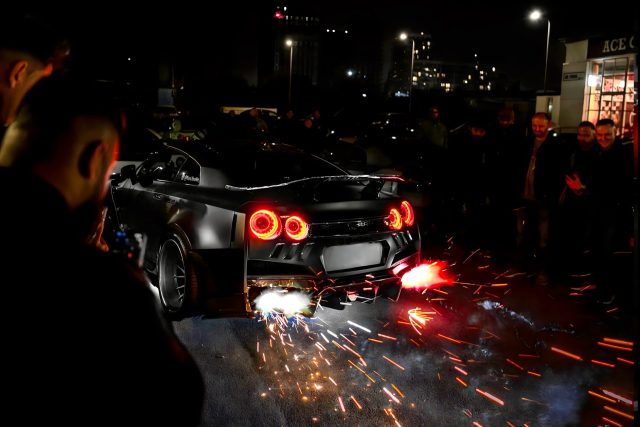
The air is misted with tyre fumes, pyrotechnic smoke, and Elfbar vapour. A barrage of bangs, whines, and bass-heavy music orchestrates my path as I make my way on foot toward the distant jamboree. Fireworks scream into the air and crimson flares erupt from the crowd as dozens of us approach the clouded spectres.
I hit a contingent of black puffer jackets and nudge my way through. Two cars are doing donuts on a small roundabout, their tyres burning. People cheer. Passengers hang out of all available windows, whiplashed as if riding a rodeo bull. Then the chaos suddenly ceases. The police arrive, on foot. Clad in high vis, they resemble a row of traffic cones as they amble toward the crowd. The puffer jackets disperse, not with the panic that follows a speakeasy raid but with a purposeful nonchalance. They rustle into their cars and the ephemeral hive disperses into the night to reassemble elsewhere. Ben decides it’s best if we both go home.
Disappointed, I approach a police officer. In principle, he says, they’re “All for” this kind of thing. “If you’re seventeen and like your cars [and] want somewhere to go with likeminded people, then it’s perfect.” But he stresses that there is a safer option: “Static car meets don’t kill people. Street racing, doing donuts, and breaking the speed limit does.”
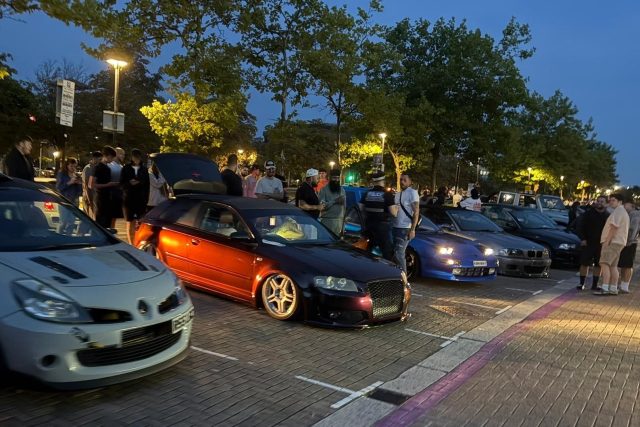
The static car meets he refers to are a more benign part of the subculture. These consist of people driving to an area, parking their vehicles, and talking to one another. There are no races or stunts. Instead, there is a more diverse crowd of attendees (men and women of all ages) and a continual police presence. According to one of my contacts in the car meet world, such an event happens every Sunday in a car park in the centre of Milton Keynes. Unlike other car meets: “No one runs it or organises it, it’s just been a thing for so long to meet on a Sunday at that time that people just attend.”
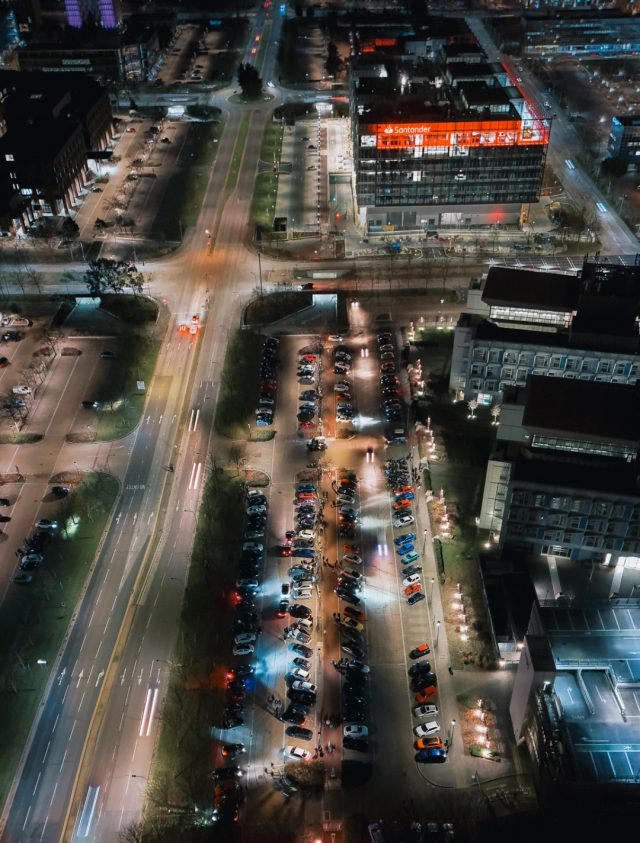
Another source takes me there the following weekend. The sun hasn’t yet set as we navigate the cardinal grid and roll into a car park outside the Network Rail offices. Dozens of parked cars sputter, whine and pulse. Music blares. Pairs of police officers meander. There’s a carnival atmosphere. Even for a non-enthusiast like me, some vehicles are objectively beautiful: Porsches, Aston Martins, and what I’m informed is a Lamborghini Aventador are in attendance. In the far corner, a cluster of discarded motorcyclists mingle among themselves.
The need for recognition is ubiquitous, exemplified by the custom-made stickers of Instagram handles plastered across car windscreens. The cars that attract the most attention are not the most expensive ones but, rather, the ones that have the most modifications. A burgundy Audi A3 is encircled by a mob of outstretched iPhones. A woman in her mid 30s, in a clubbing dress and black heels hangs out of the passenger seat. The ajar door, pock-marked with speakers, produces a bass so monumental it explodes her hair like an electrocuted Looney Tunes character. She poses for the cameras and films herself before being led away by her partner, the car owner.
I chat with a group of women sitting in a crescent of fold-out chairs. Some dandle (ear-plugged) babies; others sip tins of gin. None took their own car and most have partners nearby. I am offered some apple cake by a lady whose facial studs put me in mind of a Chesterfield armchair. After coming alone for four years, she has now made friends on the scene. She would be “just sat at home” if she wasn’t here. “Everything else costs money,” she notes. “I love the cars, I love the modifications and I never feel intimidated.”
Night descends. Lampposts and headlights are illuminated. The music volume rises and the frequency of bangs and revs increases. I meet “Ryan” who is in his mid 20s and works as a Team Leader in a highstreet chain’s warehouse. He drives a premium brand of car which he’s modified with a “lowered suspension, more tyre grip and some bolt ons”. He claims his vehicle is worth “over 50k”. “The types of cars people bring have definitely changed,” he says. “It started with what people call boy-racer cars, but now, on finance and if you live at home or have a small rent, you can basically drive what you like.”
He has a point. Around 90% of new cars bought privately in the UK are now reportedly financed using personal contract purchases (PCPs). The model is simple: pay a deposit, make lower monthly payments, and at the end of the contract, you either hand the car back, pay a lump sum to own it, or roll straight into a new deal. Buyers like Ryan don’t use a PCP to reduce their monthly payments; instead they use it to afford something flashier at the same cost. The result is that a young person living at home, pocketing a modest warehouse wage and eating his mum’s food, can pull up to a car meet in something previous generations of enthusiasts could only dream of.
What Ryan is driving at is that having a limited income no longer means you must accept a limited speed. He pays over £1,000 a month (over half of his income, working six days a week) paying his car’s finance and upkeep. Despite living at home, he can’t think of anything he’d rather spend his money on. A 2023 survey by the King’s Trust found that two thirds of 18-to-24-year-olds have lowered their career aspirations and expectation for financial security. Half of those surveyed said they weren’t planning beyond the next six months. According to the Office of National Statistics, there are over a million 16-24-year-olds not in education, jobs, or training (NEET).
What Ryan’s £50K car provides that, say, a one-bedroom flat does not, is a thrill. He regularly races with friends and is “addicted” to the “freedom” that comes with driving fast. I ask him how he feels when people describe his behaviour as dangerous and his eyes gloss over. “I’m just being myself,” he says. “I can’t change the fact we find it exciting.”
Stood in the warmth of exhaust fumes and glow of headlights, Ryan regales me with tales of the car community battling the police: driving bans, arrests, daring escapes and close calls. He boasts that “[The police have] been pelted with eggs and flour bombs, had their tyres slashed” and shows me a video that appears to show a police officer punching a young man in the face — framed as an unnecessary retaliation. These stories clearly feed back into the culture’s mythos, YouTube-friendly updates of Marlon Brando in The Wild One growling: “Nobody tells me what to do.” In that classic movie, lawbreaking is represented as a tragic symptom of societal failure — but perhaps Ryan is unaware such stories are doomed to end in tragedy.
On the road adjacent to the carpark, a motorbike goads the police by maintaining a wheelie. It’s an invitation to test the boundaries that others predictably accept. The more weathered enthusiasts, however, are not impressed. “It’s so fucked up people start acting like dickheads,” says one. I start talking to “Pete” who is in his 50s and wears wire-framed glasses. He’s been coming to the Sunday meets for over a decade. “It used to be a bunch of fellas, mostly my age, with an actual passion for motoring,” he says. He seems like he’d be more at home at the sort of car meet that involves bunting. He doesn’t seem to realise he is surrounded by hundreds of people just as enthusiastic about motoring as he is. The difference is that, despite their relative generational poverty, car finance schemes have given them access to the sorts of cars it would have once taken half a lifetime to afford.
The atmosphere shifts. “Tyler” tells me the police have “tried clamping down [on this static car meet] for years, tried loads of different enforcements and plans, but nothing works”. Like an oncologist observing a tumour, law enforcement now consign themselves to a policy of watchful waiting. Two patrol cars are parked nearby, there are a dozen police officers on foot, a police van tactically placed near the exit and reflective signs declaring the area subject is to a “public space protection order” — with “car cruising / racing” specifically prohibited.
These orders are one of many tools authorities use to attempt to assert some control. Thames Valley Police Force informs me over email that the difficulty lies in car meets being conceptually legal while the sorts of anti-social behaviour they give rise to are not — “and that’s why we monitor them”. The police can issue a Section 59 notice for anti-social or careless driving marking a driver or vehicle for the next 12 months. If they are seen driving recklessly again during that period, the vehicle can be seized and legal action potentially brought against the driver. In North London (a car meet hotspot), Enfield Council secured an interim injunction from the High Court to prohibit car meets across the borough, leading to several fines and suspended sentences. Sussex Police have also developed a dedicated unit called Operation Cruz to monitor car meets. But the question is: does providing boundaried infrastructure provide a safety value — or create an anti-authority culture?
“The police coming does add to the fun,” Ben admits weeks later as we make our way to a different type of car meet far from the watchful waiting of authorities. He says it’s frequently a “bit of a game of cat and mouse”. Often, once the police arrive, more chaos unfolds. As I had seen, police intervention can force the swarm out of the nest and into the open.
A clear stretch of semi-rural road unfurls and Ben quickly seizes the opportunity to speed. The number on the digital dashboard swiftly rises to 160mph and we zoom unencumbered by the materiality of the world. A roundabout confronts us and, like a ship unable to change course, we burst into the maelstrom and rapidly circumnavigate it. Ben reminds me that he “knows where all the [speed] cameras are”. We return to a straight road, and a car materialises directly ahead. Time slows as we hurtle toward its rear and Ben begins to apply the brake. Utterly powerless, my hand slams against the ceiling and I recoil in a futile attempt to gain distance from the seemingly inevitable crash. At the last second the other car swerves away and we fly on unharmed. Ben lets out a nervous laugh: “At this speed your head would detach from your spinal column if we hit something.” His bloodlust fails to reassure me. He’s interrupted by a car driving parallel to us. It matches our (now reduced) speed. The young driver gyrates and cheers after having witnessed the near-miss and gestures for a race. Ben declines on account of my visible terror.
In order to be sent the location for this car meet, Ben had to provide the organisers with two videos filmed at prior events, a requirement he fulfilled. He parks nearby. I am still numb from the near miss, and my distress as I slowly push open the car door counterpoints his exhilaration. Illuminated drones whir overhead, an army of hoods and masks encircle a roundabout. Dozens more spectators are crammed on the central island, marooned as multiple cars kaleidoscopically spin around with no barrier or means to prevent a vehicle from barrelling into the crowd. A young driver tells me: “Illegal ones are very safe because they’re highly organised, roads are blocked off and you’ll be called out if you do something dangerous.” When I query the effectiveness of this, he declares: “I’m a good driver, I know I’m not going to crash into anyone.”
This confidence sits uneasily with the reality that people really do get killed at car meets — not to mention the riotous atmosphere. While there is admittedly no alcohol visibly present, men grip firework cannons between their legs and discharge sparks into the already smoke-filled air. I am jostled in a sea of contagious mob-mentality, clandestine thrill and apocalyptic hedonism.
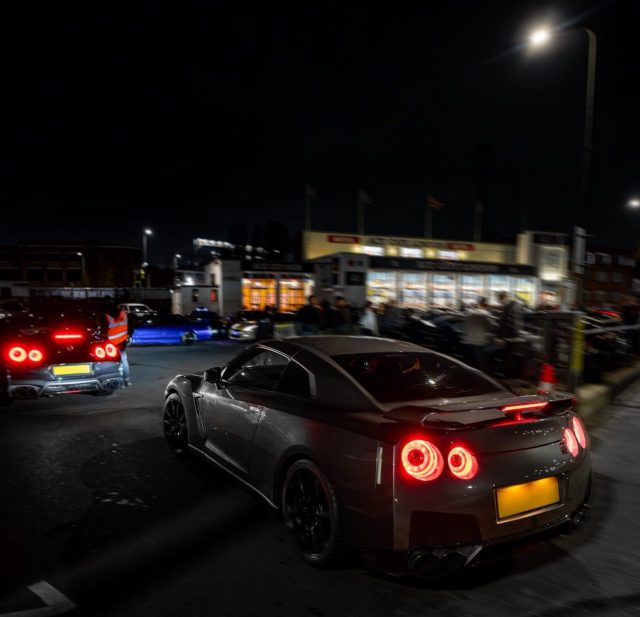
But I have come to believe this subculture is far more nuanced than evidence suggests; as diverse as the areas it inhabits, as multifaceted and difficult to define as it is to police. I met many members who lament the boy-racer stereotype. They see it as a way of keeping working-class culture in its box and resent being forced underground. “If I had somewhere where me and my mates could race our cars for free, I would 100% go,” says “Sam”. Many of the young men I speak to describe a feeling of being constrained by society and unable to get on. The simple act of crowd-sourcing where the speed cameras are provides a semblance of community as well as autonomy amid a system that feels rigged against them.
The car was the democratising vehicle of the 20th century: a guarantee of social autonomy and freedom. That version of freedom has since been revoked in a Britain, of compounding parking fines, proliferating speed cameras, and city-centre congestion charges. The freedom of the open road may be a fallacy — but then so too are the opportunities for these young men to progress, aspire and achieve in life. But it is too convenient, too simplistic to blame social pressures for unlawful car meets. There are questions to be asked of society’s failure to fund third spaces and an economy that hands a generation of lost young men a £50,000 car on finance, but these individuals are not inarticulate victims. They are autonomous adults who choose to endanger themselves and others.
Since my visit to the Sunday meet in Milton Keynes, Thames Valley Police have reportedly launched a crackdown. Nearly 100 vehicles have received their final warning. Attendees and spectators now risk £100 fines. The car meet, needless to say, will move on, burrowing further underground, risking an escalation in casualties and injuries. But the danger isn’t incidental to the appeal — it is the appeal.
***
Note: Some names have been changed.