




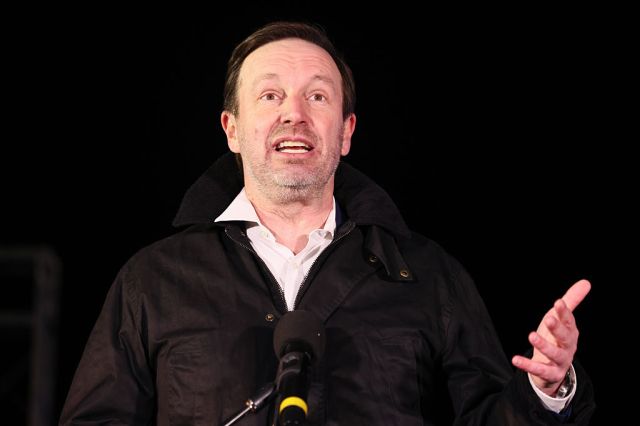
Sen. Murphy is trying to balance #Resistance liberalism with common-good Leftism. Credit: Getty





“We’ve become such a technocratic party that we’ve stopped spending time truly analyzing the way people are feeling,” Chris Murphy, the Connecticut Democratic senator and (suspected) presidential contender, tells me in a phone interview. “The Right has done a much better job than the Left of really thinking about how people are feeling, and of drafting policies that speak to people’s metaphysical state, not just their material state.”
It’s the summer of 2026. Most of Murphy’s fellow Democrats have long given up on the sort of national soul-searching that followed President Trump’s first election in 2016. You remember: that brief window in which Left-of-center pundits and electeds crisscrossed the de-industrialized heartland for clues to why they had lost their working-class base. Soon, though, soul-searching gave way to lawfare aimed at reversing the election’s outcome: Russiagate, the Ukraine phone call, this, that — all futile.
Not Murphy. For several years, the senator has been on something like a spiritual quest: not to find God or himself, but what ails America at a much deeper level than most of the center Left has either allowed or even bothered with. Murphy’s new book, titled Crisis of the Common Good, is the thoughtful, surprisingly well-written, densely researched product of that quest. This, even as Murphy carries a separate persona as a fierce #Resistance liberal on social media and the network formerly called MSNBC.
Whether these two dimensions can work together, and perhaps elevate him to higher office, is the central question of his career.
Crisis of the Common Good is remarkable for many reasons. For one thing, its pages and notes section are littered with positive references to conservative intellectuals, mostly from the post-liberal-ish corner of the Right. These include the Notre Dame political theorist Patrick Deneen, the American Affairs editor and re-industrialization advocate Julius Krein, the political economist Oren Cass, and, ahem, yours truly.
“I’ve certainly been enamored of the intellectual Right,” he tells me, “and I think there’s a lot of overlap.” In a way, that understates things. Murphy’s deepest project involves translating to American terms and conditions the political tradition known as blue Labour in Britain and Left conservatism in continental Europe.
Proponents accept the necessity and blessings of market activity. But they’re also acutely aware of the dangers posed by unrestrained capitalism to family, religion, belonging, and community — the goods historically cherished by conservatism.
To mitigate the dangers, they turn to social-democratic means, or what Murphy in his book describes as the “social-contract” model of American political economy: business regulation, labor unions, wage floors, industrial policy, jealous guardianship of public goods that private actors can’t preserve even if they want to. The “conservative” or “blue” half of the equation identifies what must be preserved; the “Labour” or “Left” half sets out the means.
Or as FDR, quoting Macaulay in a 1936 speech, put it, “Reform, if you would preserve,” adding in his own words: “I am that kind of conservative because I am that kind of liberal.” Reform the market if you care to protect society.
The words and speaker are significant. America came closest to adopting a blue-Labour or Left-conservative politics during the New Deal order, roughly from the 1930s through the mid-1970s. To cite one example: the New Dealers’ massive rural-development programs — emergency farm credits, foreclosure moratoria, rural electrification — kept hundreds of thousands of landowning families on farms they would otherwise have lost.
Under Eisenhower and Nixon, the Republican Party upheld these reforms in many areas, and even expanded their logic in others. Then came the neoliberal counterpunch under Reagan and the Bushes. Yet as Murphy is the first to admit in his book, neoliberal Democrats also did their part in tearing down the socially managed capitalism of the midcentury.
The senator devotes the bulk of his book to chronicling the consequences with anecdotes and data. He organizes his chapters under several “cults” that enthrall Americans: the cults of profit, “everywhere,” technology, consumption, credentialism, and corruption. (The religious undertone here isn’t accidental; surprising for a progressive, Murphy seems to premise his thinking on the assumption that human beings are fundamentally religious animals; all culture is cultus, and some cult or other always commands our obeisance.)
He opens the chapter on the profit cult, for example, by noting how he and his fellow parents are barred from filming their own kids playing hockey by the for-profit entities that now control much of youth sports. Why? Because the firms insist you pay a monthly fee to access footage from their proprietary cameras.
The example is well-chosen. The small businesses and wealthy donors who once underwrote youth sports in his part of Connecticut did so not expecting to turn a profit, as Murphy notes. They did it because they valued the camaraderie and public-spiritedness cultivated — cultus again — by youth sports. But now, profit-maximizing enterprises have invaded this corner of American life; the days aren’t far when you can place Polymarket bets on high-school sports.
The examples pile up grimly: a lonely teenager who killed himself after an AI chatbot convinced him that he could join her in the afterlife; the class-based stratification of literally every corner of public life ($20 gets you someone who will stand in line for you at a congressional hearing; $100 a night gets you special amenities in the California prison system); the obscene commodification of higher education; and much else of the kind.
In the book — if not always in his cable-news commentary — Murphy frames Donald Trump not as the cause of these transformations and the social alienation to which they’ve given rise. Rather, Murphy treats Trump as a symptom. “Literally the first time I mention his name in the book,” the senator tells me, “it’s in the context of drawing him as a symptom, not the cause, of our spiritual rot.”
The distinction matters, because many conventional Democrats would prefer to frame Trump as a demonic aberration — the easier to avoid the systemic rot the 45th and 47th president has revealed. Says Murphy: “It’s so easy to blame all of our problems on him. He is the main character, and he is, perhaps, an existential threat to democracy, so he’s an important character, and he can’t be avoided. But I just worry that it’s not enough to beat him in an election.” The underlying political, economic, and cultural crises would still churn beneath the surface.
More than that, Murphy is surprisingly willing to acknowledge Trump’s preternatural ability to register and address America’s subterranean ailments, even as the senator vehemently disagrees with Trumpian solutions (such as they are). And while the post-liberal intellectuals of the American Right, he believes, offered useful diagnoses and prescriptions, “my impression is that Donald Trump has effectively obliterated that small but previously growing movement within the party” that sought to re-orient the Right toward worker power and social solidarity. I think that’s overstated but, alas, directionally correct.
So does the Left have anyone who comes close to Trump’s capacity to “get” American discontent? And wouldn’t Democrats have to change course on immigration, especially, if they want to get within striking distance?
In his book, Murphy identifies a sense of place and belonging as one of the goods ravaged by corporate-led globalization and neoliberal capitalism. He rails against the commercial ideology of “everywhere” that runs roughshod over local community — “a belief that efficiency and scale should trump rootedness and place, that it really doesn’t matter where you live so long as you can order the same products, watch the same streaming shows, and follow the same influencers online,” as he writes.
But isn’t American discomfiture with mass, low-wage migration — a defining cause for the Trump campaign in 2024 — part of the same rejection of the cult of “everywhere”?
Murphy seems to bristle a bit at this question. “I hope I’ve put my actions where my mouth is. I spent five months in a locked basement room trying to drag my party to the center on immigration.” He was a major proponent of a bill that would’ve given the president the authority to close the border if average daily crossings crossed 5,000 in a given week. Restrictionists objected — rightly, I believe — that the president already has the statutory authority to shutter the border, while the bill championed by Murphy would have legitimized a huge number of illegal crossings annually as long as figures stayed south of the threshold.
He goes on: “I think you have to have an answer to the existing, often unrestrained migration patterns this country has dealt with over the last decade. It is hard to live in a country where people are different from each other, in which there are so many new entrants. And one of the ways you keep a multicultural, multilinguistic country together is to have clear rules about who can enter — how you become a member of our club, how you become a citizen, how you become a worker. The Democratic Party has been far too casual about answering that question. And I do believe there’s a way for the Democratic Party to be stronger on the question of border security, stronger on the question of a true immigration rule of law.”
Fair enough, but doesn’t the right to call somewhere home also entail the expectation of some stability in who else gets to live there? More to the point, the #Resistance Murphy has joined many further to his Left in calling for the abolition of Immigration and Customs Enforcement. What gives?
“Well, you have to have an internal immigration enforcement mechanism,” Murphy says. “You have to have a means to control the border. But he has literally built a personal political police force. There’s no way to just make a few personnel changes and have an actual internal immigration enforcement office that is obeying the law. So, yeah — I’m someone who believes we have to have a way to enforce our immigration laws internally. But I also believe we’re going to have to rebuild it in a different way when he’s gone.”
Perhaps this line — yes to what ICE does, no to ICE itself — is just enough to position Murphy in the sweet spot between a national electorate and where the Democratic Party’s insurgent socialist wing is taking it. Speaking of which, is Murphy planning a presidential run in 2028?
“I mean, I don’t know,” he replies, sounding earnest. “I really don’t. A reporter said to me earlier today, this would not be the book you’d write if you were running for president — because it’s not a book about me. It’s a book about a deeper set of questions about the country. And I’ve had a couple of my friends — who I absolutely know are running for president in 2028 — text me and say, ‘Hey, listen, I think you’ve found a way to frame some things that people have been having trouble talking about, this spiritual rot in the country.’ And, you know, hopefully, if this gives a vocabulary to people to use in 2028.”
Sohrab Ahmari is the US editor of UnHerd and the author, most recently, of Tyranny, Inc: How Private Power Crushed American Liberty — and What To Do About It
 SohrabAhmari