




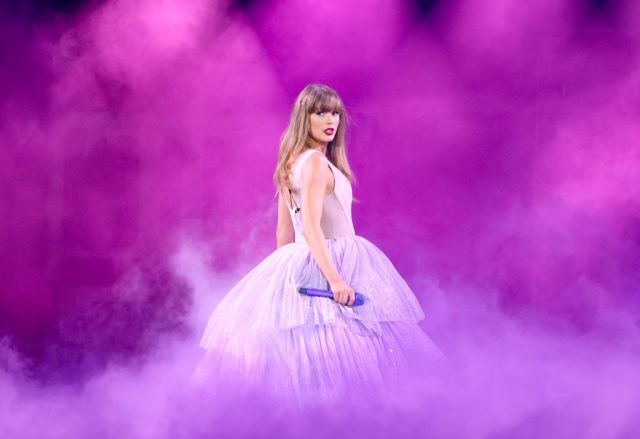
Will the new hierarchy last forever? (Kevin Mazur/TAS24/Getty for TAS Rights Management)





Our chronically leaky national governments could learn a thing or two about opsec from Taylor Swift’s wedding planners. Rumours swirled for weeks in the run-up. New York streets were closed off. Mysterious delivery vans arrived with exotic cargoes such as lobster, roses, or “branches”. Guests reportedly signed NDAs.
Then, on 3 July, at Madison Square Garden, the iconic arena in midtown Manhattan, the billionaire pop superstar wed Kansas City Chiefs American football star Travis Kelce, in a celebration attended by 1,000 of the couple’s closest friends. There were barriers, and guards. No phones were allowed at the ceremony.
It was both the most public and the most private event of the year. It took place on the day of America’s 250th anniversary, and bore all the hallmarks of Swift’s longstanding talent for narrative reflexivity. And, above all, it offered proof positive that the 21st century is, once again, a time of lords and princes. Ironically, nowhere is this more evident than in the nation founded by those who left England to escape the medieval past, and its hierarchies.
Despite the secrecy, a few details have emerged. Notably, we’ve seen photos of the wedding favours received by every guest: a lace napkin embroidered with a special logo and — startlingly — a line from one of Swift’s most darkly self-destructive songs, “Blank Space”. It’s an odd choice of quotation for a wedding favour: the song is anthemic for every girl who has ever chased wild passion, knowing it’ll end in disaster. “So it’s gonna be forever,” reads the napkin. No one more deftly refracts her own self-image through her fanbase like Taylor Swift; the line was surely chosen knowing fans would immediately fill in the blank space, where the song’s next line would be: “Or it’s gonna go down in flames.”
Swiftological omens aside, what was so remarkable about the event was how much of a blank space it remained. Despite New York City surely having one of the highest densities of camera-phones per square mile anywhere on earth, the only footage to have leaked so far is a short clip filmed from the edge of the stadium’s interior. Guests can be seen processing toward a stage-set structure, decorated by greenery. There are verbal reports of the décor and food, but that’s it.
Outside in the streets, throngs of adoring Swifties gathered to participate in this radically exclusionary, wildly opulent, maximum-security event simply through proximity. And later, after the feasting was over, the catering company distributed left-over wedding desserts to fans, who screamed, scrabbled, and fought to consume a holy, sweet fragment from Travis and Taylor’s nuptial feast.
No one could miss the eucharistic parody here — nor the echoes of feudal bounty, bestowed by the great within to the peasants at the gate: a form of lordly munificence that has largely vanished from the modern world. It survives today mostly as quirky traditions: for example at my alma mater, where the Masters celebrate Ascension Day by throwing pennies into the quad from the towers, and local children scrabble to gather them up.
Such gestures of charity to commoners were once part of the ordinary fabric of social life. Historian Eamon Duffy describes the liturgical calendar of pre-Reformation Christian England as including some 40-50 celebration days, on which “servile labour” was partly or wholly forbidden. On these days, those with means were often expected to show their wealth, and piety, by contributing towards communal feasting in charity to the poor.
This medieval holiday regime was scuppered in the 1530s, when Henry VIII broke with Rome. Shortly thereafter, the Crown abolished most of the local and national feasts, especially during the summer months, because all this liturgical partying was getting in the way of agricultural productivity. Nor was this dour onslaught on Merrie England’s pre-modern cakes-and-ale schedule the last: not long after, Henry also dissolved the monasteries, selling their lands to his friends and in the process ending a whole form of subsistence peasant life.
The more profit-focused new owners of former monastic lands didn’t always exhibit the same sense of obligation to the poor as their predecessors. Unscrupulous rent-extraction and callous landlordism became a persistent social problem, and songs and folklore from the period express an angry sense that the rich had reneged on what was expected of them. It got worse, in some respects: a century later, even kings were abolished, and the brilliant, ruthless Roundhead general Oliver Cromwell set out to transform England into a Puritan paradise — to the still greater detriment of that old regime of feasts and holy days. No more partying, even at Christmas.
A Royalist broadside ballad from the 1640s blames the loss of charity and free feast-day goodies on the Puritan levelling instinct:
To conclude, I’le tell you news that’s right, Christmas was kil’d at Naseby fight:
Charity was slain at that same time, Jack Tell troth too, a friend of mine,
Likewise then did die, rost beef and shred pie,
Pig, Goose and Capon no quarter found.
Yet let’s be content, and the times lament, you see the world turn’d upside down.
But in other respects it got better. The same reforms also drove the creation of a new middle class, shook up laws governing heredity, and kicked off a revolution in agriculture. The resulting transformation would remake modern England, driving the Industrial Revolution, turbocharging growth, and impelling the uprooted English outward into the empire — including her then-colonial lands in America.
The irony behind Taylor Swift’s opulent extravaganza is that the origin story of the United States lay in those Puritans who left England in the 17th century, in pursuit of still greater levelling than could be managed in the Old World. Some were disappointed by the failure of radical Puritan measures during Cromwell’s Protectorate; more were underwhelmed by the religious compromises and royal Restoration that followed Cromwell’s death. These radicals sailed away, to create their shining city on a hill somewhere unburdened (as Kamala Harris put it more recently) by what has been.
Now, 250 years in, the nation that spun off from those pioneers counts more billionaires than anywhere else on earth. And, ironically, their rise is downstream of a great hollowing-out of America’s own middle class, characterised by urban geographer Joel Kotkin as a coming age of neo-feudalism. This, he suggests, is sweeping away the middle-class characteristic of the modern age, in favour of a huge subsistence peasantry, a comparatively small “clerisy”, and an unthinkably rich aristocracy.
Kotkin’s book The Coming of Neo-Feudalism was intended as a warning, and a call to arms by the beleaguered middle class. Conversely, among the new aristocracy, many seem keen to lean into the corollary of this neo-feudalism: that just like in the olden days, the new lords and princes will be obligated to dispense alms to some portion of the peasantry. Tech plutocrats, especially those producing AI of the supposedly job-destroying kind, periodically float (and sometimes pilot) “Universal Basic Income” proposals that are post-modern variants on pre-modern subsistence peasant life. The subtext, whether explicitly stated or not, is that if things continue in the current direction the wealth gap will soon be so immense that some kind of redistribution will be prudent, simply as a hedge against revolution.
All of this makes for a much sweeter pill when refracted through the prism of lordly magnificence. At least one fan interpreted Taylor Swift’s pastry distribution thus, gushing in suitably feudal style that “She loves us”. But does she? Set against the eye-watering expense of her celebration, distributing a few left-over slices of cake to fans outside isn’t much in the way of hospitality. Was it even Swift who authorised the pastry distribution? Or just a departing caterer’s van that knew the cakes would otherwise go in the bin?
The question bites much more sharply for those who have grown rich not through entertainment, but more controversial (or even job-destroying) lines of business. The last household-name billionaire wedding to hit the headlines was Amazon founder Jeff Bezos, a man who acquired his unthinkable wealth rendering high-street hardware shops obsolete, and algorithmically optimising delivery-drivers and warehouse staff to the point where they need to pee in bottles to keep up the pace of work. This time last year Bezos and his bride Lauren Sanchez took over great swathes of Venice for a three-day wedding that cost somewhere in the region of $50 million, and attracted at least as much criticism and protest as excited rubbernecking.
Bezos also seems to be fumbling toward lordly charity — at least, by proxy. He asked his guests not to bring gifts, but instead to make donations to local Venetian charities. Despite this, his wedding still attracted protestors. Perhaps this reflects a misunderstanding of how aristocratic bounty is supposed to work: Bezos didn’t spend any of his own money throwing a party for the Venetians; he just asked that his guests dispense alms at their own expense, in lieu of wedding gifts. Those pre-modern peasants who expected goose pie now and then might have thought this a contemptibly cheapskate approach, especially given the degree of magnificence expected of a figure such as Bezos.
But a simpler interpretation is that the protests are a natural reaction to what figures such as Bezos represent: both in terms of financial inequality, but more profoundly still in power. Taylor Swift has the kind of reality-altering wealth that can close entire streets in midtown Manhattan on the nation’s 250th Independence Day holiday weekend, and build a fairy-tale film-set castle inside an iconic concert arena, in near-total secrecy. Normal people, quite naturally, find this unnerving. What else might she do with that power?
Swift evinces little interest in more hard-edged uses of her clout. But her wealth — in old-fashioned terms, we’d say “rank” — abuts the kind of individual power that can change regimes, massage markets, or redraw continental maps. All the hue and cry over other household-name billionaires, such as Bezos, the Soros family, Elon Musk, or Peter Thiel, ultimately turns on this recognition of power on a par with nation-states. Are the individuals wielding it friends, or enemies? Does it even matter what any of us thinks? If we rubberneck at billionaire weddings, and project fantasies or protests onto their lives and desires, it’s because we correctly intuit that they could do things we might never even dream of. They are, in a very concrete sense, not like us.
Is this new hierarchy gonna be forever? Some think AI will make it vastly more extreme. Should we simply accept this state of affairs, and say thanks for the left-over pastries? Resisters say we can tax these new plutocrats back into line: can the faltering middle classes still resist? Is this all, as Taylor Swift’s wedding favours didn’t say, gonna go down in flames?
It’s probably too early to tell. But if I were to guess, I’d say that in the end the excited queue for pastries will outnumber the angry mob. Provided, that is, our new, glittering overclass manage to re-learn the lordly art not just of magnificence, but also of feast-day hospitality.
***
An earlier version of this piece stated Taylor Swift’s wedding happened on 4 July. It actually happened on 3 July. We apologise for the error.
