




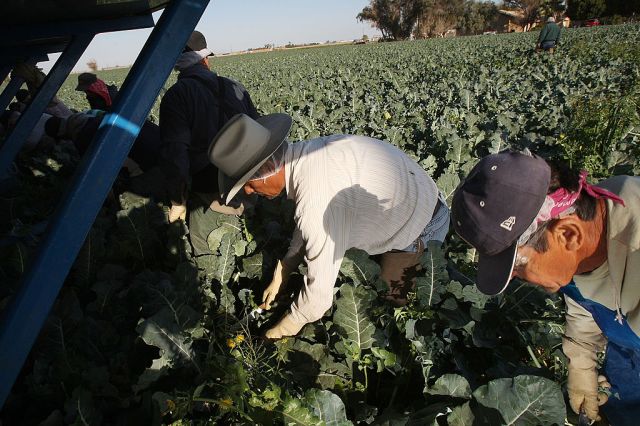
The agricultural sector is addicted to cheap labor. Credit: Getty





If today’s name ends in a “y,” then you can be sure that some business lobbyists in Washington are pressuring Congress to expand the role of cheap foreign labor in the US economy, at the expense of American workers and wages. The latest example is a bill with bipartisan support, the Securing Agriculture’s Workforce Act of 2026, introduced by Rep. Glenn “GT” Thompson, Republican of Pennsylvania.
Yes, that would be the same Republican Party founded by Abraham Lincoln on the slogan of “Free Labor.”
The problem the bill addresses is real. Team Trump’s crackdown against illegal immigration has deprived farmers and ranchers of the low-wage foreign workforce upon which they once relied, in defiance of US employment and immigration laws. To address the genuine short-term labor shortages, the bill proposes to raise wages in American agriculture to lure US citizens, while providing federal subsidies to farms in labor-intensive sectors to allow them to purchase labor-saving agricultural technology.
Just kidding! Thompson’s bipartisan bill neither raises wages nor subsidizes labor-saving tech. Instead, it makes raising wages and investing in tech less necessary, by increasing the number of foreign indentured servants bound for fixed terms to American agribusiness and by granting amnesty to many illegal migrants already laboring in agriculture. According to the news release announcing it, Thompson’s bill widens the availability of temporary foreign labor “for year-round operations, controls costs to restore certainty to balance sheets, and streamlines the interactions of the government agencies administering the program.”
The proposed legislation has outraged some Right-wing populists. But unsurprisingly, it is “supported by the American Farm Bureau Federation, the Western Growers Association, the National Milk Producers Federation, and more than 400 other agricultural groups across the entire industry,” according to the Thompson news release.
Today, nearly 1 in 5 workers in the United States is a foreign national. These foreign workers fall into two categories: permanent immigrant workers (aka “green-card holders”) and temporary non-immigrant workers. Green-card holders are considered permanent immigrants because it is expected that in time they will apply for naturalization as US citizens, although not all of them do. Apart from the right to vote, green-card holders have most of the rights of US citizen-workers, including the right to quit their jobs without their boss’s permission.
So-called non-immigrant workers, in contrast, form an underclass of workers on US soil with fewer rights than either US citizen-workers or green-card holders. Technically, they are “temporary,” although their fixed terms of work in the United States can be extended indefinitely. They aren’t considered immigrants, because if their fixed terms of work aren’t renewed, they are expected to return to their home countries.
Another word for “non-immigrant worker” is indentured servant. An indentured servant is a worker who isn’t allowed by legally enforceable contract to quit his job without his employer’s permission, for a fixed period. Indentured servitude, however well paid, is temporary slavery.
The H-2A visa in agriculture that Rep. Thompson and the agribusiness lobby are trying to expand is only one of many non-immigrant visas for foreign indentured servants laboring in the United States. Other indentured-servant visas include the H-1B visa, used by firms in Silicon Valley, Wall Street, and even universities and government agencies to replace American workers and green-card holders with unfree foreign professional workers; the H-2B, supplying the construction, landscaping, meatpacking, and other non-farm industries with unfree foreign labor; H-3 visas for employers to bring in labor in the guise of trainees; and an alphabet soup of other contract-labor visas. What they all share in common is the denial of the most fundamental rights of a free worker: the right to quit your job without your employer’s permission and without having to leave the country immediately.
Supporters of these varieties of indentured servitude tend to be found among business-class conservatives and libertarians who like to quote Adam Smith. But the 18th-century Scottish political economist would have recognized today’s American indentured-servant programs for what they are: versions of unfree labor, albeit versions less harsh than chattel slavery.
Speaking of 18th-century Scottish coal workers and mine workers who were bound to their employers, Smith wrote: “They can be sold, it is true, but then it is only in a certain manner. When the work is sold all the colliers or salters which belong to it are sold allong with it…” He contrasted this kind of indentured servitude, along with highly restrictive apprenticeship programs in guilds, with “perfect liberty,” defined as “the right of a worker to change his trade as often as he pleases.”
Convinced that unfree labor of all kinds is less efficient than the labor of free workers paid adequate wages, Smith argued that the reason for the near-universality of unfree labor in various forms was the psychology of slaveowners and business owners, who were willing to sacrifice efficiency and economic growth to the pleasure of lording it over their underlings. In The Wealth of Nations, Smith wrote: “The pride of man makes him love to domineer, and nothing mortifies him so much as to be obliged to condescend to persuade his inferiors. Wherever the law allows it, and the nature of the work can afford it, therefore, he will generally prefer the service of slaves to that of freemen.”
Indeed, all of the arguments made by the indentured-servant lobby for more foreign contract labor could also be made to justify legalizing slavery again in America. Take consumer prices. In the US workforce as a whole, illegal immigrants make up around 5%, with the number rising to as much as a fifth in construction, crop production, and food processing.
According to Goldman Sachs, in a tight labor market with lower immigration, consumer prices for some goods might go up. Why? Because employers would have to pay higher wages and pass along the costs of decent wages to consumers. Oh, the horror! But this argument applies to slavery as well. If only employers were allowed to use slave labor in the fields once again, then consumer prices might go down.
The Republican Party was founded in the 1850s to oppose the expansion of slavery. During the Civil War in 1862, the GOP-dominated Congress enacted and President Lincoln signed into law a bill that sought to prevent Southern slaveowners from importing “coolies” or indentured servants from China and India. Today, however, reflecting the capture of the party of Lincoln by former reactionary Southern and Western Democrats, many Republican members of Congress and every Republican president in the past generation, including Donald Trump, have consistently favored expanding access to unfree foreign serfs by individual American corporations.
In explaining why ICE should not raid farms, for example, Trump has used a weird neo-Confederate argument. According to Trump, speaking in the summer of 2025, “we have a lot of cases where ICE would go into a farm and these are guys that have been there 10 or 15 years, and the farmers know them — it’s called farmer responsibility. Or owner responsibility. But they’re going to be largely responsible for these people. And they know these people. They’ve worked at the farms for 15 years.”
Of course “these people” have sometimes worked for the same farmers “for 15 years.” Many of “these people” are rented to a single farm owner or corporation for repeated, fixed terms by a single labor contractor acting as a labor broker. If the stability of the workforce is a goal, then old-fashioned lifelong chattel slavery is even better than fixed-term indentured servitude. In the Old South, slaveowners often referred to their enslaved workers as “family” and boasted that they were more responsible for their welfare than cruel Northern capitalists who had to lure free labor by paying wages.
Which brings us to Irony No. 2. The dominant economic philosophy of the GOP until recently has been libertarianism. Libertarians claim to favor radical individual freedom — except for the freedom of certain categories of legal foreign workers on US soil to quit their jobs and seek others without the permission of their employers.
The libertarian philosopher Murray Rothbard, one of the founders of the Cato Institute, argued that “voluntary” slave contracts should be legal. The celebrated libertarian theorist Robert Nozick, in Anarchy, State, and Utopia, published in 1974, agreed with Rothbard that individuals should have the right to sell themselves into slavery, answering, “I believe that it would” to the question of whether “a free system will allow [an individual] to sell himself into slavery.”
So maybe the libertarian supporters of unfree indentured servitude on American soil are consistent after all. Unlike Rothbard, Nozick did not argue that the law should allow parents to sell their unwanted children or allow them to starve to death. Rothbard: “The law, therefore, may not properly compel the parent to feed a child or to keep it alive…”
These two groups — pro-servitude Republicans and libertarian ideologues — are joined by conservatives who are confused about economics in a technological society, treating America as if it were a plantation economy like that of the Old South or the slave societies of Cuba and Brazil. Today’s Republican conservatives claim to favor economic growth, industrial development, and technological progress. But importing foreign serfs retards all three. While unfree labor in various forms may increase overall output in tobacco, cotton, or avocados, large numbers of low-wage workers undermine the formation of a national home market of prosperous worker-consumers to support advanced manufacturing industries. And cheap labor undermines technological progress, because it reduces the incentive of employers to limit labor costs by either replacing workers with machines or by investing in machines to make individual workers more productive.
Then there is the pseudo-nationalist argument for importing unfree foreign serfs to labor on American farms. If American farmers can’t import unfree, low-wage workers from Mexico to pick avocados, then the American avocado industry might lose market share in the United States to Mexican imports. Beware the avocado gap!
This argument persuades neither libertarians nor America First populists. Libertarians have no objection to cheap imports from foreign countries, including imports that are cheap because foreign wages are lower. And protectionists would answer that if there is a vital national interest in protecting the American avocado industry, then let it be protected by tariffs. The Trump administration sided with the libertarians in this case, by exempting Mexican avocados from tariffs.
When all other arguments are exhausted, one plaintive cry is heard: Will nobody think of the small farmers? Indeed, what about small farmers and other small employers addicted to imported, unfree labor? Won’t they suffer, if they have to pay free workers higher wages and can’t afford to invest in labor-saving technology in compensation?
They may well suffer — the way that Southern planters suffered when they were forced to pay their workers instead of owning them, and the way that other employers suffered later when child labor was outlawed. Good riddance to small capitalists who are so incompetent at business that they can’t make enough profits to pay their workers a living wage, after paying their other expenses, and demand that the government supply them with a never-ending stream of foreign serfs.
Here is a very simple test that can distinguish genuine pro-worker Republicans and Democrats from pseudo-populist mouthpieces of employer interests: support the abolition of all non-immigrant worker visas. There should be only two categories of workers employed in the United States: citizen-workers and legal permanent resident green-card holders with the right to apply for citizenship. All workers on American soil, whether citizens or green-card holders eligible for citizenship, would have the right to quit their jobs at will and seek other jobs in the United States.
In the 2020s and ’30s, we must adopt a gender-neutral version of the slogan of the antislavery Free Soil Party of the 1840s and ’50s: “Free Soil, Free Labor, Free Men.”