




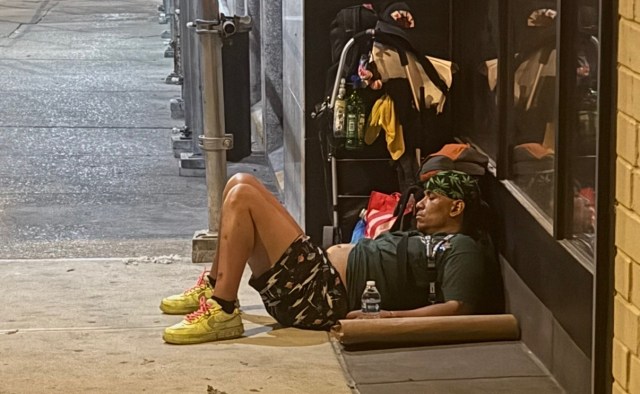
The human misery of New York’s streets makes a poor showing for social democracy. Credit: Sohrab Ahmari / UnHerd





“A lot of the people here are gone now — they came and moved us out.”
So said the woman standing next to a squalid tent residence that has sprung up at the corner of 46th Street and 11th Avenue, on the far west side of Manhattan. Skeletally thin, eyes almost popping out of her wan, sunken face, she’s hunched over trying to light something as I approach. “Jane” (not her real name) looks like she could fall over any second. A strong gust would do the job. But she keeps it together, somehow.
We’re across from the Intrepid, the WWII-era carrier that serves as a floating aviation museum, beloved of tourists and younger New Yorkers, like my 9-year-old son, Max.
When I visited this area a fortnight earlier — so Max could watch the action-sci-fi classic Independence Day on the deck of the Intrepid — the homeless camp was much more expansive. It took up a significant span of the block and teemed with people in various states of undress and intoxication. Then the New York Post (where I used to work) got wind of the camp and gave it two days of coverage: “Lawless NYC Homeless Encampment Near Intrepid Grows,” ran one headline.
Pressed at a Monday news conference about the camp, Mamdani gave what the Post fairly described as a “non-answer.” Said Hizzoner: “We are focused on connecting New Yorkers to shelter and on establishing a pipeline to stable housing, not just moving New Yorkers from one place to another place. To this specific encampment that you brought up, we’re going to look into the details of that.”
Well, now we know what “looking into the details” would entail. The camp looked much smaller by Monday evening when I visited. “They” had dispersed the residents, as Jane reported. Who’s they? “Sanitation,” she replies, pointing with her chin at the official notices duct-taped to the wire fencing next to her makeshift home.
“That piece of paper says we have to take our stuff and move on,” she says matter-of-factly. “Otherwise, they’ll come and throw away our stuff, and we can do nothin’ about it.”
As she says this, I happen to notice a green-and-white Department of Sanitation SUV driving slowly — very slowly — toward the tent (or tents, really, a complex of them conjoined somehow by various boxes and carts and covered over by multiple tarps). But the sanitation boys roll up their windows and tear away before I can ask questions.
And in that set of interactions — Jane’s report of the great dispersal, sanitation preferring to do its work quietly — lies the key to how Mayor Zohran Mamdani is addressing one of the persistent crises of blue-city governance. Across the country, homeless encampments have become hotbeds of open drug use, prostitution, violence, and general human misery. They annoy local residents and businesses and foster a general sense of decay and disorder.
Mamdani’s response amounts to a careful threading of the needle between doing what’s necessary and keeping the activist, anti-police Left at bay. He doesn’t want a “Mamdani-Ville” mushrooming on his watch, feeding daily horror images to the tabloids. But he’s tackling it with the lowest-intensity and -visibility means possible.
To wit, Mamdani has apparently resolved to disperse the west-side camp — but crucially, without involving the police or coercively removing its “residents” from the streets. The residents still haunt — I use the verb decidedly — the neighborhood. But they’re no longer as visibly concentrated and thus less likely to attract media attention.
It’s (sort of) working for now — a testament to the mayor’s political agility, not to mention the Post’s power to set the agenda. But in the long term, the strategy risks damaging his credibility and, by extension, that of the wider social-democratic renewal he’s attempting.
One thing Mamdani has going for him is the tight geography of Manhattan. Save for its parks, which have historically avoided the encampment scourge, the city has few wide-open spaces conducive to the permanent in-gathering of the addicted and mentally ill (a substantial majority of those who camp this way abuse substances or have severe mental-health problems — often both).
Manhattan’s situation stands in contrast to more sprawling West Coast cities with plenty of open room for camps to grow into unless the authorities intervene — something they often didn’t do amid the anti-policing mania that swept American progressivism beginning in the mid-2010s. “At least we don’t have the camps” was thus one of the consolations of Gothamites during the era of “peak woke” and #Defund.
If there is one part of Manhattan where camps could take root, however, it’s the sleepy far-west stretch along the Hudson River. With its warehouses, auto-repair shops, and utility facilities, the area has always been surprisingly empty, though more recent development has brought a number of glass high-rises straight out of Doha or Dubai. The area’s relative emptiness has been an invitation to encampment, and it was only a matter of time before one would appear.
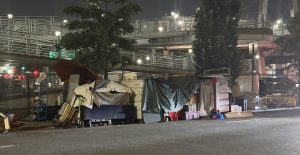
Soon, locals and businesses were complaining about the sights, sounds, and smells of the camp. Joggers found themselves hurdling the limp bodies of drug cosmonauts sprawled across the pavement, dodging the paraphernalia and other filthy detritus scattered around them. I saw all this myself on my earlier visit.
By Monday night, though, the scene is more contained.
“Where have the rest gone?” I ask Jane.
“Not far,” she replies. “They’re just down the 40s. Just walk up and down, man, you’ll see.”
Has anyone offered to take them to shelters? She shrugs. “I mean, they come and talk to you. But —” Her voice trails off. My questions are beginning to annoy her.
A security guard on a foldable chair across the street backs up her account. “I see cops come by and sort of chat with ’em. City workers, too. But they don’t do anything.” The Mamdani administration seems to have placed much — perhaps most — of the onus for dealing with the crisis on the shoulders of sanitation workers.
Jane tells me she’s been on the streets for two years, at this corner for two weeks. She’s outlasted the others, but sooner or later she, too, will have to drag her things a few blocks and start again.
Her neighbors aren’t hard to find. Farther north, at 47th Street, a smaller camp: a more alert woman working the corner in a bedraggled mini-dress (“Hey, Daddy!”), two pairs of male eyes staring coldly from inside the tent behind her. On 45th, another makeshift residence, where a couple smokes outside while a third man tries on roller blades. On 44th, a couple lies belly-down in their tent, watching videos on a phone. Farther east (away from the river), clusters of men doze off in various nooks and doorways.
Jane was right. You just have to walk up and down. Mamdani, for now, has “solved” the problem at a surface level, and in the most non-coercive manner imaginable. There will be fewer fentanyl-porn scenes readymade for Post cameras. But the total volume of decay and disorder hasn’t been diminished, only the concentration.
When it comes to the complex of social crises that gives rise to a Jane, his administration’s philosophy is still largely informed by the Left libertarianism that refuses to coerce people whose illness tells them they’re doing just fine. What this model has to do with social democracy — with the project of subjecting our common life to rational deliberation — is anyone’s guess.
Sohrab Ahmari is the US editor of UnHerd. His next book, on The Triumph of Normal, is forthcoming from HarperCollins.
 SohrabAhmari