




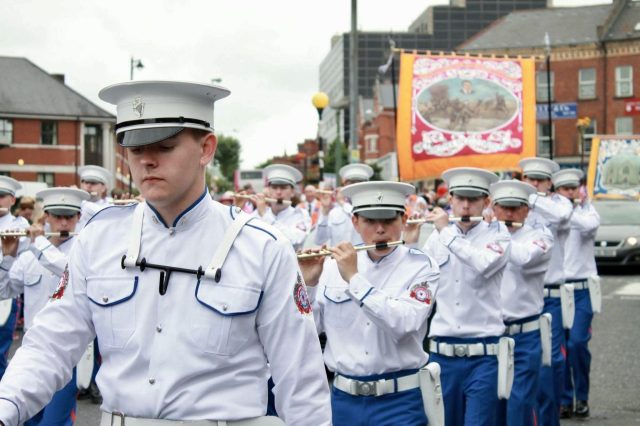
‘The Order has a reputation of being a drinking club for bitter old men.’ Credit: Adam James Pollock





There’s a party atmosphere in Carrickfergus. Thousands of spectators line the streets, and the screeches of children fight for attention over a chorus of tin whistles. The town is closed to cars, save for the hired coaches decanting excitable bandsmen and tour groups into its ancient lanes. A Norman castle, looming above the pageantry, surveils the crowds. A statue of William of Orange stands just outside its gates, a thick wig sweeping past his shoulders, a seagull perched upon his head.
So far, so Ulster. Yet if this warm summer day is like many others in Carrickfergus’s history, commemorating William’s “Royal Landing” at the harbour in the summer of 1690, look a little closer. There, amid the pomp of marching season, is a sight that many visitors might not be expecting: countless young people dressed in orange. There they are, the boys in collerettes and trainers, the girls, grouped together, swapping the traditional bowler hats for skirts and tights. All walk in lockstep, breaking composure briefly to wave to school friends watching from the outdoor seats at McDonalds. Their lightweight sashes, more sparsely strewn with pins than those of older members, flutter in the breeze.
These youthful cohorts stand in stark contrast to their fellow bandsmen, and what many regard the Orange Order to be: a social club for old men to relive the sectarianism of yesteryear. Yet as the province gears up for “The Twelfth” — the anniversary of William’s final victory over his Catholic enemies on 12 July 1690 — it remains unclear if a more sprightly Order can truly salvage Ulster Unionism.
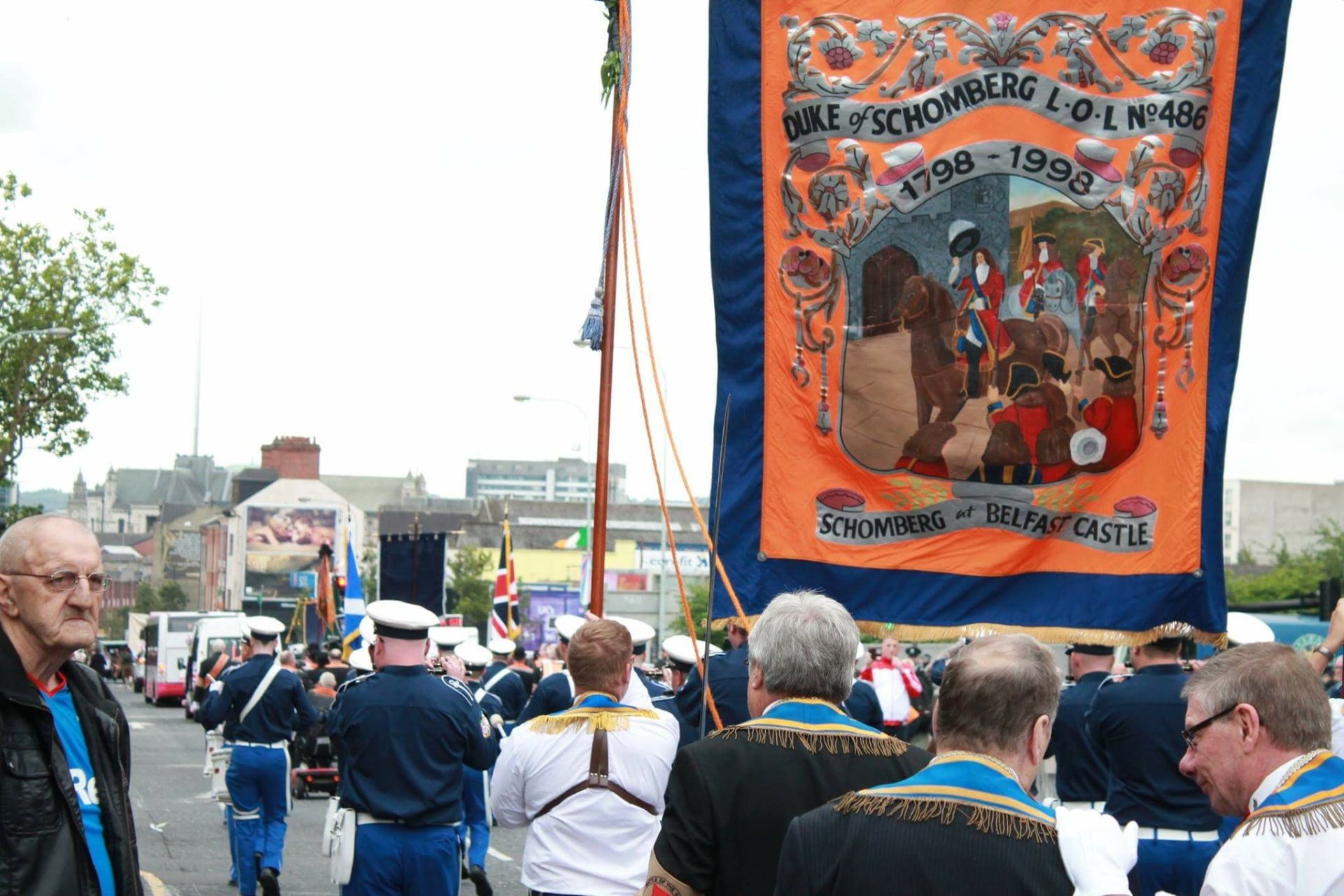
The Orange Order started life around a century after William’s landing at Carrickfergus. In the 1790s, sectarian violence stalked both Ulster and Ireland as a whole. Drunken brawls were commonplace, fights that often descended into armed conflict, especially as the tensions unleashed by the French Revolution crossed the Irish Sea. In September 1795, following one particularly vicious battle, the victors founded a Protestant defence association: the Orange Order.
Two centuries on, the Order has an international membership body of over 1,400 lodges. Members commit themselves to upholding Unionism, loyalism, broadly conservative beliefs — and, of course, the Protestant faith. Yet despite these long-held values, as well as provocative marches through “contested” neighbourhoods with large Catholic populations, membership is surging: particularly among young Protestants. One young member, Tristan Morrow, says that his generation has brought a huge spike to membership of his local lodge. Living in a County Fermanagh village, local numbers have swelled from just 10 in 2002 to over 50 two decades later. Internal figures from the Junior Orange Order show a similar rise: since Covid, they have opened 26 new lodges, with membership increasing by over 70% in the four years from 2021.
This comes as somewhat of a surprise to outsiders — myself included. The dominant account of Ulster Unionism, repeated ad nauseum in local media and Irish Nationalist politicians, is one of inexorable decline. With the 2021 census in Northern Ireland revealing, for the first time, more Catholics than Protestants, and with Sinn Féin becoming the region’s largest party at the last general election, some suggest that Unionism in Ulster is “dying out”.
In the broader culture, too, the Order has a reputation of being a drinking club for bitter old men, like a working-class equivalent of the Cavalry and Guards Club, albeit for paramilitaries rather than hussars. For people unfamiliar with the organisation’s parades, certainly, it’s difficult to distinguish between the Order and the more rowdy, paramilitary-adjacent pipe bands; they all get tarred with the unfortunate brush of drunkenly emptying bladders on the wall of whoever’s house is nearby, or else snorting drugs in full view of bystanders.
Watch the Order in action, though, and things look rather less sordid. Two weeks before this year’s reenactment of the Royal Landing, over 2,000 young members of the Orange Order paraded through Donaghadee, another pretty coastal town not far from Carrickfergus. These young people, many of whom don’t look old enough to have left primary school, marched in jackets and ties. One lodge’s shrunken lambeg drum, processed near the front of the parade, seemed far more manageable than the adult alternatives.
For Joseph Magill, grand master of the Junior Grand Orange Lodge of Ireland, this enthusiasm is partly social in nature. “I think the growth we have seen in recent years is largely down to the range of experiences available to boys through the Junior Orange movement,” he says. “Our members take part in competitions, educational initiatives, charitable activities and social events, bringing together boys from across our jurisdiction.”
In a world where so much interaction now happens digitally, these activities are strikingly offline — and old-fashioned. Magill highlights the popularity of lecturing, where young people are taught to recite questions and answers from memory. Given working-class Protestant boys are by far the most disadvantaged demographic in Northern Ireland, these activities have the potential to be useful far beyond the lodge.
Talking of which, religion inevitably plays a role in youthful Orangeism too, though perhaps not in the way you might imagine. There’s a tendency among outsiders to view the Orange Order as reflecting a distinct kind of cultural Protestantism. Just as the general perception of being Catholic in Northern Ireland has morphed from having 10 children and eating fish on Fridays to advocating for abortion and the boycotting of Israeli quinoa, so too does Northern Irish Protestantism have its own stereotypes — mostly involving cheap booze and Rangers.
Yet if Christianity doubtless matters here, Magill sees it less as a politicised label and more as a genuine matter of faith. “Through my involvement I developed a deeper understanding of my faith and a personal relationship with God,” he says, “which has been a positive and important influence throughout my life.” Jay Basra, a young Unionist activist who joined the Orange Order when he turned 18, makes a similar point, noting that his fellow Orangemen help him live a Christian life.
This, in itself, is striking. In England, the so-called “quiet revival” is usually seen as a Catholic phenomenon. But in Northern Ireland — by far the most religious region of the United Kingdom — young people are still active adherents to their Protestant denominations. Here, some 46% of people who identify as Protestant attend church at least once per month, with residents aged 18-24 much more likely to hold a positive view of Christianity than their elders. In other ways, too, Protestant belief is much more embedded in ordinary life than elsewhere in the UK. Hundreds of young people attend various Christian youth festivals each year, and it’d be naive to imagine that the Orange Order doesn’t play a role here.
Given all this, it might be tempting to see a correlation between young Orangeism and Unionist politics more generally. But, again, any link isn’t straightforward. “A lot of Northern Ireland’s young people are switched off from constitutional politics, particularly people of a similar age to me,” Jay explains. “Regardless if a young person is in the Orange Order or not, the onus is on political Unionism to engage with them. It is high time Unionism began to fully appreciate that it cannot take young people’s votes for granted.” That’s reflected more broadly: faith in Northern Ireland’s political institutions has hit rock bottom, especially for young people, with knowledge of how the government functions here lower than in any of the other devolved nations.
How to explain this gap? Just look at the news. Jeffrey Donaldson, a household name in Ulster Protestant politics for years, is now a convicted paedophile. Gavin Robinson, the current leader of Donaldson’s erstwhile Democratic Unionists, has admitted it’s “clear” that other figures in the party knew about the abuse but kept it secret. This recent scandal follows a never-ending succession of controversies that defines the incompetent Stormont Assembly, which has only functioned, in the loosest possible sense of the word, for around 60% of the time since the Good Friday Agreement was signed 28 years ago.
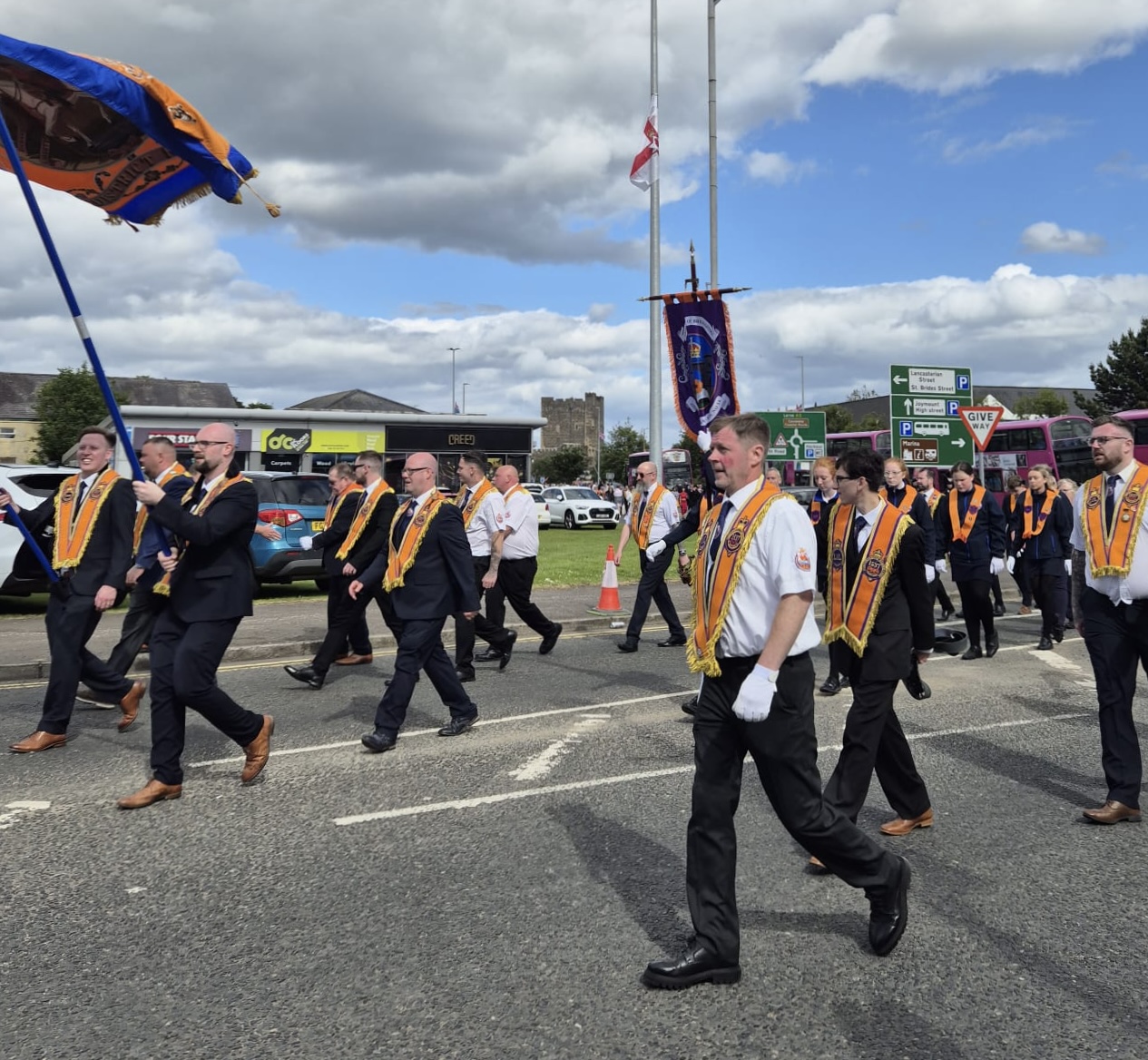
For young people keen to express their Unionist beliefs, but who find conventional politics too depressing a vehicle, the Orange Order offers an alternative. In the end, though, it’s hard not to return to the demographic question. As Sam* concedes, part of the reason that Order membership is growing is precisely because some Nationalists think they can secure a united Ireland simply by waiting for Unionism to disappear.
To be fair, the numbers aren’t clear cut. The 2021 Northern Ireland census showed a larger number of Catholics than Protestants for the first time, with 45.7% of the population coming from a culturally Catholic background. Yet this represents an increase of only 0.6% in a decade, casting doubt on whether a majority of the population will ever fit this definition — something proponents of Irish unity often tout as a trigger for a border poll.
Still, some young Unionists would rather not be complacent. That, of course, raises another question: is the Orange Order a political institution after all, albeit one you can’t cast your ballot for? Magill still doesn’t think so. “Boys do not join the Junior Orange movement because of political debates, and we do not exist to promote party politics.”
That’s the formal line. But for other young Orangemen, being part of a lodge is clearly about more than faith or lectures or even sticking it to the DUP. As Sam puts it: “Zoomers will not be the generation to fail Ulster.” And, whatever the numbers say, it’s institutions like the Orange Order that could offer Unionism some hope. Irish Nationalists don’t really have any equivalent organisations, even if their representatives are often as shambolic as their Unionist rivals.
All the while, it’s clear that young people, of both communities, want stability, order, and a basic sense of normalcy in their politics, after decades of violence then decades more of sclerosis. It’s partly for this that people are flocking back towards the moderate embrace of the Ulster Unionist Party, the oldest political party on the island of Ireland, and whose new leader Jon Burrows has shot to the top of opinion polls. And it’s for similar reasons, perhaps, that young Protestants are joining the Orange Order.
Back in Carrickfergus, the parade ends in the late afternoon. Old men, exhausted, remove their dark jackets and wipe sweat from their brows. Their coaches, parked along the main stretch of road leaving town, provide the first seats they’ve sat on since the early morning; several fall asleep before the journey home even starts. Across the road, though, a group of young Orangemen have met up with their friends. They laugh and run back towards the site of William’s landing. For them, the day is still young.
*Name has been changed.