




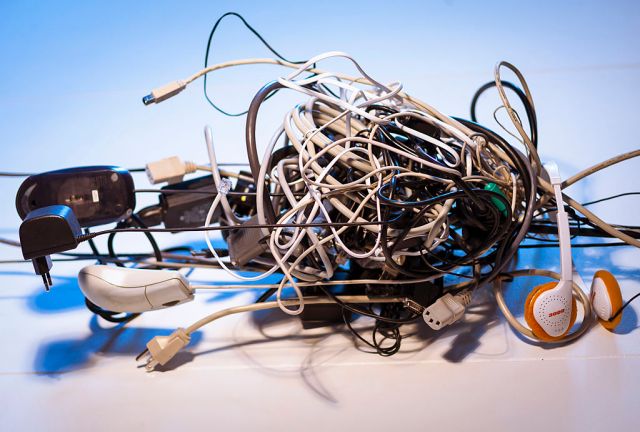
Modern life, like intertwined cables, is increasingly confusing. Credit: Getty





Many of us have been surprised when the removal of the wall of a house or office reveals a Jackson Pollock drip-painting of copper wires, fiber-optic cables, water pipes, and other cords and strands, obviously installed with no plan for how the different threads would be woven together. Every pipe, cord, and tube was jury-rigged by separate tradesmen, adding to the complexity each time, to the point that the first step in any repair is the detective work to determine what leads where.
I call it the Tangle, and increasingly, it is the condition of modern life.
My own recent entrapment in the medical and health-insurance side of the Tangle illustrates its pernicious reach. In the dark ages of copper-wire telephony and paper records, I would call my doctor’s office and make an appointment with a receptionist who was often middle-aged, middle-class, well-paid, and experienced. Sometimes, the phone line was busy, but not often.
Some time ago, I tried to make an appointment with my then-doctor. After enduring the purgatory of listening to the dozen or so recorded options on the automated answer line, the recorded voice finally let me know the number on my phone to press to make an appointment.
Soon I was routed successively to four individuals with South Asian accents who struggled to speak British-inflected English — a call center in Bangalore, perhaps. One after another passed me on to a colleague. The fifth call-center operator, calling me “Sir Michael” instead of “Mr. Lind” — I’ve been knighted in India! — explained that the system did not allow me to contact my doctor’s office directly, but she would help me by sending my doctor’s office an email. I could expect a reply by email from the doctor’s office the following week.
“I live a mile from my doctor’s office,” I told the nice wage slave on the other side of the world. “I can get in my car and drive there and be there in 10 minutes. Thank you for your help.”
Instead of violating the norms of the internet age by walking into my doctor’s office and demanding an appointment, I chose a better option: I fired my doctor and got another.
Oh, boy, a new doctor, a new username, and a new password for my new account that allows me to … communicate with my doctor! Once more, I had to jump through many digital hoops, receiving codes and so on — a process much slower, less convenient, and more life-draining than the previous system. The new doctor’s practice was marginally more accessible, responding usually in hours, rather than days, to the messages I was forced to leave by phone or on the web.
But when my new doctor ordered some routine blood tests, as part of my annual physical, I asked the staff how much the tests would cost me. They seemed baffled and offended by the impertinent question and referred me to the separate medical testing lab to which my doctor had sent the test orders.
When I phoned the testing lab and asked how much the tests would cost, the staff said they could not answer my question. I should call corporate headquarters in Chicago. When I called corporate headquarters in Chicago, I was told they had no way of knowing: I needed to call the local lab which had directed me to the headquarters in Chicago.
Thus ended Day One of my quest, after a couple of hours.
On Day Two, I called the local lab again and told them their corporate overlords had told me to get the information from them. After a pause, the lab staffer on the other end of the line asked if I had the CPT codes for the tests.
“What is a CPT code?” I asked, and learned that it is a Current Procedural Terminology code, created and promulgated not by the federal government — that would be too easy — but outsourced to the American Medical Association, whose members have a vested interest in making medicine mysterious to the laity.
“Don’t you have the CPT codes already?” I asked the lab staffer. “Can’t you pull up the order and read them? My doctor sent you the order for the tests by computer last week.”
Apparently this was an operation too difficult for the lab to perform. So back I went to my doctor’s practice. I spoke to three nurses who could not help me. Finally, late at night, a kindly young doctor’s assistant called me with the CPT codes for the tests. He explained that even in this age of technology, he had to transcribe the codes by hand and read them to me over the phone. Whatever.
Day Three dawned, and I renewed my quest to find out in advance how much a few routine and simple blood tests would cost. I phoned the lab a third time, only to be rebuffed again. Sure, I had the CPT codes now, but they couldn’t tell me the cost; only my insurer could tell me the cost.
Undeterred, I persevered. I phoned my then-employer’s health insurer and, after running the usual gauntlet of 18 options and being fobbed off by staffers on other staffers, I finally found a sympathetic insurance-company employee. In a Southern accent as thick as Dolly Parton’s, she said, “I’d be glad to help you, honey!”
And she did. We spent the next hour on the phone together — “Just stay on the line, darlin’” — as she phoned my doctor’s practice and then the lab. We bonded as we listened to the dozen options recited by the recorded voices at each institution and waited together through quarter- or half-hour interludes of hold music.
When those who finally answered the calls learned that an insurance-company representative, rather than a mere patient, was on the other end of the telephone line, the staffers at both institutions were remarkably cooperative. The soft-spoken Southern belle managed to pry from the lab staffers exactly how much the lab tests would cost before insurance — about $1,000.
The next step was to figure out how much the insurance would cover, and how much I would need to pay because of my deductible, my collectible, my incredible, my inedible, and my ritual penalty for being a customer of a private-insurance company in the United States, the greatest nation in the world. Ever helpful, Dolly Parton (as I pictured her) spent half an hour phoning her colleagues in the big insurance company, only to be told that nobody would know how much I would have to pay until after I took the lab tests.
“Doesn’t it seem like a strange business model, for a business to tell you the price of something is secret and you can only find out what it costs after you buy it?” I asked.
“I know, honey, it doesn’t make any sense,” my helper sighed. The two of us had been defeated by the Tangle. Wherever you live in the developed world, chances are, you’re defeated by the Tangle at least once on a weekly, if not the daily, basis.
What is going on here?
The current situation first appeared on the horizon in the 1970s and ’80s, when there were two dominant visions of how computers and the internet would transform institutions. The optimistic vision predicted that the internet would level the playing field to the detriment of giant corporations and centralized regimes — and to the advantage of small firms and local governments. The pessimistic vision forecast a future of concentration: society would be dominated by a handful of giant, vertically integrated corporations or a totalitarian state.
Both predictions turned out to be wrong, and nobody foresaw what has actually happened, at least in the United States: the unbundling of companies, government agencies, schools, colleges, and other institutions through outsourcing, and the integration of the outsourced functions in networks coordinated by obscure agencies that are impossible for customers and citizens to understand and difficult for policymakers to regulate. As we enter the AI stage of the computer revolution, it is important to understand the unintended consequences of the first phase — and to realize that perhaps the AI predictions will be equally off-base.
In the 1980s and ’90s, before digitally enabled outsourcing, at the government agencies, media companies, and nonprofits that I worked for, employee health insurance was handled by a single person, the accountant or HR officer — it was not outsourced to a large insurer. Employees would be called into that individual’s office and handed a list of options on a piece of paper to be marked, after the staffer in charge answered any questions. Miraculously, America’s employer health-insurance system worked well, though it relied on analog tech like ink, pens, and paper, with the occasional contribution of a Xerox machine, printer, or fax.
In the third decade of the 21st century, digital technology has made the system less efficient and more frustrating. There are still HR officers, but sometimes they are part-time employees or contractors of some third party. All too often today, the job of the HR staffer is to direct employees to websites of other companies that provide the health insurance. On the internet, the employee is baffled to find page after page of confusing instructions and a bewildering variety of slightly different choices. When, after struggling with the third-party agency’s website for a few hours, the employee finally gives up and asks the HR officer for help, the HR officer sends a link to a video that purports to explain how to use the unusable third-party website.
Every layer in the multiple onion skins of outsourced bureaucracy requires you to devise, and remember, a separate username and password. And then, on top of that, you will receive a six-digit security code, or perhaps a nine-digit code, if you are banking. In the Late Analog Era of the 1990s, your employer didn’t require you to have a username and password before you could get employee health insurance.
The difference has to do with security, of course. State-backed Chinese or Russian hackers or multinational mafias can steal my online health-insurance information along with that of thousands or millions of others with the click of a mouse. In the old days of primitive analog tech, the only way that foreign governments or criminal networks could obtain my Social Security number was to send commandos or burglars to break into the offices of governments, businesses, or nonprofits and break open filing cabinets full of paper. Inconvenient! The theft of personal information in the age of paper was as difficult as it is easy today, when periodically we are told by governments and banks and corporations that the personal information of millions of citizens or customers has been compromised, all those easily forgotten usernames and passwords and annoying double-confirmation codes notwithstanding. Progress! Isn’t high-tech capitalism great?
Hence, my recent defeats by the health and insurance industries. As late as the mid-20th century, in most cases, the local doctor told you what a service cost and you paid. Today, in the United States, your doctor is merely a minor figure in a mostly invisible web of national and multinational organizations. He or she orders tests having no idea how much they cost. And his or her orders may be overruled by other doctors, whose identities neither you nor your doctor knows, who are employed by insurance companies whose profits depend on denying coverage. Two of the three most recent MRIs my doctors ordered for me were denied in advance by my then-insurer, which claimed that they were medically unnecessary.
To whom in the Tangle was I supposed to complain?
Granted, the dysfunctional US medical industry is an extreme example of the Tangle. But one institution after another in Western society has been unbundled, and components that used to be part of the organization have been replaced by wires and pipes that lead away from the organization and disappear into crazy knotwork. Universities and companies as well as government agencies outsource not only health care, but also payroll, receptionist services, and accounting to third-party agencies, platforms, and consultancies with bland corporate names that form the dark matter of today’s society — influential and universal but hard to identify or hold accountable, by accident if not by design.
The technology of the first information era from the late 20th century to the present did not create the Tangle. At most, the current version of information technology enabled it. In another timeline, the same computer and communications technology might have produced the integrated, computerized corporate behemoths of 1970s nightmares. The Tangle is the unplanned, unintended result of the outsourcing of former in-house functions, by companies large and small that decided, for example, to save money on receptionists by outsourcing their jobs to barely literate poor people on the other side of the planet.
In theory, it might seem that a few large firms could efficiently replace full-time receptionists at every office. But this assumes that the outsourced operators or other contractors are as experienced and competent — and as fluent in English — as the middle-class corporate employees or civil servants whom they replace. The system doesn’t work if the outsourced employees are ignorant, as well as poorly paid. Which they usually are. The result is the replacement of in-house competence by outsourced incompetence, worsened by the lack of accountability anywhere.
Can AI dissolve the Tangle? Maybe some outsourced functions will return to well-managed firms, if in-house AI entities that don’t need wages and benefits are more competent than outsourced personnel who are hidden at various nodes in the thicket and who can barely speak English. Or maybe the poverty-wage-paid, barely helpful or entirely unhelpful foreign call-center operators and the invisible doctors paid to recommend denial of insurance coverage will simply be replaced in the Tangle by bots that suffer from cybernetic hallucinations.
In all likelihood, we will still need many codes and passwords to interact with them, and what accountability they will have, and what unintended consequences they will wreak, nobody knows.