




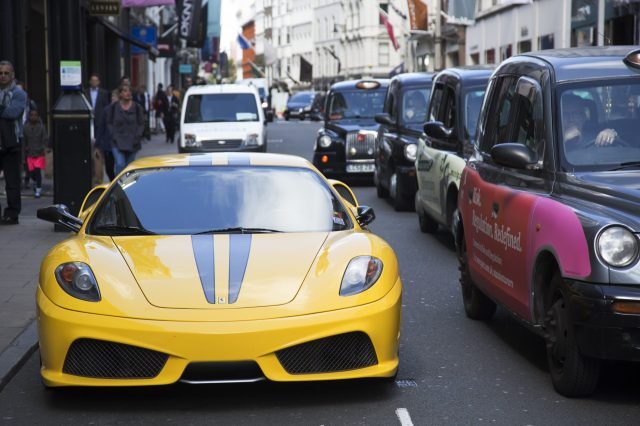
‘hen I want to see what piles of money look like, I walk round Berkeley Square.’ (Mike Kemp/In Pictures Ltd./Corbis Getty)





When I want to see what piles of money look like, I walk round Berkeley Square. First there are the car showrooms — Ferrari, Bentley, Porsche — ready to absorb sudden windfalls. Then there are the restaurants, places with names like Sexy Fish and Nobu, with Land Rovers idling for the disgorging diners. There’s also Phillips, the auction house, where an Andy Warhol painting of Mao recently went for £1.6 million. But more than these varied examples of conspicuous consumption are the Mayfair buildings themselves. Many are owned by offshore companies linked to Sheikh Mohamed bin Zayed Al Nahyan, President of the United Arab Emirates and Emir of Abu Dhabi. Just around the corner is the Saudi embassy, an 18th-century pile worth over £100 million.
This, then, is Middle Eastern London, part of an influx of wealth that has transformed the West End and cities right across Britain. It is all generated by the Middle East’s energy exports, which have created the fortunes of Gulf State sovereign wealth funds and the private wealth of ruling dynasties whose family offices expand their property empires. Yet it might not last forever. With the US-Iran war persisting unabated, and the Strait of Hormuz still closed, the Gulf’s black gold is no longer such a safe bet. And, as my walk round Mayfair hints, a red line on an accountant’s laptop in Doha can have profound consequences here at home. That’s true in the cars on the streets and the restaurants and the clubs — but also in the influence that foreign money can buy.
Middle Eastern London has been decades in the making. After the 1973 oil crisis, Gulf money made inroads into London’s property scene, with Saudi Arabian and Lebanese investors buying up the Dorchester Hotel two years later. These days, the scale of Gulf oil money in Britain is truly bewildering. Alrayan, a Sharia-compliant bank, estimates that $112.45 million landed on London real estate between March 2024 and March 2025 alone, a significant increase on the previous year. Spears magazine used data compiled by estate agent Frank Knight to suggest that private Gulf investors last year deposited £245 million into UK commercial real estate.
These estimates aren’t particularly reliable considering how much money is routinely hidden offshore. But they nonetheless hint at the scope of Gulf wealth and also imply a striking resilience. Of course, the rise and rise of private wealth is global. But the fact that Gulf assets are currently battered by war — yet still continue their march from the Middle East — neatly evokes the affluence of oil royalty.
This is clearest in the London property market. Qatari Diar, the country’s eponymous property development business, is behind a string of prestigious London hotels, including the Ritz and Claridge’s. Luxury stores like Harrods, the iconic Shard building, and the Canary Wharf Group that operates London’s Docklands — all these are part of Qatar Diar’s portfolio too. So too are some of the most prestigious residential properties in the city, including the spectacularly redeveloped Chelsea Barracks.
It’s striking, too, that the footprint of Qatari investment now extends far beyond London. Qatari Diar is behind multi-billion pound urban developments in Glasgow, Manchester and Leeds. When it comes to private individuals, meanwhile, the Guardian discovered that Qatar’s ruling Al Thani family hold more than 4,000 land titles throughout Britain: from luxury mansions and hotels to industrial estates and ordinary terraced houses. Other Gulf monarchies have similarly vast holdings, with the Saudi royal family owning a portfolio of West End properties which dwarfs that relative pauper, the Duke of Westminster.
Not that you need Companies House to understand the Arab impact on London. For that you can just walk the streets of somewhere like Knightsbridge. With Harrods as its commercial centre, the area is notorious for its “dark” streets and partly empty blocks, giving the neighbourhood a ghostly under-occupied feel. Knightsbridge is part of the London Borough of Kensington and Chelsea, which has the highest concentration of vacant, underused and second homes in the UK. Many of these apartments are used by their Middle Eastern owners for only a few weeks a year, when the weather in the Gulf is at its hottest. These dead streets are not a London asset. On the contrary, they look a bit abandoned.
Or else there are the luxury hotels, shops and art galleries, where displays of wealth and entitlement play out on a daily basis. Especially during the annual summer migration, young men fly their luxury cars to London from Riyadh or Muscat, speeding about in noisy displays of wealth. This too can cause problems: late-night races keep residents up, while eye-watering insurance bills result when crashes inevitably occur. There are also questions of accountability when foreign nationals are involved in accidents; Saudi Arabia doesn’t have an extradition treaty with Britain.
Not that these screw-ups are really a problem: there just are so many incentives for foreign plutocrats to park their cash in Britain. Last year, Alrayan Bank reported that Gulf investors told them that they like the diversity of UK property, from modern blocks with concierges to period mansions like the Saudi embassy. They also like the favourable terms of purchase and the well-developed infrastructure in banking, accounting and legal services that supports international investment. The UK’s political stability, legal structures and relative financial transparency make it a good place to store their money.
None of this really helps the Treasury, as visitors and foreign investors add little to the UK’s tax take or collective prosperity. And what’s bad for Knightsbridge ear drums can also cause more profound tensions. The Qatari-funded redevelopment of Elephant and Castle resulted in the demolition of social housing, with residents relocated to more distant parts of London and beyond. Gulf money in Britain has other second-order consequences too. Housing shortages keep property prices and rental yields high, benefiting Gulf investors who can’t grow their money as effectively at home. None of this helps hard-up British professionals forced to commute to central London from Zone 5.
What, though, might change in London and other British cities if the Hormuz crisis continues — and the financial and symbolic power of the Gulf States erodes? What if investments slow, stop, or are withdrawn altogether? In the first place, it’s likely that a drop in Gulf money would shrink displays of conspicuous consumption in places like Knightsbridge. Considering the various downsides, that might not be such a bad thing, allowing these West End neighborhoods to open up to more than property speculation and the super-rich.
In a sense, we don’t have to speculate what this might look like. All wars are different, but when Russia invaded Ukraine, the symbolic, political and financial authority of Russian oligarchs living in London quickly ebbed away. Roman Abramovich, Oleg Derpaska, Igor Sechin and their compatriots left the city — once dubbed “Moscow-on-Thames” — as government sanctions froze their assets and imposed travel bans. Today, their mansions are empty and their yachts motionless. Evgeny Lebedev, Boris Johnson’s friend, media baron and member of the House of Lords, may still live in London’s Regent’s Park. But his celebrity parties are no longer high-profile society events.
Of course, wealthy Middle Eastern investors aren’t the only international plutocrats in cities like London — though, like the Chinese, they are significant contributors in making the city what it is. All the same, might a decline in Middle Eastern clout lead to a rethink of the importance placed on international investment and wealthy foreigners in making these places special? Alongside iconic skyscrapers, Middle Eastern contributions to British cities are often seen as signs of vitality, a way of creating exciting city life, and a pathway to underscoring a certain global panache.
But allowing overseas investors to dump money in Britain also makes life painfully expensive for the rest of us. Nor does it have to be like this. After all, Canada, Denmark and New Zealand are just three of several countries that ban international investors from buying property. The UK, though, lets anyone with money to buy whatever they like. To that extent, the Iran war might be a good moment in which to pause and reconsider the impact of the oil money parked on British streets. In the end, does this wealth embellish people’s everyday lives? Or does it just make spots like Berkeley Square unliveable?
***
A previous version of this piece incorrectly named the President of the UAE. We apologise for the error.