




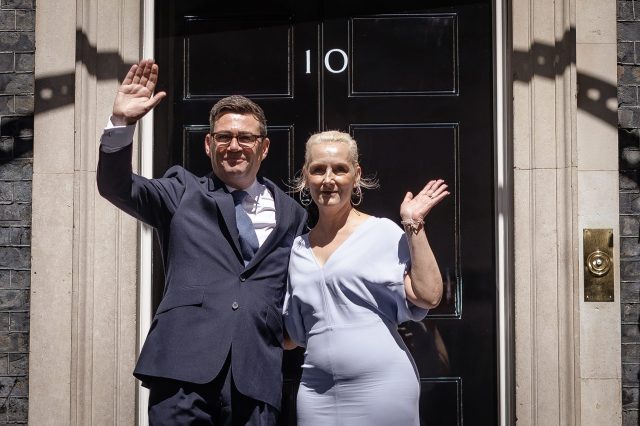
Frankie goes to Downing Street. (Dan Kitwood/Getty)





On the day Andy Burnham became prime minister, my female friends had eyes only for his wife’s dress. The lilac Victoria Beckham gown that Marie-France van Heel wore to No. 10 on Monday was the wrong shape or colour, they said. The fit didn’t flatter. It was too expensive at £890 in a cost-of-living crisis. Then there was the scraped-back hair, a style that’s satisfying to wear but harder to photograph. Oh, but we are awful! All these years complaining that prime ministers’ wives are judged so harshly on their looks, and here we are, the ones doing the judging. I sighed — before admitting that they were only saying what I was thinking.
Who, then, is the real van Heel? We all know that she’s Dutch and also lived in Belgium when young. She met her future husband after coming to study at Cambridge and apparently becoming the coolest girl in college. The football-loving lad was punching above his weight, it is said, though the couple has now been married for 25 years with three grown-up kids and a dog. Much of her professional career has been spent in marketing.

We also know that she once went on Blind Date, despite already dating Andy, as she thought it would boost her marketing career. Choosing “Will from Surrey”, she ended up throwing a cushion at him while he called her “a cold fish”. (What’s hilarious is that “Will from Surrey” might only have been on the Cilla Black show to boost his career, too — as he later became the Conservative Party’s marketing director.) Since then, van Heel has worked at BSkyB, has run her own agency, MVH Marketing, and has progressed to chief strategy officer at a London-based agency called Heavenly, where she worked on campaigns for England Rugby, the BBC, and HSBC.
She has already experienced press interest: when the tabloids disliked an outfit she wore in 2009 at the unveiling of a sculpture of the Queen Mother, and, on a more serious level, when involved in a dispute over her husband’s parliamentary expenses claims for refurbishments of a south London flat they’d bought. The Telegraph noted this week that it was van Heel who “took up the baton, faxing detailed notes ‘on behalf of Andy Burnham MP’ to parliamentary officials, asking them to approve expenses they had previously rejected”. Burnham had already told the Parliamentary Fees office, when expensing the refurb of a previous flat, that his wife would divorce him if he wasn’t reimbursed. On a personal level, she lost her sister to breast cancer, a disease which also affected her mother and other sister, and carrying the BRCA1 gene mutation she opted for a pre-emptive double mastectomy herself.
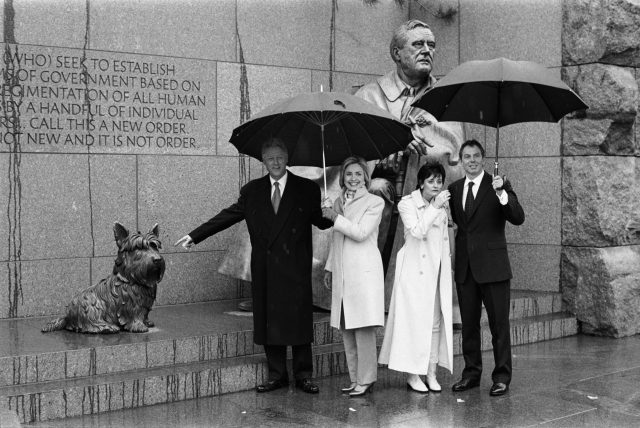
So yes, there are details — but the bigger problem is that, ever since Cherie Blair unwittingly opened the door to the press in her nightie, the wives and husbands of our leaders have insisted on keeping a scrupulously low profile. So low that we barely know who they actually are any more. Cherie’s achievements as a barrister, QC and political activist were soon overshadowed by lifestyle dramas — such as when the press got very excited about her best friend Carole Caplin, who, according to Alastair Campbell, styled herself as “the Blairs’ guru” and rapidly progressed from fitness and fashion advisor to telling Cherie to ward off No. 10’s enemies using crystals. Caplin would often massage Tony because it helped him relax. I mean, the stories were golden — but imagine Victoria Starmer explaining to the public why she let her best friend massage Sir Keir.
As for the Blairs’ children, three of whom went through their teenage years at Downing Street, the papers also had a field day. At least, until 1999 when Blair appealed to the Press Complaints Commission and his complaint, on whether the way they obtained his daughter Kathryn’s school place was really in the public interest, was upheld. Yet in 2002 the Blairs had reason to complain again when their son Euan’s Oxford application became known as the “acid test” for press intrusion on the children of public figures. Would this be news if it were about an ordinary person? No. Subsequent prime ministerial children have benefited from reinforced press protections ever since.
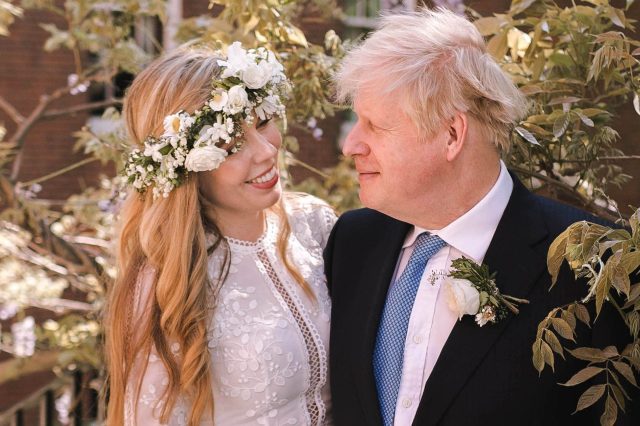
Cherie surely also suffered from the Lady Macbeth trope, a little like Carrie Johnson later on; an intelligent woman who’s politically involved must be exerting a malign influence on her husband. Yet her successor, Sarah Brown, could not have been more different. Her diligence and dutifulness, as well as charitable work, fitted well with her husband’s dour attitude to the job. (Perhaps her own background in PR, having co-founded the firm Hobsbawm Macaulay, instructed her well in how to play it.) Yet his premiership lasted less than three years, and her insistence on humility in the face of public attention has perhaps only truly been matched by Victoria Starmer, whose husband’s time in the top seat lasted a similarly short time. Could it be possible that the more hidden or humble the partner, the less successful the PM? In trying to remember Liz Truss’s husband my mind has just come up with a businessman called Peter, but I’ve just checked and in fact he was an accountant called Hugh.
It’s hard to blame any prime ministerial spouse for avoiding the press, but it does seem that, without hearing any kind of voice from the person themself, or knowing what they want from life, people are left making idle comments about their clothes. Perhaps that’s a price worth paying. Victoria Starmer’s insistence on wanting no part in the whole shebang, to playing the media-friendly wife, seemed chic in itself. And yet — if Keir’s problem with the public was a lack of human touch, then it would have surely helped to see inside his marriage. When his time was finally running out, he began to make frequent references to his wife, something he understandably tried to play down while running the country. Yet how you run a family together surely has a bearing on how you run a country. If his potential supporters really couldn’t fathom who he was, being able to see his family could well have helped. It is certainly not a woman’s duty to prop up her husband’s career by playing the role of the smiling wife. And yet, at the same time, the public isn’t strange or prurient for wanting to know who they’re voting for.
Samantha Cameron let the cameras in and talked about family life. She had been a music and Ibiza-loving raver and went on to set up a fashion brand. She also told her husband David that he was to serve no more than two terms as prime minister — she couldn’t bear any longer — but her media-friendliness certainly boosted his brand. The strength of their marriage, particularly through the death of their beloved son Ivan, shone through to even those who hated their politics. She was the weapon he needed, and when Carrie Johnson later replaced Samantha’s minimalist kitchen with a lavish refurb, people judged Carrie for it.
Then there are the spouses who are equally politically motivated themselves. Hillary Clinton went from being First Lady (under her husband) to secretary of state (under Obama) to presidential nominee herself. Whereas Michelle Obama, regularly and indeed almost relentlessly asked if she’d consider being president herself, has only ever given the idea an exceedingly firm no. With rumours still abounding that she might, her husband had to take up the theme. “There are three things that are certain in life,” he claimed: “death, taxes and ‘Michelle is not running for president.’”
It is a thankless task to raise kids in a family under such scrutiny where you can’t afford to make one single mistake in public — or to leave one of your children behind at the pub, as the Camerons did. Marriage, when it works, creates a unique support system that the highest job in the land clearly benefits from. And yet given we’re on our seventh prime minister in a decade, all of them married, clearly marriage wasn’t enough. As an unmarried person I’d be fascinated to see a singleton take on the job of PM. I wasn’t around for our last one, Ted Heath in the early Seventies, and I can only imagine that answering endless questions about your sex life would be as exhausting as trying to have one. Then again, that didn’t stop Boris Johnson.
But given how many of my middle-aged friends are now divorced, if they were ever even married, or are busily muttering to their partners about “opening things up”, surely the whole nuclear family thing will cease to be such a requisite of our politicians? If our parliamentary spouses feel too much of the spotlight is on them, perhaps they could share the load by entering a throuple?
This isn’t an easily squareable discourse, and telling women what to do isn’t my usual thing. We all feel conflicted by our nosiness — but nosy we remain. It’s precisely because of how damaging intrusion can be that it’s best to get ahead of the competition and intrude on yourself first. Accept that your husband has already made a play at being Mr Normal, and let the cameras in. Given how little we know about Nigel Farage’s partner, or Kemi Badenoch’s husband, it could provide the competitive edge that our new prime minister needs.