




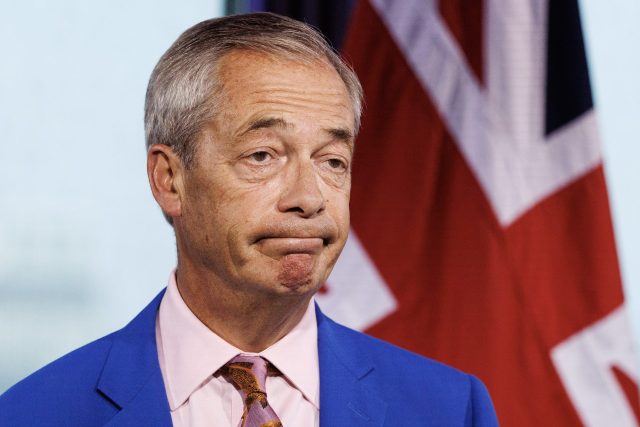
Peak Farage? (Credit: Dan Kitwood/Getty)





In politics, triumph and tragedy run close together. When Nigel Farage decided to resign from Parliament and force a by-election in Clacton, he clearly thought he had pulled a masterstroke against the political establishment and mass media that are mostly hostile to him. As things stand, however, none of the three main parties is standing against him. The great victory over his enemies that he was expecting may, barring accidents, be simply over Count Binface. Farage’s adversaries accuse him of creating a distraction from allegations of financial impropriety. He denies any wrongdoing, and one presumes that by forcing a by-election and winning it handsomely he would expect to draw a line under the accusations against him. Sadly, it is not so simple as that.
I have known Farage for over 30 years, and happily campaigned with him in 2016 for Brexit. I remain convinced he was the main architect of the great popular vote to leave the EU — the kudos claimed by Boris Johnson and his former henchman, Dominic Cummings, is simply not credible. Brexit happened because of the mobilisation of the British working and lower-middle classes, and it was Farage who mobilised them. Many of those enlisted then moved into Reform and helped its massive popular vote at the last election. For Reform to hold on to those voters it needs Farage as its guiding spirit. If anything happens to him, it is over for the party.
Those were the stakes he was playing for in making his decision to resign: but it may well answer nothing, except the question of how much his standing in a far corner of Essex compares with that of Count Binface. It will not disperse the problem of Farage’s undeclared £5-million gift from a crypto-currency billionaire, or of the largesse the Sunday Times claims he received from George Cottrell, a convicted fraudster. Assuming he wins his by-election — and given the competition, it is hard to believe he will not — the investigation into his financial arrangements by Daniel Greenberg, the Parliamentary Standards Commissioner, will resume the day he returns to Westminster. If Farage is found to have behaved improperly and is suspended for 10 days or more, his constituents could launch a recall petition and trigger a second by-election. Should that happen, the main parties (which seem to expect it almost as a certainty) have indicated they would contest it.
Where, though, are the people of Clacton in all this? At the 2024 general election 58% of them turned out to vote, just 1.7% lower than the turnout nationally. It will be interesting to note how many will turn out to vote in the Farage vs Binface contest. One difficulty for him is that he has not been a frequent visitor to his constituency, though has acquired a reputation for frequently visiting the United States, as he did last weekend. Will voters regard this by-election as having been called lightly or frivolously? After all, if Farage was true to his word, and had done no wrong, there would not have been any need for a by-election at all. Some Clactonians, even some who voted for him in 2024, may feel they are being trifled with, or that he is trying to avoid, for a short time, serious scrutiny. If they are asked to turn out a few weeks later to go through the process again, the situation would be so unprecedented that it is hard to predict what would happen.
Farage is not stupid, and presumably took all this into account before calling his by-election. Perhaps he thought all the main parties would take him on and, having defeated them, would not bother to orchestrate a recall petition should Greenberg find against him, and should he receive a suspension of more than 10 days. Now, because the other parties will not fight in this by-election, he may find himself fighting a second in a climate of voter exhaustion, and unable to rely on his own supporters turning out again — especially if his opponents exploit the findings against him necessary to provoke a second contest as evoking sleaze.
As elsewhere in 2024, the growing uninterest in politics in Clacton seemed to reflect a larger than usual disenchantment with the established parties, especially with the Conservatives, who had been the incumbents. Although Reform only won five seats in that election, they had the third-largest popular vote, ahead of the Liberal Democrats, who won 72. The fact remains that under the first-past-the-post system, Reform was lucky to win any seats at all. Since 2024, Reform has waited for pivotal moments to transform its undeniable ability to garner votes into an ability to garner seats. Perhaps it thought that moment had come when did well at the 2025 local elections; but its support remained concentrated in certain geographical areas.
Perhaps it thought that moment would come in the Gorton and Denton by-election, at a time of spectacular unpopularity for the Labour party; but the combination of a poor candidate and a strategy to harness ethnic minority voters gave the Greens the seat. Perhaps it thought it would come at this year’s local elections, but some stunning local triumphs were not followed by victory at the Makerfield by-election, in a seat where Reform had won all but one of the council wards in the local elections. Again, there was an indifferent candidate; but whatever the reason, Reform did not break through and win a by-election that would have pitched a defeated Labour party into turmoil. To lose one such contest was a misfortune; to lose two started to look more than careless. For some time some connected with Reform, which has money and a gift for commanding publicity, have admitted there is struggle to find top-class candidates, even for local government. As the Conservative party’s opinion ratings slowly improve, the appeal of Reform to ambitious politicians diminishes: and the need for the pivotal moment becomes ever greater.
Even if Farage wins a second by-election — which, one must stress, would be a far harder task than winning the first — there is no guarantee that would provide the pivotal moment. Perhaps the party’s most profound problem is that they have lost their unique selling points. They may want to be tougher on illegal migrants, and bid farewell to the ECHR, but so too does the Conservative party. For a long time people on the Right preferred to support Reform because to them the Conservatives were the party of 14 wasted years, their dismal reputation compounded by the horrors of Johnson and Truss. But that party is now under new management; Mrs Badenoch is more popular now than her party, but the party’s popularity is slowly rising too.
A by-election, or possibly two by-elections, in Clacton could give Reform an opportunity to rebuild its momentum. Or, a second election following sleaze allegations could allow the old parties to prove there is life in them yet. For some months it has been said that Reform peaked too soon. Farage wishes to defy that belief. It may take until well into the autumn to see whether he is right, or whether the much-canvassed people of Clacton have had enough.