




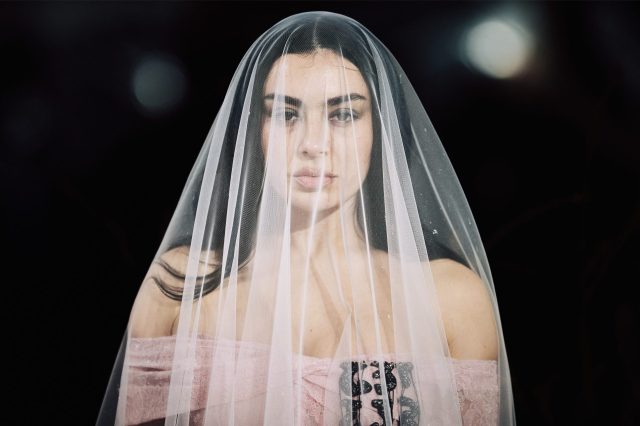
‘Charli is correct that art is not going to save us.’ (Gareth Cattermole/Getty)





Charli xcx is having a death summer. Music, Fashion, Film — her first proper album since 2024’s season-defining Brat, and her second if you include her soundtrack to Emerald Fennell’s Wuthering Heights from earlier this year — starts with a statement of creative destruction. “I think the dance floor is dead,” she announces on album-opener “Rock Music”, a celebration of hanging out with friends and making art.
Maybe you don’t have to take that statement completely seriously. It’s less a manifesto, more a declaration that this record is not going to be a retread of Brat’s ferocious celebration of club culture and “365 party girls”. But the idea of dying recurs again and again in Music, Fashion, Film’s lyrics. Sometimes it’s a kind of figurative suicide: “It makes me wanna throw my life away,” Charli sings on “Camera”, as she reflects on the risk that her acting ambitions could come at the expense of her pop career.
Sometimes, death here is the measure of affection: “I’d cry if you died,” she promises on “Magic Metal Montana”, a platonic love song addressed to her long-term collaborator AG Cook. Sometimes, there are shades of apocalypse: in “SS26” (a self-aware skip through the marketing conventions of the entertainment industry), Charli deadpans that we are all “walking on a runway that goes straight to hell / Nothing’s gonna save us, not music, fashion or film.”
It’s completely fitting that, when Rolling Stone magazine asked Charli to suggest a location for an interview, she proposed the Hollywood Forever cemetery. And by the end of the album, death has become literal. “No One Lasts Forever” is built around a sample from a conversation between Charli and the 83-year-old Canadian horror director David Cronenberg. It cuts in midway through Cronenberg describing an incident in which he collapsed. “As I was lying there on the sidewalk, I did not think about art at all,” he says. “I thought about people, I thought about life.”
“Yes, some artists have created art that has really survived thousands of years,” Cronenberg continues, “but experientially, for them, they are dead, they are gone, they are not experiencing that.” The track, and the album, ends in a minute and a half of Cronenberg’s voice looping around the words “they are dead, they are gone, no one lasts forever” while the music disintegrates underneath him. It’s beautiful, it’s profound, and it’s one of the strangest pieces of pop music ever recorded.
This isn’t a completely new fixation for Charli: you can see Music, Fashion, Film as a second act to the gothic masochism of her Wuthering Heights collection. Or you can watch her mockumentary, The Moment (an imperfect but also underrated satire on the music industry), which imagines a version of Charli who went all-out to cash in on the Brat phenomenon. As things spiral out of control for the Charli of the film, she veers ever closer to self-destruction, until she goes AWOL, sparking suicide rumours.
In the film, this all works out for the best, commercially at least: when the fictional Charli comes back from the dead, she’s hotter than she’s ever been. But she’s also creatively moribund. Her juggernaut success comes at the ultimate Faustian price for an artist. After The Moment’s release, there was a lot of speculation about whether it was intentionally mocking Taylor Swift’s Eras tours. The inclusion of a special thanks in the credits for the Swiftologist, a video essayist who posts critical takes on Swift’s work, suggests that the answer to that is “maybe”.
The alleged Charli-Taylor beef begins publicly in 2024, with the song “Sympathy is Like a Knife” on Brat — an earnest, self-lacerating account of Charli’s feelings of inferiority around another pop star who she sees “backstage at my boyfriend’s show”. (Both Swift and Charli were at one point dating members of the 1975: Swift broke up with singer Matty Healy, and Charli married drummer George Daniel.)
Swift appeared to respond the next year with “Actually Romantic” on her album The Life of a Showgirl, a clod-hopping and misjudged track addressed to an obsessive hater. “It feels like you’re flirting with me,” croons Swift, in an unconvincing imitation of someone who doesn’t care. Compared to Brat, The Life of a Showgirl sounded pedestrian and self-satisfied, and “Actually Romantic” was one of its weakest tracks. The song reaches an apotheosis of cringe with the line: “It’s kind of making me wet.”
What’s interesting here isn’t so much the ins and outs of two women in their thirties who may or may not have had a falling out (neither has gone on the record regarding their feelings about each other). Rather, it’s the contrast between two different ways of dealing with making it. Since 2022, Swift has settled into an imperial phase that has seen her brutally expunge experimentation and vulnerability from her output. The last traces of risk-taking seemed to leave her body somewhere around the album Midnights.
If I had to pinpoint the moment Swift stopped being interesting to me as an artist, it would be the 2023 tweet in which she announced a re-recorded version of “Snow on the Beach”, her duet with Lana del Rey: “You asked for it, we listened: Lana and I went back into the studio specifically to record more Lana on ‘Snow on the Beach’.” You asked for it, we listened, as though making pop music were a question of beta testing and tweaking based on user feedback until the product has been perfectly refined. The customer is always right.
This is the absolute antithesis of the Charli approach to creativity, which is to court danger for the sake of experimentation. On “Camera”, she sings about how acting offers the prospect of “Something new and undiscovered/ And something kind of violent/ Daring to fail and being ugly/ I’m inspired and alive.” Charli recently posted Lou Reed’s despised-at-the-time 1975 album Metal Machine Music to her stories. Better, in her version of the creative life, to flop than to fade away: nothing is as frightening as inertia.
Music, Fashion, Film is several orders of magnitude less confrontational than Metal Machine Music, but like Reed in the Seventies, Charli is facing in the direction of the future. Her post-Brat death-drive caught a mood that has been picked up by some of this year’s greatest pop albums. Worst Girl in America by Slayyyter (an artist Charli singled out for praise in her Rolling Stone interview) is a concept album about a party girl’s rise and demise: the last song, “Brittany Murphy”, is a giddily hook-filled suicide note.
Even more powerfully, Madonna’s Confessions II is — under the thumping return to the floor-fillers of Confessions on a Dance Floor — a record filled with thoughts of mortality. Having spent the years since the first Confessions frantically outrunning her own age, Madonna at 67 suddenly sounds like an artist coming to terms with both her own mortality and her influence. “People really think there’s a beginning and ending to this thing called life. But energy never dies,” she says over the intro to “Fragile”. It is the inverted version of Cronenberg’s words on “No One Lasts Forever”.
You don’t need to be in your pensionable years to feel that existence right now is precarious. This is an unstable world politically, and a frightening world environmentally: large tracts of Europe and North America have been turned to ash this summer. Charli is correct that art is not going to save us — not music, not fashion, not film. The restless desire to make something new, the impulse to create is still worth following for its own sake. It’s one way of knowing you’re alive. When you’ve accepted that your life is finite, why would you waste it doing the same thing on repeat to please other people?
