




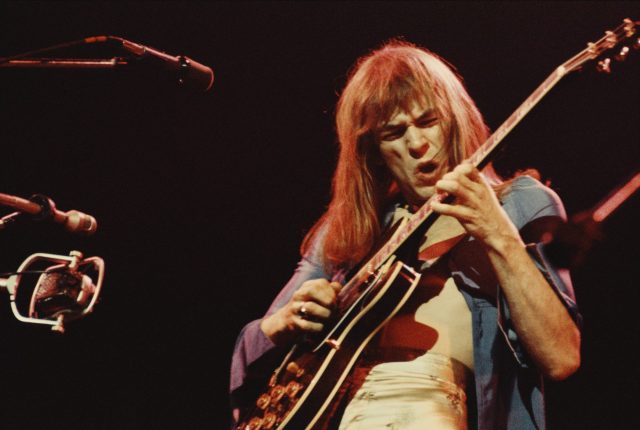
‘Musical tribalism is acceptable in teenagers, but only among teenagers.’ (Paul Natkin/Getty)





Has any genre of music ever suffered so cataclysmic a decline in popularity as progressive rock? Disco comes close: in 1979, a shock-jock DJ named Steve Dahl blew up a crate of records by the likes of Chic and The Bee Gees in front of 50,000 excitable haters at Chicago’s Comiskey Park Stadium. But by the mid-Nineties, disco was back in style and Barry, Robin and Maurice had been thoroughly rehabilitated. Prog’s redemption arc is a lot more complicated. Certainly, there’s an annual Caribbean cruise where surviving stars of the genre perform their classics to aging fans, and in 2026 you can see Rush in concert or buy a new album by the latest incarnation of Yes (which contains no original members). But compared to disco, prog rock is a decidedly niche taste — like building model railways.
And yet, for a few years in the early Seventies, complex, 20-minute long songs with nebulous lyrics and intricate guitar and/or synthesiser solos could earn you critical plaudits while also making you a millionaire. Emerson, Lake and Palmer rearranged Modest Mussorgsky’s Pictures at an Exhibition and went on to fill Madison Square Garden. Yes made an album based on a footnote in a yogi’s biography and did the same. Rick Wakeman had a custom ice rink installed at Wembley Stadium so professional skaters could bring to life the narrative of his LP The Myths and Legends of King Arthur and the Knights of the Round Table. Audiences loved it.
Then came the backlash. Grandiose concepts and technical chops were out; the raw three chord rebellion of punk was in. Prog became a term of scorn, a byword for rock at its most bloated, self-indulgent and pretentious. Erstwhile cosmic voyagers interested in paying the mortgage changed their sounds completely: Phil Collins went from channelling hyper-skilled jazz drummers on Genesis records to warbling about a “Groovy Kind of Love”, while Yes went pop rock and scored a massive radio hit with “Owner of a Lonely Heart”. To be labelled prog was a threat to your reputation: in the late Nineties, when critics suggested that Radiohead’s OK Computer was a bit proggy, the band took umbrage, denying that they knew anything about the genre. Even “out” prog fans tend to be self-deprecating and a little defensive. And yet I would argue that prog rock is one of Britain’s greatest contributions to popular music; and it is high time to recognise it as such, while at least a few of its founders still walk among us.
What, then, is this contentious music? The genre’s origins lie in the late Sixties, when bands like The Beatles, Pink Floyd and The Moody Blues were expanding the parameters of pop music, pushing it into experimental, psychedelic and even symphonic territory. The record credited with crystalising the genre is King Crimson’s debut In the Court of the Crimson King, which combined heavy riffing with elements of jazz, English pastoralism, improvisation and overblown, portentous lyrics. Within months King Crimson were supporting The Rolling Stones at Hyde Park; a few months later their original lineup imploded. In their wake, however, a slew of new, ever-more ambitious bands emerged, while others, such as Genesis and Yes, changed their sound with the intent of “advancing” rock music. Highly skilled young musicians experimented with classical, folk and mediaeval influences, whole-tone scales and odd time signatures. The playing became ever more virtuosic, the concepts ever more grandiose. By 1973, prog was at its peak — Pink Floyd released The Dark Side of the Moon; ELP released Brain Salad Surgery, which stayed in charts for 47 weeks; Yes unleashed their monumental Tales from Topographic Oceans, a concept album the length of a Mahler symphony and which shot to number one in the UK charts.
Tales, however, also marks the turning point, where prog hubris meets nemesis. For the first time, Yes faced significant critical hostility, while even their cosmically inclined fans grew restless when the band tried to play the whole thing from start to finish. Record labels began pushing prog bands to write shorter, more commercial songs that could be played on the radio. The popular notion that punk killed prog is, therefore, an oversimplification. Not only that, it gets the timeline wrong: punk exploded as a musical and cultural phenomenon in late 1976, three years after Tales from Topographic Oceans pushed the boat out a little too far. Meanwhile, Yes topped the UK charts in 1977 with Going for the One, which featured an unapologetically complex 15-minute epic that filled most of side B. It spent two weeks at number one, the same amount of time as the Sex Pistols’ Never Mind the Bollocks a few months later. Yet this was the last hurrah: by the end of the decade, most of the prog bands had broken up or changed their style.
If not punk, what did kill prog? To some extent, it was creative exhaustion: once you have expanded the parameters of rock by adding in every possible ingredient, where do you go next? But, for the most part, I think the answer is simple: fashions change. Or, at least, they used to.
Strange as it may be to imagine in today’s era of cultural stasis, where octogenarians headline festivals and 60-something rock critics write reviews of Taylor Swift albums, popular music used to be made by young people for even younger people. Styles flourished and then vanished constantly. Flower power and psychedelia burnt brightly then disappeared; glam rock came and went; then it was prog’s turn. Given that you couldn’t dance to it, fall in love to it, or even play it on the radio, the truly remarkable thing is that it was ever popular at all. In the next decade, the primary expression for instrumental virtuosity in rock was heavy metal guitar, while prog’s more cosmic, spiritual themes would manifest in New Age music.
So if prog’s downfall was to be expected, the more interesting question is: why was it so despised for so long? Why was there no triumphant, disco-style resurrection? Here I think we see the baleful influence of those geriatric rock critics. It goes without saying that rock criticism is one of the worst forms of writing to have emerged since the invention of cuneiform; yet there was a time when people cared about the opinions expressed in NME, Melody Maker and other long-forgotten publications.
Being writers and not musicians, rock critics tend to emphasise skilled lyricists — Bob Dylan, Patti Smith, Lou Reed, The Smiths — while musically they fetishise simplicity — punk, post-punk and New Wave — on the grounds that anyone should be able to pick up a guitar and express themselves. Class also plays a part: prog was supposedly played by posh boys who had benefited from music lessons, while punk was of the street. And yet Jon Anderson, frontman of Yes, was an ex-milkman from the North of England while Joe Strummer, frontman of The Clash, was the son of a diplomat.
Musical tribalism is acceptable in teenagers, but only among teenagers. But prog served as a convenient whipping boy for lazy rock critics for decades, even as they aged into their thirties, forties, fifties. I didn’t start listening to it until I was almost 30, when an Italian friend, unburdened by British musical taboos, introduced me to Red by King Crimson, a spectacularly heavy yet complex record. From that very first listen, I realised that I had been lied to. But I think that by far the worst legacy of the war on prog was the stigmatisation of musicianship, which reached its nadir in the Nineties with Britpop — a bland, backward-looking movement that left behind a smattering of catchy tunes but very little of interest musically.
Now that rock — like jazz and classical music — is primarily enjoyed by the middle aged and elderly it is time to leave childish things behind. Prog is great because it’s the sound of ambitious, accomplished musicians with an expansive vision pushing themselves to their limits. As with all musical movements, some practitioners had better judgment than others, but all of them were on fire with possibilities. It is the sound of why not? Of what if? Of taking everything that’s available to you and creating something new and unprecedented.
Today there are modern prog bands who continue the tradition — technically accomplished groups from Scandinavia who draw on the classics of the genre, as well as subgenres like prog metal. But I prefer the early stuff, which captures the sound of discovery — like watching Eisenstein or Dziga Vertov invent the language of film, or Lawrence Sterne subvert the novel even as the form was taking shape. Robert Fripp, the leader of King Crimson, once described his vision of music as Hendrix playing Bartók. How can you argue with that?
So if you haven’t tried prog, I encourage you to dive in — there is much to explore. If you have, then I congratulate you on your excellent taste. Now if you’ll excuse me, I’m going to go and listen to my 15-disc Tales from Topographic Oceansbox set. I may be some time.
Daniel Kalder is an author based in Texas. Previously, he spent ten years living in the former Soviet bloc. His latest book, Dictator Literature, is published by Oneworld. He also writes on Substack: Thus Spake Daniel Kalder.
 DanielKalder