




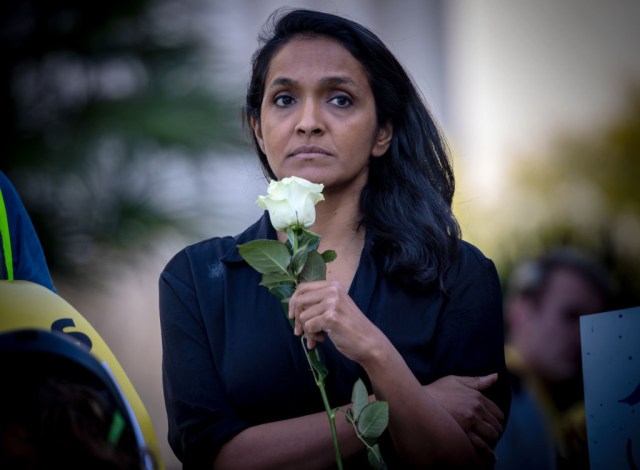
Mayoral contender Nithya Raman wants to decriminalize drug use and decommission the central jail. Credit: Getty





Last March, a makeshift drug factory exploded next to Los Angeles resident Juan Galicia’s craftsman-style home, built in 1910. The flames spread to his gas line, setting off a fire that destroyed the house and killed his three dogs — he tearfully shows me their picture. Had the accident happened an hour earlier, it would have killed one of his sons, as well. “I lived here 18 years and now it’s gone,” the 55-year-old father, an immigrant from El Salvador, tells me. The empty lot next door, he says, was occupied by homeless squatters who cooked methamphetamine there. “People occupy a place and the city does nothing,” he says.
Galicia owns a small construction business and is also a minister at a primarily Latino Pentecostal church downtown. He tries not to fume against his misfortunes, but he has a beef with the city, which to this day can’t even identify the owner of the lot. Repeated calls to his city councilman, radical DSA member Hugo Soto Martinez, have proved fruitless.
“There are millions for the homeless, but nothing for those who work hard,” Galicia notes. “The sidewalks are never fixed and the police are slow to come. It would be easier if the government would not make everything so miserable.”
LA is currently hosting the World Cup, and two years from now, it will host the Olympics. The city should be ready for its closeup — but it isn’t.
This is a painful change for anyone who, like me, came to the City of Angels 50 years ago and embraced its eclectic mix of cultures and businesses. In the 1980s, LA was what the conservative historian Fred Siegel called “the entrepreneurial dynamo.” Unlike New York or the Bay Area, where academic pedigree and family ties were the keys to success, LA was an everyman city, a place where you could afford to start a business and live in a house like Galicia’s, all within the perimeter of a great metropolis.
Aesthetes long preferred New York or San Francisco, but the masses headed to LA. Between 1900 and 1940, the city’s population surged to 1.5 million from barely 100,000. After the war, LA expanded again, enriched by its huge oil and defense sectors, and by 2020, hit its peak population of 3.8 million, with another 6 million living in surrounding Los Angeles County. These areas once domiciled 13 Fortune 500 companies, including Disney, Northrop Grumman, Security Pacific Bank, First Interstate, Union Oil, Getty Oil, and Arco, and a long list of successful growing businesses, as well.
Since then, the Fortune 500 locals have dwindled to seven, with just one, Farmers Insurance, inside city limits, and that just barely, on the furthest fringes of the San Fernando Valley. Meanwhile, the Los Angeles Times, once a critical part of the city establishment, has abandoned Downtown for El Segundo, amid severe financial strains and a paid circulation that’s a fraction of its once vast readership.
Most critically, Los Angeles County now suffers the highest poverty rates in the state, and among the worst in the country. As you drive the streets of South Los Angeles and along the historic main street of black LA, Central Avenue, now predominantly Hispanic, the ambience is increasingly reminiscent of the colonias of Mexico: broken pavements, battered buildings, outdoor swap meets, and fly-by-night food stalls.
The county is shrinking too. Once celebrated as “the city that grew,” by 2070 it will suffer a reduction of more than a million people — 14% of its current population. Since 2000, the area has experienced a devastating loss of 750,000 people under 25, and it has the second-lowest birthrate among the 53 US major metropolitan areas, according to the American Community Survey.
And while it is still home to more than three million immigrants, newcomers are increasingly headed elsewhere, notably to Texas, Florida, and other Southern states. The political class may be proud of creating a “sanctuary city,” but since 2010, the area’s foreign-born population has declined.
One reason is a lack of civic leadership. LA is increasingly a headless city. For many years, an almost exclusively white, male, and Protestant business elite embraced manifest destiny and dominated the surrounding region. These leaders fostered the creation of the kind of infrastructure that makes a great city — roads, universities, observatories, aerospace plants, a massive streetcar grid, as well as car and tire factories.
This ruling alliance was transformed during the mayoralty of Tom Bradley, who won office in 1973 and served for 20 years. Now the old business establishment shared primacy with unions and rising Jewish and African American communities, an alliance that fostered long-term planning rather than cosmetic and rarely effective “short-term fixes,” according to Nick Patsaouras, an urban planner and public official with a long history in LA development.
Today, groups like the Chamber of Commerce have little influence over the city’s direction. “There are no ‘civic’ leaders left,” Patsaouras told UnHerd. “Just parasites feeding from public trough and crooks.”
The optimism that once defined the city has withered as well. Once it was widely believed that LA was developing into a true rival of New York, with its own subway system and a downtown filled with sparkling high-rises. By the 1980s, trade at the Long Beach-Los Angeles port surpassed that of the Port of New York. And investment, much of it from Asia, suggested a future “capital of the Pacific Rim.” As the popular slogan had it: LA’s the place.
Today, the Entertainment Capital of the World can’t even fend off challenges from places like Dallas-Fort Worth, Nashville, and Miami. Michael Kelly, director of the Drucker Institute at the Claremont Colleges, suggests that virtually every basic industry — including manufacturing, finance and business services — has lost jobs, or at best has stagnated, since 2019. Only government-funded education and health jobs showed significant growth. If LA had grown as quickly as the national average, he calculates, it would have created 300,000 more jobs.
Instead of focusing on development, the city’s establishment increasingly resembles the rulers of the late Roman Empire, offering the people the distraction of bread and circuses. Even as the signature industry, entertainment — down 42,000 jobs in the past three years — shrinks, a passion for showiness and glamor remains. Diversions include the Dodgers, the Lakers, the World Cup, a sparkling new George Lucas $1 billion Museum of Narrative Art, due to open this fall — and most particularly, the Olympics.
The city’s business “leaders,” Drucker’s Kelly suggests, aren’t fixing the weak economy, the dysfunctional schools or the increasingly dilapidated and dangerous LA parks. “All they care about is the Olympics,” he says.
But the City of Angels today hardly resembles the brash upstart that held a successful Olympics in 1932 or the emerging world capital that, in 1984, under the brilliant leadership of businessman Peter Ueberroth, ran the Olympics with little incident and a profit. The LA 28 organization, the official host committee, claims it has enough sponsorships and TV deals to pay for what is needed, although there are growing doubts whether the city can absorb Olympics-related security costs, given its near-disastrous fiscal shape. Officials should hope that visitors, particularly journalists, will not see eyesores like Juan Galicia’s burnt-out home, and will skip the visit to Skid Row, close to the city’s downtown business district, which has a murder rate 17 times the city average.
This was once a city that, like Marlon Brando’s broken boxer in the movie On the Waterfront, “could have been a contender” to challenge New York and other more established metropolises. But since the end of Republican Richard Riordan’s mayoralty in 2001, power has shifted to a motley coalition of political operatives, those using the city’s infrastructure to enrich themselves, and increasingly powerful public-sector unions. A focus on “social justice” and green virtues has thoroughly replaced the old growth-oriented vision.
Homelessness is the most obvious failure. Even as San Francisco, under reform Mayor Dan Lurie, aided by the local tech community, has turned back the homeless tide, Los Angeles retains roughly 70,000 “unhoused” people. It has spent billions but has refused to take such steps as shutting down the camps. Half of the homeless are known to be from somewhere else, attracted by the salubrious climate, free needles, and lack of police enforcement.
The problem is no longer confined to the infamous Skid Row, but has spread to once stable neighborhoods, even as those charged with improving conditions have been charged with corruption. In a neighborhood close to where I used to live, homeless people hang out in the supermarket and eat in the aisles. Others harass business owners and illegally draw power from the city grid.
In part due to homelessness and the largely unchecked gangs, many of LA’s once great public places, like MacArthur Park, have become crime-ridden dystopias, filled with the mentally ill, firebugs and gang members. Even the libraries are increasingly unsafe. As long-term LA journalist Sam Quinones suggests: “in Los Angeles, private spaces have become public threats.”
But the homeless are just one element of the growing disorder. Add to this attacks by gangs of kids, vandalism, and theft throughout the city, particularly downtown. Thieves removed the copper pipes from Galicia’s burnt-out home. Criminals are now so bold that they have started stripping copper wire from street lights, leaving some of the city in the dark.
Not surprisingly, the middle class is heading for the exits. Since 1980, the percentage of city residents who own their own home has fallen from 40% to roughly 33%, compared to rates of roughly 65% home-ownership nationally and 56% in the state.
The loss of the middle class has transformed the political landscape, largely to the benefit of the Left. When Republican Riordan ran in 2001, Republicans could account for as much as a third of the electorate, notes longtime GOP strategist Arnold Steinberg. Today, amid the expansion of mail-in ballots and lax control over who votes, they barely constitute half that amount. Add to this ultra-permissive voting rules and legal “ballot harvesting,” including from the homeless, and changing the political direction seems almost impossible.
Spencer Pratt’s mayoral campaign may have thrilled conservatives around the country, but few of his greatest admirers vote in LA. He came in third behind current Mayor Karen Bass, a long-time Leftist who organized help for Fidel Castro’s Cuba in the 1970s, as part of the Venceremos Brigade, and Nithya Raman, a 44-year-old Mamdani clone, who lives in a $1.9 million house in fashionable Silver Lake and has a planning degree from MIT.
Bass’s disastrous mishandling of the Palisades fires has made her vulnerable to an even further Left challenger. Raman’s handlers hope to sell her as a “change agent” and a competent manager, something Bass is clearly not. Raman is currently, by some polls, in the lead. But whoever wins, nothing much will change, at least not for the better. Political power will continue to remain in the hands of militant public unions, notably the SEIU, which represents generally low-income service workers, and the teachers, who demand ever more taxes to pay their salaries and generous pensions.
Homelessness will remain a massive problem whoever wins. Raman has opposed restrictions on public camping and sleeping. “Raman’s record on homelessness is worse than Bass — if that is possible,” notes westside activist Tim Campbell, a longtime Angelino and former government auditor. “She’s incompetent and arrogant, which is a fatal combination.”
Raman’s managers will paint her as pragmatic, but her political allegiance belongs to the Democratic Socialists of America, whose platform includes seizing private housing, a 100% renewable energy system, making all public transportation free, the decriminalization of drug use, and the decommissioning of the central jail. Her purported moderation only makes sense when compared to her fellow DSA council member Ysabel Jurado, who favors not just defunding the police but abolishing them.
Whoever wins in November, Los Angeles seems likely to continue its masterclass in urban dysfunction. As in New York, Seattle, Washington, DC, and other cities, the DSA is cementing a coalition of public-employee unions and the welfare-dependent with a crop of young college graduates who predominate in neighborhoods such as Echo Park, Silver Lake and Hollywood, LA’s version of New York’s “Commie Corridor.”
If the City of Angels is to come back, don’t look to the business elites but to working and middle-class immigrants from places like Mexico, Central America, China, Taiwan, India, and increasingly, Africa. Many of them now settle in smaller cities in Los Angeles County — Paramount, Bellflower, Downey, and South Gate, among others — that are showing that you can build a successful city amid the big city’s dysfunction.
These cities pride themselves on the basics like law enforcement, street maintenance, and schools, and demonstrate that such initiatives can work in today’s Southern California. Indeed, in a study I conducted with researcher Bheki Mahlobo, we found that these south Los Angeles County cities, once seen as backwaters, have managed to outperform the city itself, particularly its South Side, in terms of employment, public safety, and school scores.
Los Angeles retains a magnificent collection of neighborhoods, and is home to remarkable institutions like the Getty Center, a striking museum in the Santa Monica Mountains. And there are some tentative signs that the LA electorate is capable of pushing back to defend it. In 2024, voters ousted Soros-financed District Attorney George Gascon; they have also displayed a growing resistance to tax increases. You can still feel the area’s potential in places like El Segundo, where space and aerospace firms are flourishing, and at a charter school in Granada Hills, where largely minority students — Chinese, Korean, Middle Eastern, Latino — routinely win the national academic decathlon. Hollywood still possesses a reservoir of entertainment-industry talent. And, of course, the weather and topography remain daily reminders of why people came here in the first place.
The key to renewal lies with people like Juan Galicia who, despite everything, is pursuing permits to rebuild in his neighborhood. Sustained by his faith and his commitment to making Los Angeles a better place, Galicia, like many Angelinos, is staking out a claim for a better future. Some, like me, may have fled — in my case, south to Orange County — but I will cheer Galicia and people like him as they try to restore a city to which I owe much, and would be delighted to see ascendant once again.
“I want my trees back and my home back,” Galicia tells me. “I have to work every day and rebuilding this house is my dream. It will happen, you’ll see. I still feel blessed to be here.”
Joel Kotkin is a Presidential Fellow in Urban Futures at Chapman University and a Senior Research Fellow at the Civitas Institute, the University of Texas at Austin.
 joelkotkin