




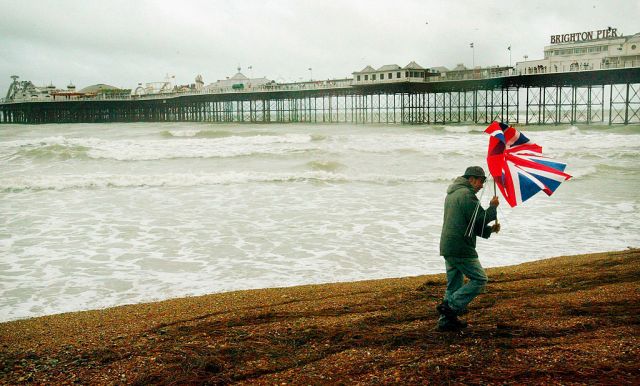
‘There’s a glimmer of hope on the horizon.’ (Graeme Robertson/Getty)





Calling Blue Labour a faction would be an insult to factions. Where some Labour tribes organise internally in their local parties, wield influence in the trade unions, prepare slates of fellow-travellers for internal elections and candidate selections, Blue Labour remains more of an idea, a vibe. There’s a parliamentary caucus but no formal organisation or wider membership. There’s a website that links to a few esoteric pamphlets, with hints towards what can best be described as a political disposition. That disposition is centred around an incredulity towards both the top-down, bureaucratic, Fabian state built up by post-1945 governments, as well as the double liberalisms of economy and culture that have dominated British politics since the twilight years of the last century.
“Blue”, we are variously told, refers to the small-c conservatism of the movement, as well as to “blue-collar” voters themselves. Suffusing Blue Labour discourse is an understandable nostalgia for old-fashioned ethical socialists, influenced by such mainstream texts as Pope Leo XIII’s Rerum novarum of 1891. And so “blue” also connotes the group’s inherent melancholia: how could it not, when their successors operate in a party overflowing with all the technocratic dreariness and cultural coding of contemporary liberal progressivism?
But forget the melancholia and the suffering and penance for the moment. There’s a glimmer of hope on the horizon. And not just because the bone-dry managerial style of a Remain-campaigning Surrey lawyer has been replaced with the more palatable normie populism of the Manchester everyman. Whether the Westminster chatterati believe the affectations of Andy Burnham’s persona or not, the incoming PM can at least earn Labour the chance of a second hearing with its former supporters in working-class Britain.
Hope begins in Burnham’s Makerfield constituency. Just 25 miles separate the Stubshaw Cross Labour Club on the outskirts of Ashton, and the high street in Gorton, a diverse, multicultural area south of Manchester city centre. But the political distance between the two could have huge ramifications for the future of Britain. Stubshaw Cross — a flat-roofed working-men’s club with England flags, cheap lager and sun-faded banners of Bobby Moore lifting the 1966 World Cup — was the centre of the Labour firmament for several weeks during Burnham’s recent by-election campaign. Gorton, of course, was the scene of the Greens’ first ever by-election triumph earlier this year.
The former Mayor of Greater Manchester, according to all the polling evidence, would have trounced the Greens’ plumber-turned-parliamentarian Hannah Spencer in Gorton, just as he eventually trounced Reform’s plumber-turned-candidate Robert Kenyon in Makerfield. But he would likely have done so having been dragged Leftwards by the Green insurgency, into the social and cultural space of the young, ultra-liberal Left, and their incongruous Muslim allies.
Makerfield is different. The Green insurgency is nowhere to be found, and until our PM-in-waiting was elected, the seat was near the top of Reform’s target list. There was an image of the constituency as a post-industrial wasteland — a quintessential Northern outpost, “left behind” and populated by the angry and white working class. Never mind that it’s far wealthier than Gorton, its rougher estates leavened by villages scattered among green fields, new cars in driveways, and neat front gardens overlooked by well-kept pebbledashed semis. For a certain breed of Labourite, seats like Makerfield remain ideological catnip: the collieries have long closed, but the area still represents something romantically assumed must always be fundamentally Labour. It’s the Britain of the non-graduate workers, the blue-collar salaried staff, the tradesmen.
Gorton and Denton, of course, was prime Labour territory too, until the Green victory anyway. But there’s always been a slight embarrassment in some of the more nostalgic party circles about Labour’s relationship with metropolitan Britain. For one, there’s an electoral logic to it: there’s no route to Downing Street through the inner cities alone. But there’s also an ideological aversion, a feeling that Labour can’t simply be the party of what Michael Lind calls “the hubs”, full of rootless “anywheres”. While the cities house the demographic fusion that makes up the party’s newer base — graduates, public-sector employees, the youthful urban precariat and ethnic minorities — Labour support among older, less mobile, and whiter workers in the smaller towns has long been in abeyance. Their struggles in seats like Makerfield, at least without Burnham on the ballot, is a sore reminder of what the party has become: the vehicle of choice for the buzzy urban citadels, while old proletarian Britain abandons them in droves.
That’s what makes the victory in Makerfield remarkable, and what makes some Blue Labour figures hopeful. A week after the by-election, on the hottest June day on record and in the upstairs of a Manchester pub aptly named The Briton’s Protection, I chaired a meeting of two Blue Labour MPs, 30 of its local supporters, and a gaggle of the politically curious gathering to discuss the tendency’s future. The room was full of an unusual positivity, as a strange unity broke out between warring intra-party tribes.
Burnham’s candidacy in Makerfield had seen him renounce his previous positions on rejoining the EU and gender self-identification. Last week, he posted about the release of a Rochdale grooming gang leader from prison, telling followers that “like everyone, I want this vile criminal out of the country”. Burnham is combining this no-nonsense, Rightward tilt on culture with a robust critique of what he calls “40 years” of market-liberal economic logic.
The unofficial radical pole of Burnhamism’s prescription has already been set out in “The Productive State”. The brainchild of Mathew Lawrence and Alex Williams, a pair of Left-leaning thinkers, it’s a detailed document that advocates for a whole new growth model based not on ever-increasing, welfarist distribution of tax revenues — but on a reassertion of public control over core sectors and natural monopolies, including the privatised utilities, transport and social care.
This will, the authors say, facilitate a new social infrastructure: one based on national investment rather than rentierism and dividend extraction by endless outsourced corners of the public-private para-state. From there, out-of-control departmental budgets will soon be brought to heel, as layers of procurement parasitism are removed in favour of in-house delivery. The growing benefits and post-hoc subsidy regime will be reined in too, once the state has made the transition from distributism and entitlements to production and investment.
Perhaps unsurprisingly, these proposals have caught the eye of Blue Labour, with whom there’s significant ideological overlap. In the sweltering upstairs function room of The Briton’s Protection, Jonathan Hinder made the case for a more robust, workerist socialism based on public investment, trade-union power and a developmentalist state that just builds things. “We’re a socialist tradition,” he tells the comrades, “against an economic consensus we’ve had since 1979” — an echo of Burnham’s own pronouncements. “Some people call us socially conservative,” Hinder adds, in a nod to what we might call the incoming PM’s Radio 6 aesthetics. “I’d just say we’re ‘normal’.”
There’s every likelihood, of course, that this vision will be eclipsed by a less radical interpretation of Burnham’s fledgling “Manchesterism”. That could constitute something like a mild increase in capital spending in the regions — made possible within the fiscal rules by allowing arms-length bodies such as the National Wealth Fund to issue their own bonds — alongside extra devolution and symbolic moves like No 10 North. Certainly, the Blairite Right of the Parliamentary Labour Party would love to strangle Hinder’s ideas at birth, as would a media establishment hostile to transformative economic policy. Those dreaded bond vigilantes wouldn’t mind a go at the garotte either. All the while, some on the Left have called for more radical measures still: fiscal-monetary co-ordination, financial repression, price controls, and nationalisation.
The substance of Burnham’s agenda, then, is yet to be fully formed. Just weeks away from Downing Street, as advisers still jockey for influence, the direction of the project is still very much in flux. Indeed, that question of personnel could prove decisive. There never was a consensus among its backers whether Morgan McSweeney’s flirtation with Blue Labour’s broad messaging was based on a genuine ideological position or hard-nosed politics — the public, British Social Attitudes surveys regularly show, lean Left on economics and Right on culture.
McSweeney’s recent interview with Nick Robinson suggests the latter, with Keir Starmer’s former chief of staff expressing open hostility to any politics based on ideas, and showing himself to be little more than an adept campaign organiser, possessing no political economy, no theory of state, and little interest in policy. With the disappointments of Starmerism finally interred, the new Blue Labour lodestar within the incoming camp is Josh Simons, the former MP who gave up his seat to force the Makerfield by-election, and who is tipped as head of a No 10 policy unit. Several Blue Labour sources describe him as “aligned”, adding that he “gets it”. One says “Simons is broadly a good thing, but I don’t know him well”.
Burnham’s future cabinet sparks greater uncertainty. One Blue Labour-adjacent figure tells me that “loads of Northern MPs” are “very concerned” about the potential appointment of Ed Miliband as Chancellor. “It’s not just his policy,” they explain, “but his actual personal unpopularity with a large chunk of the electorate.” Miliband is, in their estimation, “a real bogeyman”, confirming the worst suspicions of those “who already worry that Labour are full of luvvies”. To be fair, some Blue Labourites tell me the Energy Secretary’s monomaniacal Net Zero obsessions are fuelled by a genuine belief that climate policy can be used as the fulcrum of social-democratic industrial policy, a catalyst for building a new, green, big state capitalism. Again, though, not everyone’s convinced: one insider simply calls Miliband “a crank”.
There are broader questions too. The progressive wing of the PLP will make welfare reform a difficult sell. Burnham is said to support Alan Milburn’s much-vaunted review, but any tweaking of benefits rules will have to be accompanied by genuine pathways to work, to avoid rebellion on Labour benches anyway. Similarly, there’s a disconnect between the public’s desire for harsher immigration and asylum policy and the soft-Left’s queasiness on Shabana Mahmood’s Home Office reforms. A staffer from her camp tells me she’ll “probably” stay in the role. Time will tell.
The truth is that whatever the success of an emergent Blue Burnhamism, it won’t be because the faction — if we can start calling it that — revives flat caps, smokestacks and Catholic social teaching. The industrial proletariat of old has gone, and the old Labour Party with it. The new working class of Britain are as likely to live in Gorton and Denton as they are in Makerfield. They don’t work in factories or down pits, but in call centres and shops, construction sites and care homes, warehouses and soulless offices.
Burnham the endlessly protean politician understands the performative nature of politics, and the necessity of broad-based appeal. As a Home Office minister in the Blair era, his stances on crime were so tough that he earned the nickname “flog ‘em and Burnham” from civil servants. He then went on to tease the Corbynites by attending Universal Basic Income fringes at conference, and positioning himself as a born-again Leftist. Where Blue Labour has had a tendency to over-correct, to lean into outmoded political archetypes, Blue Burnhamism can shapeshift on culture. The New Left sage Perry Anderson has written that political movements must be “capable of synthesising heteroclite demands that [have] no necessary connection with each other… into a national-popular unity”.
That is the task of leadership. Burnham must succeed where Starmer failed and simultaneously appeal to the old and new working classes by articulating a positive national renewal project, a normie populism combining civic, progressive patriotism, matter-of-fact socio-cultural positioning and comfortable regional identity with a new economic direction for the country. But if Makerfield has given his leadership some early ideological shape, the challenge will be in translating Burnham’s cosmetic difference into a real-world, concrete politics. Fail, and Blue Burnhamism will be remembered as little more than a Northern campaign dialect.
Jonny Ball is a Contributing Editor at UnHerd. He formerly wrote under the name Despotic Inroad.
 DespoticInroad