




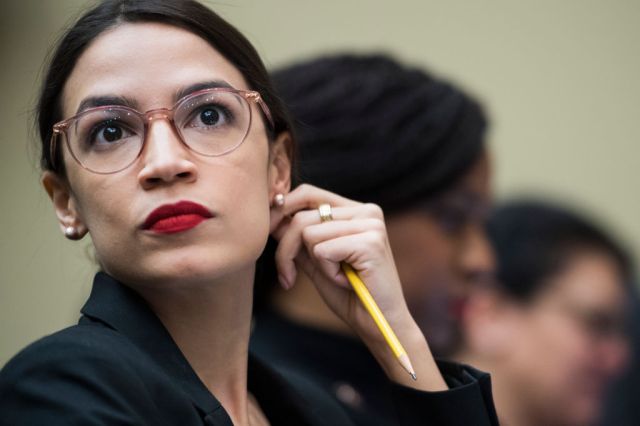
Can AOC please the Left while chasing the mainstream? Credit: Getty





Next year, the Democratic Socialists of America will have at least six of their own in Congress. The Squad — an overlapping, larger grouping in the House that includes Leftist Democrats who aren’t part of the DSA, like Minnesota’s Ilhan Omar — will be even more expansive. The upsurge owes to the primary victories of Claire Valdez and Darializa Avila Chevalier in New York City, Melat Kiros in Colorado, and Chris Rabb in Philadelphia. All are unapologetic Leftists who have campaigned on blocking aid to Israel and abolishing ICE. With the GOP facing an uphill battle to keep the House, all of these socialists will likely be sitting in the majority next year. And if Democrats somehow flip the Senate, too, they will be emboldened as never before.
Yet the woman who introduced modern democratic socialism to America, Rep. Alexandria Ocasio-Cortez of New York, may find this outcome more discomfiting than thrilling — at first blush, at least. Though AOC entered Congress as a disruptor railing against the party’s leadership, she has become, quietly, far more accommodating in Washington. Will the incoming socialists follow the same pattern — or adopt a more radical line, forcing her to choose between fidelity to the Left and her mainstream aspirations?
AOC is friendly with top Democrats, including Minority Leader Hakeem Jeffries, who might well end up the next House speaker. She has climbed the ranks of key committees. She has been, when needed, a good soldier. In 2024, at the Democratic National Convention, she delivered a forceful speech in favor of Kamala Harris, hailing the then-vice president for working “tirelessly” for a ceasefire in Gaza. Meanwhile, members of the so-called Uncommitted National Movement — progressives who refused to commit to the Harris-Walz ticket over Palestine — were all but barred from the convention. This irked Leftists to no end, leading them to question AOC’s progressive credentials and to wonder out loud whether she was a sell-out.
Yet beyond the hard-Left rank-and-file, AOC is unlikely to face an immediate battle with the new socialist electeds. She didn’t endorse all the primary challengers who won — in deference to her House colleagues, she stayed away from those challenging incumbents or the preferred candidates of incumbents. Even so, she has made overtures to the victors, praising Valdez and Avila Chevalier in New York. The winners all express a fondness for her — publicly, at least. In short, comity will likely reign within The Squad.
There’s a larger question, though, over how these relationships might fare if some of the new Leftists decide to behave in a more confrontational manner. Ocasio-Cortez may run for president and wants to make a bid for a broader national audience. A lawmaker like Avila Chevalier won’t have the same incentives. Within the DSA itself, there are also going to be fresh tensions. It isn’t hard to find online gripes from Leftists wondering if AOC is too soft on Israel, too willing to accept the Democratic status quo.
How things change.
It was in 2018 when AOC won her shock primary over Joe Crowley, the boss of the Queens Democratic Party, seen as a potential successor to then-House Speaker Nancy Pelosi. The organization that supported her, the DSA, was mostly a fringe curiosity, a legacy project of the famed political theorist and activist Michael Harrington, who died in 1989. As recently as a decade ago, the DSA boasted only a few thousand members nationally and had little impact on conventional electoral politics. When AOC won, she benefited from the first DSA boom, which followed Sen. Bernie Sanders’s unsuccessful but surprisingly robust battle against Hillary Clinton for the 2016 Democratic presidential nomination. Fast forward to today, and there are around 120,000 DSA members across the country, per the organization’s own tally.
At first, it looked like AOC would fulfill the expectations of her greatest fans and detractors alike. Before she was even sworn in, she stormed Pelosi’s office with 200 youth activists to demand Congress do more to combat climate change. Her nascent Squad seemed poised to disrupt the Democratic majority, with AOC leading the way.
Some of their number, such as Omar and Michigan’s Rep. Rashida Tlaib, would prove to be lightning rods. Yet as the years wore on, Ocasio-Cortez gradually evolved into an institutionalist, a proud progressive who would nevertheless partner with Pelosi and try to climb the ranks of the body. She is one of the top Democrats on the House Oversight and Government Reform Committee, and while she still supports policies like the Green New Deal — a massive stimulus program to fight climate change while putting millions to work on the scale of the original New Deal — she rarely talks about it anymore. In light of her rising stature in the Democratic caucus and her alliance with Jeffries, AOC didn’t endorse Avila Chevalier or Valdez in their primaries, though both are fellow Latina DSA members from New York City.
Among a faction of the left, AOC skepticism persists. Bhaskar Sunkara, the Jacobin founder (and a contributor to these pages), recently declared that Ocasio-Cortez is “more progressive than socialist.” Some in the DSA have grumbled that by upholding corporate-friendly Democrats like Jeffries, AOC has undercut her own seriousness about rebuilding the welfare state and union power. There’s a schism, too, between how New York City socialists view Ocasio-Cortez — they adore her — and a smaller slice of the national leadership that has always seen her as too moderate: AOC never forced a vote on Medicare for All, voted to support Iron Dome funding for the Jewish state, and seemed, at times, more concerned with placating colleagues in seniority than catering to the base.
How will these factional tensions contour her future and that of the wider DSA-aligned Left in Congress?
Power, generally, tends to change those who obtain it. For the next wave of DSA members entering the House, the question is whether they’ll follow the current AOC example — or venture down a more radical path. The latter, given Ocasio-Cortez’s own entanglements with the Left, may be more likely. Neither Avila Chevalier nor Valdez have said they would support Jeffries for speaker. Kiros and Rabb haven’t committed, either. (Brad Lander, who is not a DSA member but would be one of the most progressive Democrats in Congress next year, has said he will back Jeffries.)
This doesn’t mean, ultimately, that Jeffries won’t have the votes to win the speaker’s gavel. Nor does it imply that all of these DSAers won’t fall in line with the mainstream of the party. But it does offer a preview of what’s to come.
What was true was that Ocasio-Cortez never employed the tactics of hard-Right Republicans in Congress, many of them members of the House Freedom Caucus, who were able to take down one speaker (Kevin McCarthy) and hold another hostage (Mike Johnson). If these conservatives took relatively little interest in governing — the nihilist anti-spending approach dated back to the Tea Party years — it was inarguable this faction could, at times, impose its will on the rest of the Republican Party.
The hard Left has never been able to do the same to the Democrats, whose party leadership disciplined members far more effectively and could, more often than not, tamp down insurgencies. Donald Trump thrice clinched the GOP nomination, while Sanders couldn’t do it even once. In 2026, though, the Democrats are running out of cards to play. A democratic socialist governs New York City, and Leftists are running roughshod over establishment Democrats in congressional primaries. Jeffries, for all his skill, lacks Pelosi’s stature and naked political talent. AOC and her allies couldn’t defenestrate Pelosi because she was, unlike McCarthy, one of the great backroom tacticians of the modern era, a legislative leader with few peers anywhere. And she was a historical figure, too, the first and so far only female speaker of the House. By the time AOC entered Congress, Pelosi had already completed a four-year stretch as speaker and spent many decades in politics; she was the preeminent power in San Francisco and Washington, DC.
What is Jeffries compared to that? Suddenly, the radicalism that the new DSA members might pursue almost reads like realpolitik. Why should Valdez or Avila Chevalier or Rabb fear Jeffries? What can he really do to them? Why not try to replicate the House Freedom Caucus model on the Democratic side? Jeffries’s staunch support for Israel is outmoded, and even ordinary Democratic voters alienated from the DSA don’t have an especially high opinion of him. They’re tired of their leaders and don’t feel they’re fighting Trump hard enough.
This is where the DSA Leftists can appeal, to some degree, to the “normie” Democratic voter — both despise Trump and want to engage in political combat at his level. AOC, ultimately, will have to shift with them — she’ll need to be more pro-Palestine and anti-Israel, and more willing to spar with Jeffries. For her, this all might be liberating, anyway. The AOC of 2018 would probably be protesting the AOC of 2026. If she really wants to run for president, she’ll need every last activist in her corner. That primary will be a real war.
