




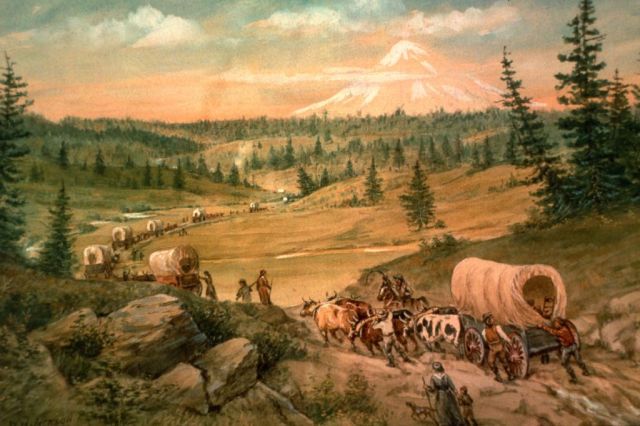
‘The reason America became a democratic superpower was its abundance of land.’ (MPI/Getty)






If there is a foundational dogma to America’s civic religion, it is that the United States is an exceptional country. The reason we emerged as the world’s first modern democracy, the reason we became the most powerful country in history, the reason we defeated fascism and communism and remade much of the world in our capitalist image, is that we’re somehow special.
For those inclined to see the world through Christian prophecy, we are ordained by God. For those who prefer to see Enlightenment-style “reason” as the engine of civilisation, it was the genius of our Founding Fathers that set us on our path to greatness. For those who are more anthropologically minded, it was the curious Tocquevillian habit of Americans to come together in voluntary associations that set us apart. But all agree that we are a uniquely favoured nation.
A wider view of history reveals a more mundane explanation: the reason America became a democratic superpower was its abundance of land.
The long arc of Western history that led to the birth of the United States did not “begin” at any particular moment, but the collapse of the Roman Empire was certainly a major inflection point. The new kingdoms founded by Germanic tribal warlords on the wreckage of the Empire were less sophisticated than the society they had replaced. They lacked the bureaucracy necessary to tax their subjects as effectively as the Romans had, and without that revenue, they could not raise standing armies. Instead, they relied on volunteer soldiers, and compensated them with the spoils of war and pillage. This included plundered treasure as well as, more importantly, land.
Out of this exchange came the military order of feudalism. The power of a medieval king was measured by the military might of the volunteer soldiers pledged to him — otherwise known as his vassals. These men tended to be experienced warriors who could fight on horseback and who could conscript peasants who lived on their land, by force or by payment, to serve as foot soldiers. Generally, the more land a vassal held, the larger his annual revenue and the greater his army. He agreed to wage war on behalf of a more powerful magnate in exchange for the right to rule over a share of the newly conquered lands that military victory would bring. With that new wealth and power, he could, in turn, attract less powerful vassals into his own service.
But this compensation scheme created an intractable problem for the king, who, in the early Middle Ages, was merely the most powerful warlord in a given region at a given moment. The more land he distributed to his vassals, the stronger and more independent they became. Thus, every vassal was a potential rival, and every fief the king granted to them increased the threat they posed to his hegemony.
The remedy only made the problem worse. The king could secure his throne against the predatory ambitions of his rivals only by waging new wars and conquering new lands to distribute to his vassals as fiefs. It was a vicious cycle: staying ahead of one’s opponents in the short term meant increasing the threat they posed in the long term. On top of that, vassals waged their own wars to amass their own retinues of lesser vassals, and were also constantly trying to build their own military dynasties. Political competition created the conditions for endless war.
The militarised politics of feudal Europe produced an intricate vertical social structure: a long chain of vassals and liege lords connected the lowliest peasant to God. At the same time, however, the competition between warlords created a countervailing ideological force: republicanism.
The core region of feudal Europe was the area that was conquered by Charlemagne in the ninth century, stretching from the south of present-day Italy to the Baltic Sea, and from Bohemia to the Pyrenees. In the early days, aspiring conquerors swarmed to this relatively populated landmass, whose large peasant class could be easily forced into serving in infantries. But eventually, the core became overheated. The power of the incumbent lords became too strong to contest, and competition shifted to the more sparsely populated and up-for-grabs lands of the east and the north.
To effectively exploit these peripheral domains, their new rulers had to encourage settlement — and not just by agricultural labourers. Centuries of military competition in Europe had steadily generated new technologies: plane and chainmail armour, long bows, stone castles and siege weaponry like trebuchets. Artisans were needed to manufacture these products, and they in turn required trading centres. In this way, towns became indispensable to the long-term security of any throne.
Sometimes rulers transferred populations to their territories by sheer force, but more often, they were compelled to offer attractive terms to prospective immigrants. Colonists were granted enhanced property rights and civil autonomy. In the 12th century, the charter of Dublin allowed its residents to administer their own local affairs and judge their own legal cases. They were allowed to form guilds and to build as they wished within the city’s boundaries. Legal innovations spread like mushrooms: a charter in a town in today’s Germany would become a template for the founding of a new one in today’s Poland. A transnational legal network began to emerge, bestowing certain rights and privileges upon urban inhabitants, who became known as “burgesses”, or “the bourgeoisie”.
As the kingdoms of the old Carolingian lands spread to the farthest northern and eastern reaches of the continent, new riverine and overland trade routes emerged, criss-crossing Europe. Trade produced wealth, which kings could tax. These new sources of revenue, along with the development of bureaucracy, began to resolve the problem of the conflicting political interests between lords and vassals. Now, instead of exchanging land for military service, monarchs could pay mercenaries to fight their wars, and even raise standing armies. The Hundred Years’ War of the late Middle Ages was fought largely by mercenaries. But at the end of the war, Charles VII created the first European standing army since the Roman Empire by bringing France’s private military companies, which were typically contracted by feuding lords, into the direct service of the king. The move ignited a brief civil war with much of the aristocracy, as the crown was consolidating at their expense.
Over time, to use Max Weber’s terminology, the crown began to monopolise the use of legitimate violence. Royal domains were internally pacified, and warfare became a matter of conflicts between great kingdoms. Something resembling the modern nation-state became dimly perceptible.
Pacification was good for trade, and the chartered townships prospered. The republican-minded burgesses flourished with them. But the old feudal class structures didn’t simply evaporate. Warrior knights slowly transformed into domesticated aristocrats orbiting the king’s court. These aristocrats continued to control the land, even while fulfilling no obvious social purpose. Stripped of their military function, they became a parasitical remnant of a social order that no longer existed. Peasants, labourers and lesser aristocrats found themselves socially immobile.
The stage was set for class conflict. The newly consolidated political power of the crown, at its apotheosis in the age of Absolutism, began to chafe against the burgesses with their democratic values.
But for the discontented burgesses, farmers, and lords without prospects there was the promise of America. In the American colonies, there was arable land for anyone with the gumption to venture into the wilderness and take it. If you could tolerate the backbreaking work of clearing forests and the threat of being massacred by Indians, you could escape the economic stranglehold of early modern Europe’s vampire class. Here, the republican values incubated in medieval European towns and cities were free to spread unencumbered by the dead weight of aristocracy.
Take, for example, those who would come to be known as the Scots-Irish, though they thought of themselves simply as Irish. Their ancestors, largely Presbyterian, had been transplants from Scotland to Ulster, recruited by Queen Elizabeth I as English-aligned colonists meant to displace the native-born Catholic Irish. Conditions were dismal in Scotland, and the land much better in Ireland, so they came in droves. But once there, they found themselves under the thumbs of absentee English landlords, who leveraged the improvements the new tenants had made to their lands to double and triple the rents they charged them. Feudalism had long since passed, but the labouring classes were still being squeezed by the nobles.
In the 18th century, the Scots-Irish fled Ulster as readily as their grandparents had once fled Scotland, this time to the east coast of the United States. After landing in Philadelphia, they beat a hasty path into the back country, where they chiselled crude farms out of the mountains and hollows of the Appalachians. Once the nation was unified following the War of Independence, the Scots-Irish pioneers, for better and for worse, became the tip of the spear of American expansionism.
The conquest of western North America entailed a different kind of warfare than their distant European ancestors had waged in the Middle Ages. The Americans faced fierce resistance from an indigenous population skilled in warfare, but not of the sort that medieval conquerors had encountered in Europe. Indian tribes had not constructed stone castles nor built trebuchets. The Americans could take their land without fielding armies in the tens of thousands, and without reordering their society to produce a warrior class and a servile population that could be conscripted as cannon fodder. The settlers who marched west of the Appalachians to conquer Indian lands largely did the fighting themselves, with the US Army playing only an ancillary role. They furnished their own weapons, and put their own lives at risk. They believed not in oaths of loyalty but in liberty, independence, and natural rights. It was a form of conquest and colonisation that was entirely compatible with the old republican values of the European bourgeoisie.
After the West had been settled, the bourgeois ideology continued to prosper. Just as the medieval warlords on the peripheries of Europe needed new settlers to secure their power, the United States had a bottomless appetite not only for labourers but for skilled workers, educated professionals and entrepreneurs to develop the economy of a newly conquered continent. As for the burgesses in the medieval European towns, it was a buyers’ market for labour. And the US government attracted labourers in the same way: by offering economic opportunity as well as political liberties the newcomers were denied at home. With the obvious, colossal exception of blacks in the South, who were still ruled by the vestiges of a European aristocracy that would only be subdued in the Civil War and ultimately defeated in the Civil Rights Movement, American democracy flourished under these material conditions. It continued to do so in the 20th century, as America’s economy boomed, increasing the bargaining power of workers, professionals and entrepreneurs with the state.
Those conditions, however, have vanished. In an age of urbanisation and industrialised farming, land is no longer a productive source of wealth to be exploited at the level of the household. Far from needing to coax migrants into the United States to develop our booming economy, we are stanching the flow to prevent them from competing for scarce jobs. And with Artificial Intelligence rapidly displacing human cognitive labour, the incentives for governments to grant new civil liberties to people in order to secure their commitment to the nation and enlist their participation in the economy is becoming non-existent. Humans are losing their leverage over the institutions that rule them as their labour becomes cheap and superfluous.
At the age of 250, the United States has long ceased to be exceptional. There is reason to question whether its republican spirit will persist much longer. Far too much emphasis is placed on vague notions of some uniquely American commitment to “freedom” to explain the success of American democracy, and far too little on the material conditions that have historically made democracy here possible: abundant land without a landed gentry. Without these conditions, democracy persists in America merely as a matter of inertia. We should be cautious not to assume it will last.
Leighton Woodhouse is a journalist and documentary filmmaker based in Oakland, California.
 lwoodhouse