




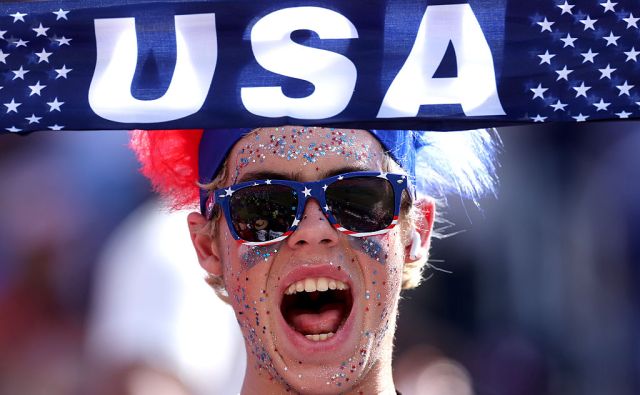
‘Ball don’t lie.’ (Jamie Squire/Getty)





“Ball don’t lie.” This phrase, originally attributed to NBA star Rasheed Wallace, comes from American basketball culture and implies that, no matter what the referees or back-office bureaucrats do to intervene in the game, the ball will end up where it should. If it goes through the net, the sporting gods wanted it to happen. The best team wins. Always. In the 57th minute of America’s game against Belgium, when US keeper Matt Freese came out of his box to deal with a long ball, only to have it stolen from his feet and fired into the back of the net for Belgium’s third goal — when that happened, Wallace’s sense of sporting justice was surely validated.
Yes, Donald Trump may have personally intervened with Fifa to get Folarin Balogun, America’s star striker, an exception on the red card he’d earned in the previous match. But having Daddy Warbucks pull strings for your side can take an athletic effort only so far: in the end, Belgium won the game 4-1. Money and power cannot buy a World Cup. Qatar is a partial exception, but even in the case of the 2022 competition, the team got nowhere close to holding the World Cup trophy over their heads while confetti streamed down.
Corruption in Fifa, much less professional soccer, is hardly new. For years, if not decades, rumours swirled around top Italian club Juventus’s strange habit of winning games at the last minute on highly suspicious penalty decisions — suspicions vindicated by the Calciopoli refereeing scandal that, in 2006, got the club stripped of titles and relegated.
Put aside the fact that Balogun’s red card was indeed dubious. The same could be said of numerous others, Francesco Totti’s red card against South Korea in 2002 being perhaps the most ludicrous. The injustice of the card is not the point. World Cup history is full of calls far worse, against teams with far greater chances of actually winning the competition, from countries who care infinitely more about the sport than the US, which after last night’s defeat will almost certainly return to treating football as a secondary concern.
What made Trump’s effort to overturn Balogun’s suspension different is what it reveals about the nature of American political life. Bending the rules — and even outright cheating — is often deemed acceptable as long as it benefits “our side”. Part of American folklore is the belief that the country represents the “last best hope of earth” — a phrase that politicians of both parties still deploy, few realising they’re borrowing from Abraham Lincoln.
The 16th president was a man nearly everyone in the establishment still agrees represents the greatest of the American ethos. Yet Lincoln too — just like Trump — bent the rules to get his desired result. When the Southern states expressed their desire to leave the Union, Lincoln maintained that they had no such right, even though the foundational premise of the American liberal tradition is governance based on consent. To this day, that element of the Civil War remains underplayed; to even touch it risks ostracism. We are told that Lincoln used the legal mechanisms available to him to make his side, our side, prevail, and the arc of history bent toward “justice”. But who decides what “justice” really is, and therefore when the established rules and norms are acceptable to break? Those in power, obviously.
Had Balogun matched his earlier form in the tournament and the US had won instead of Belgium, Trump’s maneuvering to clear the deck for his return would have become the story of the World Cup. In typical Trumpian fashion, he would have made a story completely unrelated to him — the US is finally good at soccer! — about him. There’s no such thing as bad press, as Trump’s notoriously ruthless consigliere Roy Cohn taught him. It’s a sentiment the President hasn’t ridden just to fame and fortune, but to two of the strangest presidential terms and some of the oddest cultural milestones in the republic’s history.
Alongside hosting MMA fights on the White House lawn, Trump must now add to his résumé exposing the truly bipartisan nature of American enthusiasm for corruption. When it was announced that Balogun’s red card was rescinded, the notoriously kneejerk Left pundits, who have made entire careers out of reflexively condemning everything the man does, all of a sudden flipped on a dime and said, more or less: in this one case, corruption and arm-twisting behind the scenes was good. Why? Because it made our side better off. Our tribe — in this case the US national team — had a better chance of winning.
In a culture that glorifies winning and encourages its members to see the stakes of not only elections, but competitions for college admission or job placement, as existential contests that validate one’s identity, sport is the only place where shared identity is still allowed. Studies have shown that when a fan’s team wins, their testosterone spikes; researchers famously measured the effect in fans after basketball and World Cup matches. Conversely, when their team loses, cortisol surges as though the loss were personal. This occurs, psychologically speaking, because fans’ nervous systems unconsciously treat the objects of their affection not just as extensions of their own identity but, literally, as their own high-stakes competition. So, when American Leftists and other commentators suggested, as Cenk Uygur did on X over the weekend, that Trump’s corruption might be okay in this one particular instance, they were revealing how American politicos — both Right and Left — actually think.
Put aside debates about Trump’s claim that the 2020 election was “stolen”. If you actually spend time around Democratic Party diehards, they, just like their counterparts in the GOP, will openly express admiration for cheating if it’s used to the “right” ends. Lyndon Johnson, possibly the Democratic Party’s greatest-ever legislative architect after Franklin Roosevelt, is lovingly rumoured to have instructed his staff to spread rumours that an opponent had sex with farm animals simply to “make him deny it” in the press. JFK’s father flooded the 1960 primaries with vote-buying efforts, only to have Kennedy joke about the electoral purchases himself, reading from a fake telegram from his father. “Don’t buy a single vote more than is necessary,” it said. “I’ll be damned if I’m going to pay for a landslide.”
The Democrats are not alone in bending the rules in their favour. Late-20th century political operative Lee Atwater was as notorious as he was admired for his dirty-tricks campaigns against Democratic opponents. Atwater’s legacy is nearly always spoken of positively by GOP operatives. When Atwater rode the infamous “weekend prison pass” attack against Michael Dukakis — outsourcing a brutal ad to a nominally independent group, so the Bush campaign could maintain plausible deniability — he showed us the future of America’s political present. A place where nearly every YouTube feed in the country is flooded with attacks that recklessly try to recreate some version of Atwater’s one-dimensional tarring of his Democratic rival.
But Atwater — like LBJ, JFK and, lest we forget, Tammany Hall before him — was loved by his tribe because he carried out his dirty tricks for “our” side. Presuming, of course, you have an active dog in the political race. And while more Americans than ever are disgusted with both parties, nearly everyone watching the red, white and blue on the field at the World Cup still feels the primitive pull of the national tribe.
In America, when rule-breaking delivers our tribe a win, our objection evaporates. That reflex, not Trump’s phone call, is the genuinely American thing on display. As for Belgium, they shouldn’t just have complained to the press, they should have flat-out threatened to refuse to take the field. Rule-bending for the powerful — and a public that never mobilises to stop it — is the new American face of world football, already on full display.
But here is the thing about sport that politics can only envy. The game has a court of final appeal that no president can phone. Trump proved he could bend Fifa to his will. But he couldn’t bend the ball. Ninety minutes after the greatest rule-bending intervention in World Cup history, the beneficiary’s team was down 4-1, its goalkeeper face-down in the Seattle turf, consumed with shame, and the entire apparatus of executive pressure had ultimately purchased nothing whatsoever. The sports gods audited the books and issued their correction. Ball don’t lie.
American politics, however, has no such auditor. No ball and no net. Only the next election to be bent by whichever tribe holds the whip and a public — Right and Left — that has quietly agreed to measure every violation by a single standard. Did it help us win?
B. Duncan Moench is a writer and scholar of American political culture. He also writes the Producerist Substack.
 DuncanMoench