




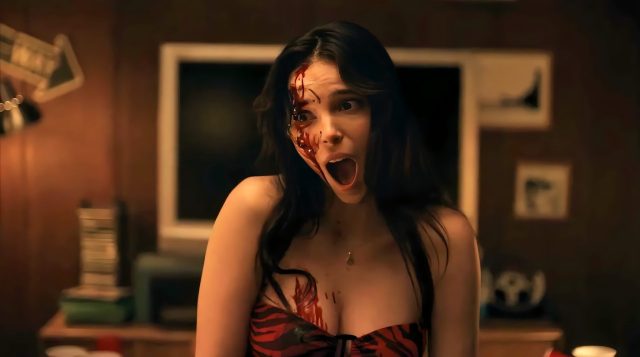
Nikki, played by Inde Navarette, pulls off an astonishing feat as the obsessed young woman. (YouTube)





It’s often observed that horror films are a good barometer of pressing cultural anxieties. If so, the weather doesn’t look very good for social interaction right now. Backrooms has just been released, exploiting the spooky Covidian aesthetics of deserted buildings, and taking $118 million in its first weekend. Meanwhile, another low-budget shocker has been crushing the box office for three weeks straight: Obsession, by 26-year-old wunderkind director Curry Barker. To watch this film is to experience unaccountable dread and terror, as you enter the mind of a Gen Z man trying and failing to get a date.
The young man in question is called Bear. Never was a name so ironically bestowed, for this Bear is anxious, tentative, and terrified of overstepping. He’s in love with a co-worker at the local music store, a girl called Nikki, but cannot steel himself to declare his affections to her. In a hippy shop selling crystals and dreamcatchers, he buys a “One Wish Willow” — marketed as a “collectible toy from the Eighties”. He breaks it in half as instructed, and wishes “that Nikki Freeman loved me more than anyone else in the world”. He immediately gets his heart’s desire, and all hell breaks loose.
To boomers, this may sound like a familiar tale of the terrifyingly unhinged power of the female libido, with shades of Fatal Attraction or Single White Female. But this film is no nostalgic reprise of that late-Eighties theme. The obsession of the title belongs as much to the male as to the female; and if anything, the latter is to be thoroughly pitied. Thanks to the fulfilment of Bear’s wish, Nikki is subject to an all-consuming romantic possession that drives her towards abject self-debasement and social humiliation against her better nature. During a rare moment of lucidity, she begs for death as a release, and who would blame her? We’ve all been there, Nikki love.
Actress Inde Navarrette pulls off an astonishing feat as the obsessed young woman, alternating insane aggression with comic pathos. Her devotion is child-like in its intensity, completely untrammelled by attempts to play it cool. Most of the time she is all id, no ego, openly begging Bear for more affection, ferociously guarding him against imagined rivals, and covering the front door with tape to stop him leaving for work. When that fails, she becomes literally rooted to the spot until he returns, with devastating consequences for the carpet.
But for all of Nikki’s spellbound antics, the more interesting character is Bear — sensitively played by another relative unknown, Michael Johnstone. His story makes a compelling contrast to the original “monkey paw” trope, created by author W.W. Jacobs in 1902. Jacobs’ short story depicted a cosy working-class domestic scene, interrupted by the arrival of an acquaintance fresh from the colonies, carrying with him a mysterious shrivelled object that will grant three wishes. Ignoring the visitor’s dire warnings and his own misgivings — “it seems to me that I’ve got all that I want” — the family patriarch, Mr White, wishes for two hundred pounds. Next morning White receives this exact sum as compensation for his son’s death, “caught in the machinery” at work. The old man’s second wish is to bring his horribly mangled son back. His third wish is to cancel out the second, finding himself too afraid to answer the ominous knock at the door.
As befits a child of his time, director Barker says he first came across The Monkey’s Paw via an episode of The Simpsons, but one hopes he has read Jacobs’ story too. Along with all the timely social anxieties it expressed about the costs to the working classes of industrial progress, and the threat from the exotic foreigner (Mr White, anyone?), there was a simpler message there too. The Indian fakir who originally put the spell on the monkey’s paw, Jacobs wrote, “wanted to show that fate ruled people’s lives, and that those who interfered with it did so to their sorrow”. White’s mistake was to fail to accept his lot in life, trying in Promethean fashion to alter destiny instead. As such, he firmly belongs in the pantheon of classic Gothic overreachers, along with Victor Frankenstein and Dorian Gray.
But Bear’s tragic flaw is precisely the opposite. He is a chronic underreacher who uses his modernised monkey’s paw as a lazy proxy for a deliberate, intentional choice. Romantically he is paralysed, terrified of being seen to “take advantage” of a girl — even though that’s precisely what he eventually does. And even after it seems clear Nikki has fallen under his spell, still he can’t bring himself to publicly own his feelings. When she asks him if he likes her, his guarded response is: “Why, do you like me?”.
Crazy as she is, Nikki can tell what Bear’s real problem is. At one point she gives him a “Tiger’s Eye” stone as a love gift, to bring him “confidence and will-power”. But it doesn’t work, reappearing during the film’s finale to no avail. It’s not hard to conclude that through this character, Barker has neatly encapsulated the predicament of a generation: unable to ask a pretty girl for a light, let alone steal fire from the gods.
According to some recent estimates, nearly 50% of men between 18-25 have never asked a woman out on a date. Possible reasons are legion, but include the fact that there are simply fewer chance encounters with strangers as social life has moved online. There is an attendant awareness in the young of social media’s potential for making private humiliations public. And there’s the surrounding progressive culture, placing huge emphasis on the potential for men to get sexual approaches wrong. Unfortunately, the threat of heavy social censure only seems to produce confusion and fear in conscientious types, while leaving habitual sex pests perfectly unperturbed.
In a sense, then, Obsession acts as a permission structure to examine this inadvertent mess, drawing to the surface of consciousness a widespread ambivalence, but without telling viewers how to feel about it. Such story-telling neutrality makes a nice contrast with the socially conscious horror that was popular about a decade ago, following the success of Jordan Peele’s Get Out. Made at a moment of peak didacticism, Peele’s film — though otherwise pretty good — was widely interpreted as saying black people should be afraid of white people, and that white people should feel bad about this. For a while afterwards, we got a spate of clunky lectures disguised as horror films, addressed primarily to viewer’s consciences and only secondarily to their viscera.
But Obsession prefers showing not telling, and is all the better for it. When I eventually staggered out of the cinema, senses bruised by spectacle and noise, the world looked temporarily different. Strangers’ smiles seemed uncanny, the birdsong eerily pronounced. I felt peculiarly in touch with the numinous, and that doesn’t often happen to me in Horsham. It was as if I’d had a tiny holiday from reality, or a restorative miniature psychotic break.
You don’t get much of this uncanny afterglow from streaming films at home, which is another reason why the phenomenal success of Obsession and Backrooms is so cheering. It is striking that both Barker and Kane Parsons — the 20-year-old director of Backrooms — began experimenting with their craft on much smaller screens, bypassing turgid studio systems by taking their output straight to YouTube, and building massive fanbases there. But still the silver screen retained its old power to bewitch. As a result, now these directors are luring the kids out of their bedrooms to watch with other people — a fact that may do wonders for the birth rate, if nothing else.
Presumably these newcomers are encountering the thrill of mental surrender to a huge cinematic experience at close quarters, with no pause or mute button available, in a place where it is frowned upon to have a rival screen out at the same time. And who knows? Perhaps they are also learning of that time-honoured way to make an easy move on your love object, something that also used to be big in the Eighties: reaching for a trembling hand in the scary dark.
