




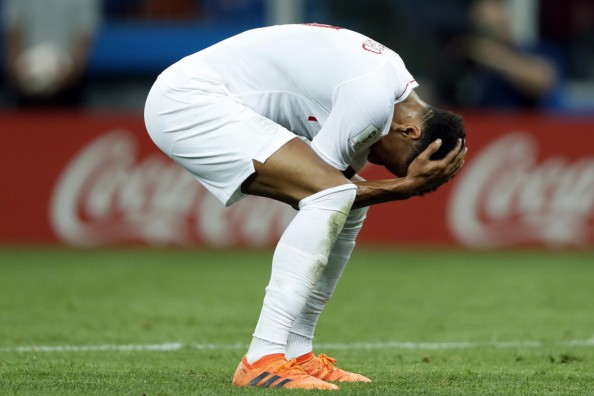
Jesse Lingard laments England’s loss to Croatia in the 2018 World Cup semi-finals. (VI Images/Getty)





England won both of their final pre-World Cup warm-ups in Florida. A 1-0 win over New Zealand was designed as a leg-stretcher, 22 players each playing a half; then Costa Rica, who have not qualified for the World Cup, were dismissed 3-0. But before patriotic pride is kindled, and hope begins to swell, it’s worth looking back to the end of March and a pair of friendlies against Uruguay and Japan that offered nothing to suggest England are a team about to end their 60-year wait for a major trophy.
It wasn’t just that England failed to beat Uruguay or Japan. It wasn’t even that their football was stodgily unimaginative, or that so many players were unavailable with injury. It was the grim sense of familiarity. This was what pre-tournament friendlies looked like in the bad old days before Gareth Southgate started taking England deep into World Cups and European Championships. There have been many occasions this season when English football has felt like an Eighties or Nineties tribute act — as the football has become more direct and the strategy more focused on dead balls — but rarely more so than in the Japan game, in which Tuchel’s players fruitlessly chased opponents who were cleverer, more tactically and technically astute than them.
With the bookmakers, England are third favourites to win the World Cup. Whatever the qualms about appointing a foreigner, Tuchel is an excellent coach. More than that, beyond the occasional lack of diplomacy, he has a skillset that seems attuned to international management. International managers have limited time available with their squads, and so the game tends to be less sophisticated, less complex, more about individuals than the club variant. Tuchel, throughout his managerial career, has managed to effect rapid change; he is good at formulating solutions and achieving player buy-in. The problems have tended to come later in the relationship, when he falls out with sporting directors and board members.
While it’s reasonable to see the dearth of plausible English candidates for the job as a failure of structure, the fact that Tuchel is German may help. Although he is an Anglophile who clearly loves London, he has a distance that arguably makes him both more clear-sighted and more willing to take risks — as demonstrated by his controversial squad selection; balance and having players fulfil specific roles matter far more to him that reputation. His life will not be defined by one decision. He can go back to Germany whenever he wants; he’s not going to be popping into Tesco in 30 years time, worried that the bloke at the cheese counter is about to harangue him about a substitution from the distant past.
And England do have match-winning individuals. In fact, it’s probable that no England manager has ever had access to such an array of creative talent. The Football Association has traditionally been an easy organisation to blame, but on this point, it deserves great credit. After England’s failure to qualify for Euro 2008, the FA launched yet another root-and-branch review, but this one actually led to change. The Elite Plater Performance Plan was introduced in 2012, radically overhauling the academy system. Two years later, a team that included Southgate launched the England DNA project, setting a template for how England should seek to play: a possession-based, tactically flexible model.
Technical accomplishment is almost impossible to gauge beyond an eye test, but a quick comparison between the current squad and the side Roy Hodgson took to the 2014 World Cup tells its own story: Tuchel’s options are so deep he could omit Cole Palmer and Phil Foden, while Hodgson was debilitatingly dependent on Raheem Sterling.
The success of the overhaul can be seen in results. Since 2018, the England men’s team has reached the finals of two European Championships, plus the semi-final and a quarter-final of a World Cup, while the women have won two Euros and reached a World Cup final and a semi-final. Both men’s and women’s teams have been more successful in the past eight years than in the entirety of their prior history.
For a long time, England were deficient in such players, which is why there was such a sense of reliance on the handful they did have — Wayne Rooney, David Beckham, Paul Gascoigne… — and why pre-tournament injuries became such a saga. But having those players is not sufficient. There must also be a system to get the best out of them and, in creating that, a surfeit of high-profile creators can be just as detrimental as a dearth.
Southgate’s first three tournaments as England manager were qualitatively different to the last. In the 2018 and 2022 World Cups, and in Euro 2020 (played in 2021 because of Covid), England had a clear plan. It might have been a more conservative plan than many fans and pundits wanted, and Southgate might not have had the clarity of vision to make in-game changes when things began to go against his side, but underlying it all there was a strategy and it brought progress.
Euro 2024 was different. England got to the final, it’s true — but they also did not play well. Basic tactical issues were never resolved, and the sense was of a return to the bad old days of picking big names and trying to find a solution on the hoof.
Most obviously, there was a glut of creators all trying to operate in the same central area behind Harry Kane, when one of Kane’s great gifts is his capacity to drop deep, creating space for players running beyond him. In 2024, as well as being hampered by a back injury, Kane was playing in a team with no such runners, neutering one of his key assets. At Bayern, where he is having the season of his life, there are five such runners competing for spots in the line of three behind him. That’s why Tuchel picked less glamorous players such as Morgan Rogers, Anthony Gordon and Marcus Rashford, who naturally make those runs beyond a centre-forward, rather than taking an out-of-sorts Palmer or Foden.
That has created a backlash, among media and public — just as the decision to leave out Bellingham did last October. Bellingham had missed the 5-0 win in Serbia the previous month through injury, and Tuchel preferred the balance without him. Perhaps Tuchel also felt it would make for a more harmonious dressing room; Bellingham is a large personality and the suggestion is that certain other members of the squad can find that grating. Whatever the logic, it resulted in a media furore. The scale of the hysteria is only magnified by the long yearning for another trophy. And that may in part explain why England managers tend to take the path of least resistance and pick the most famous players.
England is not the only country in which the national football team exists in a tumult of opinion. But it is the country with the most intense league in the world. Of the 30 wealthiest clubs in the world by revenue, according to Deloitte, 15 play in the Premier League, and that means that the average game in England is tougher than elsewhere. When Arsenal play Wolves, they are playing against the 29th-richest club in the world; the challenge for Barcelona or Real Madrid playing Oviedo or Elche, or for Bayern playing Heidenheim or St Pauli, is simply not the same.
This is not a new phenomenon. When he was Uefa president, Michel Platini used to speak of English clubs as lions in winter and lambs in spring, when fatigue set in. Of course, there are foreign players in the Premier League, who are also affected, but only two of Tuchel’s probable 26-man squad for the World Cup play abroad. England, habitually, go to major tournaments exhausted.
That exacerbates another issue, which is that the majority of major tournaments are played in hot weather. Admittedly England were awful in the winter chill of South Africa in 2010, but it’s probably not insignificant that, in terms of quality of football played, their best recent tournament was played in Qatar in December, before they were exhausted and when the temperature was in the low 20s. In football, climate is destiny, and England’s traditional game is based on the sort of hard running that simply isn’t possible in high heat and humidity. The USA will be hot and humid, while Mexico City, where England could play their last-16 tie, is hot and 2,240 metres above sea level. Tuchel’s assistant Anthony Barry has spoken of developing a “heat-proof” game model, which is encouraging, but there is a limit to how much national managers can do to curb the natural instincts of players.
In time, it may be that the academy reform and the England DNA project will lead to greater homogeneity of style, something that has, for instance, helped Spain’s rise over the past couple of decades. Individual club identity in England, though, remains extremely resilient, which makes it harder to develop the sort of coherence that characterised Germany with their Bayern core when they won in 2014, or Spain with their Barcelona influence in 2010. But Argentina in 2022 and France in 2018 overcame a similar scattering of their talent.
There’s also, clearly, an issue of psychology. The 60 years of hurt are real, at least in the sense that persistent failure gnaws at confidence, particularly when the prize comes in sight. In the Euro 2020 final, England led Italy 1-0 and looked the better side, but tightened up in the second half, as the full scope of what they appeared to be about to achieve dawned on them. The issue of the heavy shirt is likely to persist until England actually do win a trophy; just as Spain went 44 years without success and then suddenly won three tournaments in a row.
This could be a good England squad. Unlike a decade ago, player production is not the issue. But few, if any, of England’s game winners are fit or in form, the over-emotional media/public landscape is unhelpful, and English football still needs a light drizzle on a chill autumn afternoon to be seen at its best — conditions that will very much not be present in the summer. There’s no reason to believe the 60 years of hurt will be coming to an end any time soon. Failure begets failure, and so too does fatigue.
Jonathan Wilson is a columnist for the Guardian, the editor of the Blizzard, the co-host of the podcast It Was What It Was and author of 12 books on football history and one novel.
 jonawils