




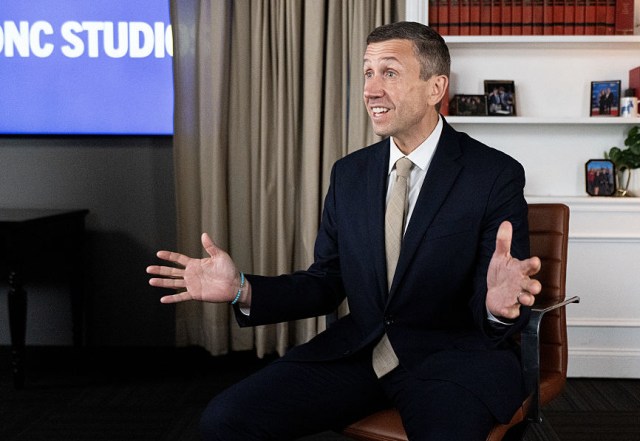
DNC chair Ken Martin won’t face the truth. Credit: Getty





Just five months until the 2026 midterm elections, the political conditions strongly favor Democrats. President Trump remains deeply unpopular, with a 37% approval rating and a 60% disapproval rating, matching President George W. Bush’s polling before Congress flipped blue in 2006, and far below President Barack Obama’s numbers before his party’s 2014 midterm losses. Even more worrisome for Republicans, economic anxiety is high. Voters now trust Democrats more than Republicans on the economy, 52% to 48%, according to an April Fox News poll. Democrats should be positioned to win back the House and gain Senate seats heading into 2028.
So why does it seem that Democrats are fumbling a winnable midterm cycle?
Two recent developments within the past few weeks reveal the party’s fundamental problems leading into the fall. The first demonstrates the real limits of Democrats’ ability to fight back against Trump. And the second shows that the party’s refusal to admit its mistakes prevents it from unifying around a coherent strategy to win.
Consider how badly Democrats lost the redistricting war with President Trump over federal congressional seats. Last year, Trump coordinated a sweeping national redistricting effort designed to lock in Republican control of the House. In response, California Governor Gavin Newsom and Virginia Governor Abigail Spanberger decided to “fight fire with fire” by gerrymandering their own states to counterbalance Republican gains in places like Texas. But this response made things worse.
In Virginia, the state supreme court struck down the new Democratic map, ruling it violated the 2020 voter-approved redistricting reforms. Worse, Newsom’s California plan — which could create five new Democratic-favorable seats — gave Republicans exactly the rationale they needed to escalate their own gerrymandering efforts in states where the GOP initially showed reluctance to do so. North Carolina Republicans explicitly cited Newsom’s redistricting as justification for their own maps, saying the Golden State was “blocking the efforts of blue state Democrats to take control of Congress.”
The math is daunting. As of now, Republicans stand to gain roughly 13 House seats from their gerrymandering efforts nationwide. Democrats, thanks to Newsom, may gain five. That is a net gain of seven seats for Trump. In sum, Democrats’ attempt to fight back didn’t stop Trump’s redistricting efforts. Rather, they normalized a sleazy policy and gave hesitant Republican-led states the push to escalate the effort.
If Trump’s redistricting efforts hold, Democrats could fail to retake the House this fall. Without at least one chamber to create institutional leverage, Democrats would be unable to access critical tools to reach voters before the 2028 presidential election, such as investigative power, subpoena authority, and a platform for high-profile hearings. Instead, they would be forced to continue their symbolic protest and opposition for the remainder of his term.
But the real fumble of Democrats leading into 2026 and 2028 comes not from losing the redistricting fight or any of the other defeats to Trump, but from the party’s ongoing refusal to honestly examine why it lost the 2024 election.
This institutional failure has come into focus with the Democratic National Committee’s recent release of its much anticipated 2024 election post-mortem, a report that was supposed to answer hard questions about why the party lost, but instead highlights the insularity and self-protective tendencies of the small professional class of Democratic operatives who influence the party.
The timeline of the report’s suppression and eventual release illustrates this problem. In February 2025, Ken Martin, the then chair of the Minnesota Democratic-Farmer-Labor Party, won the election to become the next DNC chairman. He defeated Ben Wikler, the Wisconsin Democratic Party chair, who had the backing of Sen. Chuck Schumer (D-NY), Sen. Nancy Pelosi (D-CA), and other top Democratic leaders.
Martin’s strategy to win the most votes from the 448 DNC members, the majority of whom are state party representatives, was straightforward. He promised a “50-state party strategy,” pledging to invest more money in state parties across the country, including the least competitive ones. This stood in contrast to Wikler, who wanted to concentrate resources on media and battleground state elections. Not surprisingly, the candidate promising money to more of the voting constituency beat the candidate advocating for strategic spending focus.
But Martin had to do more than promise money to win. He also had to appease the numerous Democrats angry about the 2024 election defeat. Many of these critics weren’t voting DNC members, but their voices and donations mattered. For them, he promised an independent autopsy conducted by an outside auditor that would rigorously examine why the party lost and tell the truth.
But something changed once he got into office.
Instead of an independent process, Martin put one of his close friends, Democratic strategist Paul Rivera, in charge of the report. Then, in December 2025, Martin announced that the DNC would not release the final report after all. He justified the decision by saying it would distract from the party’s 2025 wins and take focus away from the midterms.
It was only when CNN was preparing to expose details of the report’s drafts in late May that Martin abruptly changed his position, releasing the complete report on May 21, 2026.
Much of the fallout has focused on the draft report’s shocking lack of quality, which included factually incorrect claims and missing sources. But the real problem is what the report deliberately avoids. Most strikingly, the report never addresses the simplest, most obvious explanation for why Harris lost: the Biden administration’s record was unpopular, and Harris was not a credible alternative. On immigration, inflation, and governance more broadly, voters rejected the first Biden term. By the time Harris launched her campaign, President Biden’s approval rating had collapsed to 36%, and Harris was unable to credibly distance herself from his record. The autopsy avoids both of these truths.
Instead, the report downplays Harris’s responsibility for the loss, arguing that she was not properly armed for victory. Its key finding: “the White House did not effectively support Vice President Harris over three and half years to improve her standing before the candidate switch.” This is absurd. It was never the plan for Harris to run in Biden’s place during his first term, nor was it the plan when he announced his withdrawal from the race abruptly in July 2024. The White House had no obligation to spend four years grooming Harris as a successor, because Biden was supposed to be running for reelection. Any lack of preparedness of the Vice President should be blamed on herself and the dozens of Democratic operatives who opportunistically asserted her name as the natural successor to Biden in the hours following his announcement, thus shutting down the efforts of former President Obama to create a process for new candidates to be selected by the party (and of course, to avoid having Harris be the nominee). A former prosecutor, attorney general, and senator ought to be able to demonstrate her capability to be an effective leader without the handholding of an entire team. If Harris needed more prep time to be a good presidential candidate, it means she was unfit for the position.
And the reality is that many Democratic operatives knew this simple truth about Harris and either endorsed her bid or hid their hesitation and got behind her. But what can be said about the judgement and character of the Democratic operatives who did this, knowing full well of her ineptness and dysfunctional managerial style, one that resulted in a 91.5% staff turnover rate while she was vice president? They all knew about it but looked the other way. This includes Ken Martin, who was a vice chair of the Harris-Walz campaign before running for DNC chairman.
For many Democrats, the autopsy’s silence confirms their suspicion that a small network of operatives is suppressing a report that would examine their own conduct. Many of these same operatives ignored or hid President Biden’s cognitive decline while prioritizing their own positions over the risk to the country and party. They then helmed a campaign so financially chaotic that it blew through $1.6 billion in roughly 100 days and left the party $20 million in debt. And now they are using the DNC chair to ensure that the most obvious truth about the 2024 election is not stated by the party itself. Namely, that it was the Democratic professional operative class that were the primary drivers for creating a disastrous first term for Biden, and choosing an unfit replacement candidate to succeed him.
Ken Martin was installed as DNC chair to keep this problem from being named. Instead, he and many Democrats want to pretend the party’s current leadership ecosystem is capable of mounting a serious effort in 2026 and 2028, without acknowledging the role many of these operatives played in hiding Biden’s decline, downplaying Harris’s unfitness, and suppressing honest examination of the party’s candidate selection.
A party that cannot be honest about its own mistakes is destined to repeat them. And in both the gerrymandering fight and the handling of the election autopsy, the party chose to do the expedient thing rather than the right thing — both decisions that have been disastrous. Democrats know these truths about themselves. Until they admit them, they will keep losing winnable elections.